Monthly Archives: February 2010

Taste No Evil

The Prompt:

The title gives it away, no?  Continuing to explore the senses through our writing, today’s prompt (page 16 of Room to Write) is about describing what surrounds us through our sense of taste.

Response:

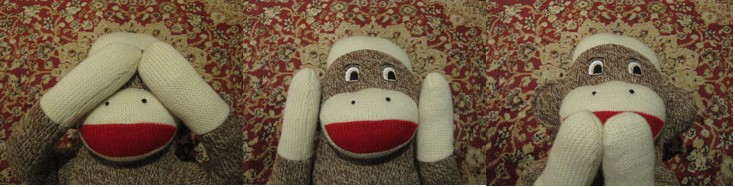
Just took a sip of water, which tasted of cool, filtered nothing until leaving a plastic aftertaste at the tip of my tongue.  If I licked this crystal water goblet, it might taste of my bland lip balm caked at its rim.  If I ran my tongue along the smooth glassy surface of this desk, it might taste of bitter dust with a hint of metallic at the edges.  If I stuffed my sock monkey that sits on the desk into my mouth, its dry fibers might have a dried oatmeal, shredded wheat quality, much like the linen-covered journal resting beside it, though the latter might have an added hint of salt or chemical from its black dye.  The napkin in front of my keyboard would dissolve on my tongue almost too quickly to detect an unexpected sweetness of bran.  As I gaze through a pane of glass at the potted plants on the window sill, I imagine snapping into their thick, rubbery leaves to yield a moist burst of lettuce and aloe, crisp and awakening on the tongue and almost slightly acidic like citrus fruit.  As I further pretend to mash my face down into the soil, I taste the gritty mineral-rich dirt and strain in trying to swallow down the rusted-penny tinged taste of dried and brittle clay.  Looking further on to the leafless branches across the road, I sink my teeth in and snap off a twig to savor its dirt-peppered smoky oakiness that slides into the somewhat salted juices of my saliva (the taste-buds of which are still saturated with the essence of chili pepper and coconut curry) as I gnaw on its end.

Reflection:

And I think that’s where I’ll conclude, as I’ve developed a weird hunch that a lot of things within my field of vision right now might end up tasting alike—though definitely not like chicken, as everything else seems to :). I wanted to resist reflecting on any of the meals I had today to avoid describing actual food that would make sense being in my mouth, though that potency of my literal taste clearly began to influence my imagined ones.  What a challenge, though!  This was a real effort in concentration, clearing my mind of everything but that object and dissecting it for its “ingredients” so that when I vividly envisioned rolling it around on my tongue those flavors would come forth…even then, however, when I really felt I had locked in my mind what it would taste like, the tricky part was to articulate that in words.  As I mentioned in my previous post, taste and smell are what I find to be  the most difficult to convey as sensory details in writing, so, again, I find this will be a useful exercise to return to with frequency.

Hmm…a world in which you could taste everything?  What might that be like…


Smell No Evil

The Prompt:

My next series of posts will be pertaining to our senses, and, today, page 15 of Room to Write kicks us off with our sense of SMELL.  In describing smells, we can list significant smells or try to describe a person or place strictly using sense of smell:

Response:

There was an air freshener my mother used to keep in one of the bathrooms that always made me think of my grandmother’s winter home in Cape Coral, Florida.  Even though I hadn’t been there since the age of 5, any time I used the loo as a teenager I was transported back to this place that I could barely recall visually.  In attempting to describe this smell, it was pungent (in a good way), spiking through the nostrils with a sort of juicy, fruity, ocean breezy scent that makes me think of blue.  I also still hold onto shampoo samples from my first trip to Cabo San Lucas a few years ago (yes, I’ve saved the toiletries that long), as all I have to do is sniff to get that same teleportation to a calmer, tranquil retreat.  It smells most dominantly of sage mixed with aloe and a well-rounded fruitiness that I could cup my tongue around, though it isn’t tart like the air freshener scent–there’s something more arid about it like the dry winds breathed out by the Pacific across the sand and carried green brittle scents of cacti.  It’s a scent that makes me see a cloudless blue sky from the vantage of floating on my back in the waters of an azure-tiled pooled.  As a kid I would love to step into my parents’ garage on a humid summer day and deeply inhale the fragrance of gasoline (healthy habit, I know), which gave me the same satisfaction as the scents of freshly-cut wood and wood stain still can when I enter a home improvement or furniture store.  An odor on the cusp of this category, but that walks a finer line between love and hate with me is that of fresh paint.  No, in fact, the jury is in on that one after all; I don’t like it for its way of teasing me at first that it’s wood stain then goes in for the sting of sour headache-inducing toxicity.  To alleviate it, I open my windows to the moist air that can smell of snowy chills and soil and the must of dried leaves, exhaust, and the occasional coriander.  I like the smell of entering the bathroom after my husband has already showered so I can take in the herbal, apple-y, musky mixture of assorted toiletries, undermined only by the now-and-then stink of mossy mildew, like grub-infested mud.  As I remove my clothing to take my own shower, I may catch a whiff of paprika and salted alfredo.  I’ve never been one to be able to distinguish between the components of a glass of wine’s bouquet, so perhaps my olfactory sense is, in fact, weak, but I’ll say this:  one scent I cannot handle is breath.  The mildewy rot of halitosis goes without saying; I’m talking even the slightest essence of chicken or pepper or garlic, the stale, chemical scent of consumed alcohol, or the milder yet gag-inducing average scent, like milk steamed with the stifling closeness of humidity…whatever it is, I’m not having it in my face.  I’ve never understood the possibility of poets’ descriptions of “sweet breath” in their odes of love, and “baby’s breath” always creeped me out as a flower’s name.  Breath is what stinks up a bedroom like dirty feet and clammy armpits when one falls asleep with one’s mouth open without having brushed one’s teeth.  Contained odor of other people’s bodies on airplanes, trains, buses, what have you, is another sensitivity for me.  I addressed my own stench above after a day’s activity and a night’s rest, but the ground-in cumin smell that practically solidifies in the air as its own entity when a human has not been washed for days, if not weeks, is an olfactory oppression, and I would be mortified if my smell was enough to infuse a room merely because I occupy it.  There is nothing scent-sational in that.

Reflection:

This activity brought me warm, soothing memories in the opening as I recalled the scents that give me pleasure, but I see how I gradually gravitated toward the more unpleasant of life’s odors and thereby yanked myself from tranquility into the judgmental crankiness of an old codger!

Like I said above, I never regarded myself as one to have the most keen sense of smell, but I realize now I’m much more sensitive in this aspect than I would’ve given much pause to realize.  It seems when people write (including myself), the first descriptions to jump to are the visual ones.  Even looking at what I wrote above, I couldn’t resist reverting to visuals.  I noticed this all the time with my high school students, and we used to workshop on revising their stories to try to incorporate all five of the senses to better immerse the reader into their storyworlds.  It’s this descriptive language that brings words on the page to life because it appeals to our living faculties and makes us feel as though we’re using them when we read, smelling what the characters smell, touching what they do, etc.

From my experience, smell and taste tend to me the least incorporated descriptors (if not most challenging), so this is a worthwhile exercise to come back to time and again.  Whenever we write a new passage and revisit it to revise, we must ask ourselves if there is anything in that passage that lends itself to scent.  If not, or if it wouldn’t add much value as a superfluous, distracting detail, then we shouldn’t force it.  But if it could enhance the scene as a more realistic sensory experience, then we should certainly try.


Resurfacing from the Dive

It’s been a few days since I’ve tended to the blog, not because I continued to sink into the despair I was feeling when I wrote my last entry, but quite the contrary.  I’ve been inspired!  One little tangible gratification that came my way since I last posted was an unexpected email regarding a contest submission I’d entered last year…I took the lack of response as a rejection, but no, I was selected for an anthology of letters.  So, not a nod toward my creative writing yet, but I take this as encouragement in my writing in general.  I have always been told that I write a nice note… 🙂

Anyways, riding on that positive bit-o-momentum, I’ve been writing a new short story over the last couple days to enter into a fiction contest.  Making decent progress on that so far, but presently taking a break by shifting gears over here in the blog so that I can refresh and dive back into my story.

The Prompt:

Page 14 of Room to Write asks us to revisit a previous “diving” (freewriting) session and pluck out a phrase, passage, or metaphor/simile that we ourselves still don’t fully understand.  Goldberg is operating on the belief that sometimes our writing is ahead of us—no, not that we’re psychic, but that we’re “tapping into a stream where imagination and intuition meet.”  What may initially sound like nonsense might contain a nugget of truth and understanding that further writing can help unlock and deepen.  To do this, we should roll this passage around on our tongue and practice any or all of the following strategies:  a) apply it in dialogue; b) list associations with it; c) create an acrostic using a key word from it; d) draw it; and/or e) verbalize it out loud using variations in tone, pitch, or accent

On revisiting a previous freewrite, then, I’m torn between these two passages (the most peculiar parts to me are highlighted):

1.  “playing at children’s games mild lost to tea and egg pie and muddle gunk and tomfoolery wizened but not wise enough”

2.  “I catch my breath and try to inhale the purity calmness gaseous extremity that I can believe in the cool quake calmness of din and then I reach the apex of snow and glide and glisten along my way the sunny fresh extremes of hilltops glossed in icing and glint and free falling to a furry escape

Response:

To address #1, I believe I meant that the benign naivety of childhood gives way to an adulthood confined by more rigidly self-imposed rules of living, like proper afternoon teas or other modes of conduct that are considered refined but may be even more nonsensical foolishness (i.e., “muddle gunk and tomfoolery“) than the ways children approach life through their innocent, natural perspectives—adults kidding themselves that they’ve learned through years of experience yet still have so much more to understand.  “Muddle gunk” sounds like something very inspired by e.e. cummings, a way of making up one’s own words that somehow capture an idea through their sounds.  On re-reading the passage, “egg pie” really sounded strange to me at first, but now that I conceptualize it more, there’s nothing odd about it at all; it’s just a more silly, casual-sounding (indeed, more childlike) way of saying “quiche.”

As for #2, as I repeat “cool quake calmness” aloud, the alliteration of the hard ‘c’ sound instantly clacks against the roof of my mouth, creating a crisp, clean connotation (look, I did it again!) that suits the image I presume I was trying to create at the time.  How “calmness” can coexist with a “quake” or “din” is confusing, though, so let’s see if I can work it out.  I associate the last two words with the two senses of touching and hearing, “quake” being a violent shaking or shuddering like an earthquake beneath one’s feet and “din” being a ruckus, a commotion of sound (for some reason I hear someone clanging on a pan with a spoon, perhaps simply because “din” first makes me think of “dinner” by virtue of its spelling, not meaning).  It could be that the tremors and cacophony somehow respectively meld into a steady vibration and white noise, within the hum of which one actually can drown out distraction and disturbance to find peace.

As to why I would describe the escape from all the clamor as “furry,” I’ll use that for my acrostic:

Friction-free

Underbelly

Refreshing

Relief

Yielding

It seems I meant that it would be a soft landing that would only bring tickling, warming, soothing relief as it breaks the fall from the more putrid, rotting, artificially-created existence described earlier in the freewritten piece.

Reflection:

This was a useful exercise for revisiting my own words.  It’s wild to think that we can write things that we don’t ourselves even understand at the time–even more so that we can extract meaning from it eventually, and something that actually does make sense!  It’s a testament to the power of writing and how it helps us to unearth truths and propel us forward into the realization of them.


My Inner Critical Beeyotch

Today is one of those days when I feel discouraged to write, even if simply in response to a basic prompt as practice. What I should be doing is working on my project or at least expanding on my previous blog post with the level of characterization detail I had omitted the first time around. But I don’t seem to be, do I? It’s not standard writer’s block, though…my ideas for my project are there and swarming around and ready to be written…yet there’s this paralysis in me noggin induced by insecurity in the face of all that’s been written by all the writers out there.

Why does this happen?  I throw the question out there because I know I am not alone in this.  How do I know?

Well, before I answer that question, I think what first triggered all this today was reading Waiter Rant on the bus home from work.  This should be a non-threat book in that it’s a nonfiction account of a guy’s experience waiting tables, something I should be able to read without comparing it to my own writing style and content (which has become a nasty occurrence whenever I read novels).  The author is a good writer, though; he’s not just ranting and chronicling like it’s Dear Diary and he just wants to catalog humorous facts—he actually has a flair for descriptive and figurative language that illuminates the people and incidents involved to a very engaging degree, and he structures it effectively.  And then suddenly it does become relevant content when he’s recalling a conversation with a fellow waiter who comments on his talent for writing, as evidenced by his blog of same name, the very one that eventually became the book due to its massive popularity.

Which reminds me of the close-to-zero viewership of my own blog, which then makes me question why anyone would ever want to read it .  Nor my stories or ongoing book project.  But it’s all fairly new and more for me anyway, so since when do I even care, right?  Right.

With that assurance, I then come home tonight and happen to stumble on other blogs that truly reduce me to clearance at 8 cents per dozen.  The cyber-smorgasbord of blogs to be had addressing the same content as both my professional and personal blogs is intimidating—all the creative talent scattered far and wide sowing their seeds so quickly and with such frequency and making it seem effortless.  I automatically feel inferior again…

Seriously, it’s one of those days that feels like everything keeps coming back to reflection on the art of writing, but not in the empowering way.

And that was just today’s insecurity blast.  At other times it comes on that occasion when my otherwise delightful immersing of self in a bookshop–a moment that is one of hand-clapping and salivating wonderment over all the literary possibilities my fingertips might fondle on those bookshelves–becomes instead like a swift slap in the face by every hardcover and paperback to be had there, taunting me from their holier-than-thou pedestals as if to say, “We made it up here.  You’re still down there, and your writing is still just in your My Documents folder on a Mac.”  (Yes, the books are quite bitchy when I’m in this frame of mind)  Or I read the book jacket of a best-selling author’s latest novel and freak out that it follows a similar theme in a similar environment to the tale that I’m presently weaving, making me feel stupidly unoriginal and, even worse, like I’m crafting a version that could only be sub-par to this writer who has already had her first book adapted to a major motion picture.

It’s like looking at everyone else’s success as it accentuates my singular failure, and there is nothing more detrimental to the process of writing than letting that creep in and seize hold of your grey matter and squish it between its fingers.

So to get back to my earlier question of how I know I’m not alone in this—and, more importantly, that it’s okay—just as I’m revisiting Twitter tonight and esteem-crushingly marveling at everyone else’s links to genius, I came across this little pearl tweeted by Electric Literature, a blog post by Maud Newton.  Posting this just yesterday, what she addresses is exactly what I’m talking about above—the crippling insecurity one feels as compared to their favorite writers.  Oh gaawwd, I don’t even dare tread that path…it’s bad enough that I’ve come to measure myself against amateur bloggers…so needless to say, it’s very encouraging to see how this is a pervasive issue for writers, among both the published and the aspiring.

So I read this and I still manage to feel paralyzed, first looking at my writing project to see–if I’m not inclined to create new stuff–if I can at least read through what I did write over the weekend and revise it.  Not feelin’ it.  So then I click out of Word and onto this blog to either embellish on the character sketch of a real person that I initiated a few days ago or sketch myself as a character, as the next page of Room to Write directs.  Yet, again…nothin’.  With reluctance I then turn to the following page to just get the 3-Strikes-I’m-Out over with so I can shut down the computer and sulk behind a book to just leave it to the professionals and what they’ve already written when…aha.

Yes, I say to you that, lo and behold, page 13 is an A-Haaaa!! sort of serendipitous moment for me.

I am an avid observer of coincidence who becomes increasingly convinced by the day that there is, in fact, no such thing…so imagine my inner gasp when I see that page 13 of Room to Write involves confronting our CRITICAL INNER VOICE.  As Bonni Goldberg says here, “A critical inner voice taunts you as you create. […] The best that most of us can do is acknowledge it and keep writing anyway.”  Folks, I will delve into this today as an exercise/exorcism:  exercising my creative confidence as I exorcise the demon of doubt from my psyche.

The Prompt:

Page 13 of Room to Write, then, asks us to convert our inner critic into a character.  Consider its gender, appearance, smell, and favorite writers (if it doesn’t think that we‘re good, who is?).

Response:

My inner voice is female.  At the risk of stereotyping (for the record, I’m a female, so reserve the right to generalize my kind based in my own observances of self), I say this because she has bitchy tendencies to coincide with her vulnerable questioning of me.  She needs me to be secure, support her, and in this need comes a desperation and doubt that I can.  So, instead of inspiring me, she tears me down, tries to hurt me to make her seem stronger, smarter.  Classic insecure female, in my opinion.  Next, she’ll be asking me if I think her ass looks fat in those jeans.  Well, it does.  She is pale and sweaty and pimply with puss oozing out and her posture is horrendously arched.  She quivers like a nervous over-bred lap dog and would jump at her own shadow if she ever did dare step into the light.  She yanks on my sleeves to pull my hands away from the keyboard and dangles carrot-shaped published works within my vision but outside of my reach to reinforce that which I cannot have.  She is bug-eyed in Coke-bottle thick glasses, deteriorating my sight with her own myopia.  Her mousy brown, thinning, yet wiry tresses with the texture of pubic hair strike like foot-long lightening away from her head, and I can smell the swampy sourness of her body odor when overactive glands from overactive pessimism spit out their secretions to moisten her dirtied linen blouse.  Her preoccupation with bullying me absorbs her time away from tending to herself, though when she does indulge herself with her books (storing up on intellectual ammo to pierce and puncture me with later), among them are Fitzgerald, Dickens, Austen, Hemingway, Rowling, Niffenegger, Maguire.

Reflection:

Ick.  Nasty little broad, isn’t she?  Well, that felt good.  This feels better.  I just described someone I loathe and would never aspire to be, so why should I be so concerned about what this chick would think of me?  She clearly has more problems of her own.  So step off, ya floozy, and leave me be with my writing.

With that activity and brief reflection complete, I’d like to close this post with 2 points of inspiration that Maud Newton’s blog directed me to.  First, in the post itself, she gives a precious word of advice—basically, keep a crappy novel that you’ve read nearby, always, so just when you’re feeling down, you can skim through it and remember how crappy that book is that still managed to get published.  Second, her post provides a link to an LA Times article, which in turn quotes Ted Solotaroff from his essay, “Writing in the Cold:  The First Ten Years”:

“Writing itself, if not misunderstood and abused, becomes a way of empowering the writing self. It converts anger and disappointment into deliberate and durable aggression, the writer’s main source of energy. It converts sorrow and self-pity into empathy, the writer’s main means of relating to otherness. Similarly, his wounded innocence turns into irony, his silliness into wit, his guilt into judgment, his oddness into originality, his perverseness into his stinger.”

Put that in your pipe and smoke it, Inner Critical Voice.

*


Character Sketch (Part I)


The Prompt:

Page 11 of Room to Write gives us some practice in developing character description.  Certainly, in creating our characters, they are not necessarily people  that we know in real life.  We might incorporate aspects of real people into our envisioning of them, but the remainder may lie sheerly in our imagination.  To ensure that we are offering the proper level of description to these characters, then, today we are to have a go at describing someone we already know–either closely or arm’s-length–with whom we have regular contact.

This will be an exercise in discovering what it is we actually notice about people first.  I’m sure you’ve taken a personality quiz at some point that profiles you based on what you notice first when you look at someone (e.g., eyes, teeth, hair, etc.), and this will be similar, just taking it to another descriptive level.  In identifying what it is that we automatically look to in a person, we will identify what it is that we automatically describe in a character.

Chances are, we’re limiting our characters in some way.  So, after I write this, I’m going to reflect on not only what I did write about but also what I didn’t.

Response:

His eyes are blue, though I still sometimes question if they’re at all green…must depend on the lighting or what he’s wearing.  It isn’t a crystal, cold, icy blue, but a muted, soft one that I’d feel comfortable dipping a toe in, then submerging into fully.  They’re kind eyes that don’t penetrate with menace or even cloud over in sorrow, but they surely twinkle when he’s happy.  They’re eyes that I can see looking exactly the same, with the same good humor, when looking out of a far more aged face.  His face now, though, is young, though showing the lines of maturity, of laughing, of squinting in the rays of the sun or the gleaming fresh powder of a snowy mountain.  His skin is sensitive to dryness in the air and wind-burn when rushing down the slopes or bouncing along the pavement.  It will redden then flake, so he moisturizes it often.  Left to its own devices in the absence of the natural elements, it is fair skin to go with his fair hair and fluffy fair eyebrows.  His blond is more sandy, darker in the winter months when shielded from the sun’s bleaching effects, and becoming increasingly peppered with grey on the sides, which is giving him that handsome, distinguished presence that befalls all lucky men who retain their hair and physique, the fellows like Cary Grant and Sean Connery who only get better with age like a fine wine.  He’s a man who can wear a beard and not look unkempt; the whiskers grow in dark and give a tanned shadow to his fair skin and protect it from the irritation of the daily shave, though it is only on holiday when he’ll let it grow this way.  Otherwise, he’s the clean-shaven type, keeping his hair trimmed close to his neck in the back and parted neatly at the top, though in casual circumstances will lightly gel it into a more naturally tousled look.  Even when casual, however, he’ll wear a buttoned shirt and leather loafers, with denims or khakis in between.  He’ll smarten up a day of air travel with a wool blazer, and every day at the office sets that bar high with his well-tailored suits and the rainbow’s spectrum of Charles Tyrwhitt shirts accented with cufflinks and ties of unexpected patterns and hues.  His answer to the proverbial male-profiling question is undisputedly “boxers,” and his socks have found new voice through multi-colored stripes.  He’s a man who does not need his wife to dress him in the morning.

Reflection:

Okay, so that’s my first pass on describing a real, living, breathing human being in my life.  What are the things I noticed first in my mind’s eye?

Face/Head:

– Eyes (from their color to how they reflect the temperament behind them)

– Skin (its physical description, including external influences that portray one of the man’s favorite hobbies–skiing, running, and, apparently, moisturizing)

– Hair (primarily physical description, which to extent reflects personality)

Body:

– Clothing (again, physical description that may reveal underlying personality)

So what didn’t I describe, then, that I could have?

– what his smile looks like

– body physique

– the way his body moves

– what his voice sounds like

– how he smells

– what he feels like

– nervous habits

– ANY habits–the way he behaves in different circumstances

– sense of humor and other personality traits

See anything that I’m missing?  Please list in your comments if so.  More importantly, give this a try yourself!