Author Archives: thefallenmonkey

About thefallenmonkey

Unknown's avatar
Primate that dapples in writing when not picking others' fleas or flinging its own poop.

Blindfolded

The Prompt:

Whereas previously we were asked to write about something we can see through our eyes, imagination, instinct, and intuition, today page 28 of Room to Write asks us to write about what we can’t see—this can be something literally out of our sight, or figuratively hidden from our understanding or missing from our lives.  This should be freely written, beginning with the words, “I don’t see…”

Response:

I don’t see what it is that wakes me on time when I’ve forgotten to set my alarm, what prompted me to unlock my door and go back into my flat that one day to check the stove that, sure enough, still had a gas burner on from my morning tea.  I don’t see what it is that holds one person up when another might slam to the pavement under the weight of the world, or what it is that binds people together when the centrifugal force of their spinning lives would otherwise fling them apart.  I don’t see what it is that I sometimes think might brush against my face as it rests on the pillow, or tickle at my toes when they peep out from the kicked-askew bed sheet.  I don’t see what some people don’t need to see because they rest their speculation in faith alone or just don’t see the point, and I don’t see what other people try to detect scientifically as evidence of what they won’t believe in unless they can see it through thermal imaging or sound waves.  I don’t see the energy that humans exude, radiating onto and into others through smiles or kind words or enthusiasm or sucking it away through frowns or insults or indifference.  I don’t see what happens to that energy when a human passes on…that energy that, in all things, can neither be created nor destroyed, so must go somewhere when its host ceases to exist as a body in motion.  I don’t see the momentum of that imprint they made in life or if it continues to survive beyond death, filling the voids that person would have filled or instead dissipating into the atmosphere, joining the energy of yet-living organisms, lifting the wings of a bird, or watering a flower.  I don’t see what is perhaps best left unseen or may be nothing to see at all, yet is somehow something I want to believe in more than what I do see.

Reflection:

I guess the idea of this activity is to understand how what is absent (only because unseen) can serve as a great presence in our writing.  Perhaps it means our characters are missing something in their lives, and their search is what drives our entire plot; perhaps it is what we writers are missing and searching for through our stories—it’s a chance to find understanding.  I’ve indeed had characters explore some of this unknown, speculating through them how something so unseen could in certain ways become overtly present and necessary for them to confront and comprehend to move forward.

Do you find that your writing has/is helping you see what you’ve in some way been blind to?  What about your characters—are they having to confront something they can’t keep avoiding?  Is out of sight out of mind?


Chairman of the Bored

“An author is a fool who, not content with boring those he lives with, insists on boring future generations.”
– Charles de Montesquieu

Uh-oh…my worst fear is happening right now, so I have to take a break from my story.  And yes, I’m sure you have guessed it:  I’M BORED.  Not with writing it (though that sometimes happens, too), but in rereading it.  Yet I can’t figure out if I’m getting bored because I’ve already reread and revised these same parts several times before or because these are just genuinely boring scenes that readers would get even more bored with.

Is it bad that my first instinct is to get up and walk away for the night rather than keep plugging through?   I mean, it’s not like I’m a published author against a deadline, after all…yet I know that real writers do not wait for inspiration to write; it’s a discipline, and part of that discipline is trudging through when the going is difficult.  That said, I’ve been looking at it for hours now, so if I mentally step away to dash off this post right now and then go crack open someone else’s novel to read, that’s also an investment in my writing future, no?  And to continue over-rationalizing for myself, life has to exist outside of the storyworld as well if we’re to accumulate any authentic experience and emotion to be able to draw on for those stories—living life, versus only writing about it, is how we get our ideas (consider this post of inadvertent character-finding in “Of Characters and Other Weirdos” from the Write in Berlin blog).

“Either write something worth reading or do something worth writing.”
– Ben Franklin

I hear you, Ben, and will try my best to make the most of this night if I do, in fact, shut down the computer until tomorrow.  And when I do revisit this little yawn-factory that is the last quarter of my story, I will be refreshed and ready to infuse some oomph into it.  And I think corresponding with this boredom is my great knack for comparing myself to others’ writing again.  And if the latter is the case, then maybe I need to adopt this mentality and just get over myself:

“My books are water; those of the great geniuses are wine.  Everybody drinks water.”
– Mark Twain (1835-1910)

Well, hopefully I can work on becoming water and not the sleeping pill the water is washing down.  Okay then, I’m off to get my sight back. If you ever encounter this same feeling, please cure my boredom with your comments!


Cat’s Eye

“It is only with the heart that one can see rightly; what is essential is invisible to the eye.”

– Antoine de Saint Exupery, The Little Prince

On page 27 of Room to Write, Bonni Goldberg tells us that it is not only with our eyes that we see.  Our inner eyes are comprised of three things:  instinct (“previous experience”), intuition (“gut reaction”), and imagination (“mental flash of possible  scenarios”).

The Prompt:

Look around at anything you literally see and visualize it more robustly by using the above three ways of “seeing.”  In doing so, we should observe which means of seeing is most difficult for us versus which comes easiest.  Today, I’m going to focus on a random image I viewed out the window two nights ago at a cocktail party.

Response:

Standing poised atop the intricately scrolling wrought iron railing of a second-floor terraced house window, the Ninja Kitty remains frozen with all four of its paws aligned in a perfectly straight line.  It holds its balance there for perhaps ten minutes, frozen in fear (or is it a calculating calm?) as it assesses the situation:  having tight-rope-walked itself to where the corner of an exterior wall juts out, separating the ledges of two different flats, Ninja Kitty stands with its two hind paws on the railing above one ledge while its front paws have traversed to the part of the railing where the second ledge begins.  At its middle, then, is the corner wall that, though an inch or two away, surely feels like a blade brushing against its fur, threatening the cat to jump as though it’s just walked the splintering plank of a creaking, renegade ship.

Ninja Kitty appears to have three choices:  1) leap off toward the sidewalk, testing the validity of the old conception that a cat will always land on its feet, 2) moon-walk backward to try getting back onto the first ledge, or, 3) keep easing forward enough that it can attain the leverage it needs to leap onto the second ledge.

Still the blonde cat hesitates, and I can almost perceptibly make out the “Fuuuuuuuudge” thought-bubble about to burst on the sharp tips of its ears; reflecting off the vertical slits of its pupils are the illuminated graphics of a mental decision-tree database, running through iterations of calculations as the cat sizes up its variables of physics.  Vectors and velocity methodically slide and sort and file away in Ninja Kitty’s mind until it’s the make-or-break moment.  This is happening.  And…NOW!  Ninja Kitty bows slightly and launches from its hind legs to alight gently and fully on the second ledge.

Victory is the feline’s, but, before it can even get its bearings and exalt in relief, there is a rustling at the shade drawn over an adjacent French door.  A flat occupant, I reasonably presume, who must have been looking on in peril from an unseen vantage, yet doing so impotently with no attempt at aiding in rescue.  Just as I judge the day-late and dollar-shortness of that cowardly individual, the dark pointed ears of another house cat materialize from underneath the shade.  Then and there, Ninja Kitty’s humility over its recent, dangerous, and embarrassing predicament is vanished, if it existed at all—within split seconds, the cats are rearing on their hind legs and clawing at each other through the glass, staking their outdoor/indoor territory as though it was one and the same.  Smack, scratch, scrape-scrape, they continue batting at each other with electric intensity, and, before I know it, Ninja Kitty is haughtily heaving itself back up on the railing (looking for a moment like it was about to do pull-ups) to no longer give this enemy the time of day.

And there it was, standing poised (in the opposite direction, this time) atop the intricately scrolling wrought iron railing, frozen with all four of its paws aligned in a perfectly straight line.  This was the point at which I looked away, disinterested.  That cat either knew what it was doing or didn’t learn from history and was thereby doomed to repeat it.  I conjecture it is living on its fifth life at most.

Reflection:

Ah, that was a fun little romp, though probably doing no justice to the profound quotation that opens this post!  And I imagine I could have taken it further and deeper if I’d chosen a human subject (sorry, PETA).

The whole scenario was amusing to actually watch, though (the glasses of wine I’d already consumed probably adding to the hilarity of the moment), and yet I can’t deny that I was simultaneously looking on in horror.  I couldn’t help but imagine the possibilities left to the cat in this seemingly impossible dilemma, yet my instinctive impression of how it was apprising the situation and would ultimately act was based on previous observations of cats and their cautious, arrogant mannerisms, as well as my intuitive understanding of what it means to be “catty,” as that feisty bitchiness is part of my own nature when I’m confronted 🙂  Monkey has claws!


The Natural State

“A lake is the landscape’s most beautiful and expressive feature. It is Earth’s eye; looking into which the beholder measures the depth of his own nature.”    – Henry David Thoreau, Walden

The Prompt:

Today I’m skipping to page 26 of Room to Write, which asks us to write about Nature—we can discuss it in terms of either the outdoors or our human nature.  Or, as a third alternative, write about both and connect them together.

Response:

Life finding a way.

Nature peeks in at my window from the flower box, offering a contrasting visual to the street traffic that I hear below.  The roof that I otherwise view out our flat’s front windows is gradually becoming obscured by the tree buds that are cracking open to unfurl their vibrant sources of shade.  While Autumn will always reign as my favorite season, there’s no question that Spring is the one that consistently unleashes the euphoria…in Chicago, it meant the cessation of the bitter cold with no more fear of a surprise snowstorm to dig your car out of as you curse into the winds; here in London, it means more gaps between the oppressive cloud-cover that has given me mole-eyes with extreme sensitivity to this golden, natural light we’re delighting in now.  As opposed to the droning hum of fluorescent lighting that dulls our pallor to that of corpses, the sunshine has slurped up the puddles for the time being and is grinning at all the people glad to scurry about in lighter jackets and exposed toenails.

But I don’t mean to make this about the weather, just the effect that it has on the human psyche, making us feel an urge to interact with it, be a part of it.  Nature expands our lungs, colors our cheeks, infuses us with a sparkle that we risk losing when all we may come into contact with day-to-day is the plastic of pens, kettle handles, or keyboards pushing against our fingertips along with the cool metal of doorknobs and pocket change.  Even the natural grain of our wooden furniture’s once living existence is separated from our skin with a layer of varnish, the embalming fluid of trees.

I once attended a series of debates at St. Paul’s Cathedral during which theologians and scientists discussed the nature of the soul (if interested, you can read the full transcript here).  While they went on to distinguish the soul from the spirit, one panel member (Keith Ward, Emeritus Regius Professor of Divinity, Oxford University) had this to say of both:

“[A]ll living things—all animals, even vegetables, potatoes and tomatoes—have souls.  They all have living principles.  So having a soul, for the Bible, isn’t what makes human beings special.”

“Every living thing has the breath of life, which is the spirit.”

Regardless of anyone’s religious beliefs—that is what made these debates so fascinating after all, as panel members across the series represented Christianity, Judaism, Agnosticism, and Atheism, and found more common ground than disparate, as far as I perceived—I think the above captures a sense that people can share universally.  It is that “living principle,” that “breath of life” that we share with Nature, and this is what binds us together no matter how much we try to distinguish ourselves by our intellect and emotion.  If this is a way that we humans are not special, that means we can commune with Nature as our brethren, giving and receiving energy from one another in much the same way we breath the oxygen plants give off only to expel the carbon dioxide they need to photosynthesize in return.

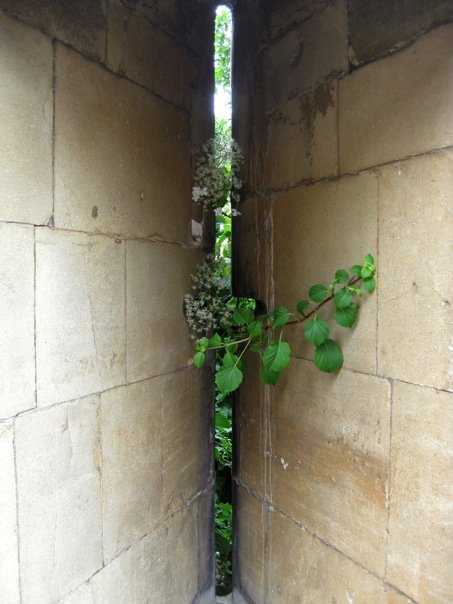
When I stand on a mountain or swim in the sea, there is something so gorgeous about the vision and experience of it that I could cry, for it taps into my own primal nature that remains embedded in my core, nonmalleable to societal influences that may otherwise shape me for better or worse.  Nature vs. Nurture is a whole other tangent on which I could take this topic, but I shall hold off on that other than to say I personally believe both factors are at play when it comes to who we are and who we become.  Our nature, however, is akin to that persistent vine that finds its way through the cracks of a stone wall; aspects of who we are at our roots are likewise things to be nourished so that they can flourish or perhaps be plucked like weeds when we recognize the bad that could come of them (the very duality addressed in my “Mad Me?” post and your comments).  Think about it; we constantly address ourselves in terms of vegetation:  early or late bloomers, budding, blossoming, being planted, rooted/uprooted, fertile, and so on.  This metaphorical language doesn’t come from nowhere; we draw comparisons of ourselves to images we somehow intuitively understand, and, in doing so, better understand ourselves.

Reflection:

On looking back at this entry, I see that I automatically addressed the gentler side of Nature.  This is the hopeful, inspiring aspect of the outdoors that we can embrace for a healthier mind, body, and soul.  Yet I would be remiss not to footnote here that I stand in awe of Nature in a fearful way as well.  It has a tremendous force that humbles us through what we term “natural disaster”:  earthquake, tsunami, hurricane, tornado, and most recently, volcanic eruption.  I literally just jumped out of my chair to look outside at the first sound of an airplane I’ve heard in days—sure enough, I just watched it fly past.  It’s been an experience directly observing the impact of the ash, leaving people stranded in a way that didn’t occur 200 years ago when Iceland’s volcano last erupted (and did so for a year!).  We take our air travel for granted and have felt practically paralyzed at being sent back to an earlier time when such was not an option.  Of course, though, our next escape routes became our trains, cars, and boats.

But envision if we did peel back the layers of technological innovation and retreated to our more basic, natural selves:

“If we assume man has been corrupted by an artificial civilization, what is the natural state?  The state of nature from which he has been removed?  Imagine wandering up and down the forest, without industry, without speech and without home.”    – Jean-Jacques Rousseau, Discourse on the Origin and Basis of Inequality Among Men

What are your thoughts on Nature (in any of its respects), and how do you think such contemplation impacts what and how we write?


Are YOU Talkin’ to ME?

We all have them.  Those heated exchanges (or ones that are on their way to becoming heated) when we bite our tongues rather than spew what we’d really like to say.  Well, I must say I’ve gotten much, much better at speaking my mind over the last decade, so it’s hard to think of any recent times I’ve muzzled myself (quite unfortunate for my husband)…but still, there are times when we’ll do it for whatever reason:  to be tactful, to spare feelings, or maybe just to save time until we can regroup and come back with a better debate strategy.

The Prompt:

Page 24 of Room to Write asks us to think back to an argument when we’ve held back.  Let it all out now, considering what you censored or reworded at the time.  Develop it as a dialogue in which you likewise speculate how the other person may have responded.

Response:

I’m going to cheat on this one.  I’ve been trying to dig up some great conflict from my youth, but it isn’t coming to me right now.  The first hot topic that does come to mind, however, is one that I addressed three years ago by writing a letter that I knew I would never end up sending.  The file name I’d saved it under was, “If I Ever Have the Nerve to Send it,” so I could at least have it at the ready if need be.  The act of writing it out was in itself therapeutic and, as of this year, perhaps financially rewarding.  I’m still waiting to hear the latest update, but as of March I signed a release to have the letter included in an anthology entitled Best of Unsent Letters (I’m doubting the intended recipients would discover it under my pen name). We’ll see.  Maybe publication is delayed.  Maybe they forgot about me.  At any rate, until I know, I can’t share it here, but if it gets posted on their corresponding blog, I’ll retroactively add the link so you can see what spiteful things I have to say when someone crosses my family. “NOBODY puts Baby in the corner!

To make up for lack of creativity this fine, lazy Sunday, I’ll throw this out there.  When I do have a bone to pick but not the commensurate nerve to say it to the applicable person, I have a habit of carrying out the exchange in the mirror.  Of course, this could mean that I’m senile.  Regardless, I ended up incorporating this into one of my character’s list of quirks to rationalize why she (me) does it. Here is the draft excerpt of such a scene:

She really did spend inordinate amounts of time standing [at the bathroom mirror].  Not cleaning it, Heaven forbid, nor was it time reserved for inspecting pores or removing blackheads from her small, upturned nose; most of the time, she spoke in whispers.  Whenever her brain felt the size of a walnut or, conversely, enlarged to the point of bursting with thought, she just vomited out the swirling words and conversations verbally, wishing she [could] deposit them in a physical, external reservoir where they could be left behind and visited when desired, rather than confronted involuntarily and often when unprepared.

Eyes locked on her own, the visual reminded that her identity did lie in something more than just her own awareness.  Her presence meant something.  Her absence meant something.  She was here, in your face, and she mattered.

And so, she resumed—partially whispered, partially mouthed—the conversation she’d recently begun in her mind, a monologue finally telling John how she felt about their relationship and threatening him with how much her absence would absolutely matter to him.

“I’d feed you the ‘It’s not you, it’s me,’ line, but it’s not not you, and it surely isn’t just me.  It’s both of us and our mutual inability to ‘get’ each other.”

The figure opposite her served as an acting coach, giving Margaret feedback on her body language as she fine-tuned the script to perform later.  Satisfied after thirty minutes that she’d thoroughly convinced her reflection with her eloquent articulation, she was too exhausted and bored with the effort to even consider repeating the words to John anytime soon.  Such was the way with all the actual face-offs that never actually happened, especially because she’d lose her nerve without her reflected self as guide.

Reflection:

So…for whatever that was worth.  I’ll try to get my mind back in gear next time to churn out something new.  How about you?  What have you left unsaid?


Mad Me?

* * SPOILER ALERT * * – Ye be warned if you haven’t yet seen Hitchcock’s Psycho.

YouTube embedding is being finicky...please click photo to access clip!

I was watching Mad Men last night and marveling over how much I continue to sympathize with the character of Don Draper.  Am I mad?  The guy has cheated on his wife for the first three seasons, even after she bears his third child, and still those dramatic shots of Don sitting in isolation as the camera gradually zooms out still pluck out a melancholy little banjo tune on a heartstring or two.

This brings to mind a post I recently read on Milo James Fowler’s In Media Res blog that discusses how the villains in books, TV, or film tend to fascinate us, to the point where we might find ourselves cheering for them.  When I read this, I immediately thought of Alfred Hitchcock’s Psycho, and how the director’s genius for creating suspense through cinematography and Anthony Perkins’s stutteringly shy Norman Bates always leaves me biting my fingernails each time Norman is close to getting caught.  The part directly following the infamous shower scene, for example, shows Norman pushing a car (with Marion’s  dead body inside) into a swamp.  As slowly as if the water was molasses, the car glub-glubs down until, suddenly, it just stops.  Norman swallows in anxiety, and after several looong seconds, the car continues to gurgle down into the swamp’s depths, now fully concealed.  There is something about the shot-reaction-shot sequence here that makes the viewer (I know it can’t just be me) tense on Norman’s behalf and want the car to keep sinking just as much as he does.  Why is that?!

Not that Don Draper exudes the villainy of a murderer with a curling black mustache and a damsel in distress bound in rope underfoot…but that’s precisely my point.  For me, if a villain is in the least bit complicated with a sense of vulnerability, I will sympathize.  The Don Draper character mesmerizes me because I can’t quite slide him into a specific slot; he is complicated by a darker past and an inner struggle between being a good person that does right by others and a psychopath that acts in complete disregard of them.  Norman Bates is a mentally unstable young man whose psychosis is likewise triggered by a difficult childhood; in his conversations with Marion before her death, we see the friendly, likable side of him that is tormented by the wicked personality of his mother that he’s invented in his mind.

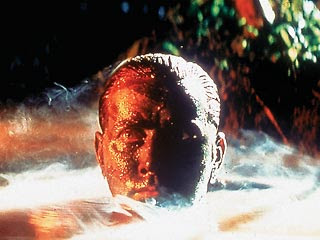
It’s the classic struggle of the good versus evil within each of us, after all, and a great many fascinating stories have been written around this internal conflict, the most engaging of which (for me) tending to be when the protagonists and antagonists of the plot at times blur into each other.  (As you can see in the photos above, Francis Ford Coppola’s Apocalypse Now is one of many films utilizing the imagery of duality—here, both Martin Sheen and Marlon Brando’s faces are half in light and half in shadow—as who is the “hero” and who is the “villain” is called into question.) As it stands, Don is a flawed protagonist just as much as Norman is a well-intentioned antagonist.

So, in the end, what I think makes me want to pat someone like Don on the back and console him with a glass of Scotch along with a Lucky Strike cigarette is the fact that, while I cannot directly empathize with his choices/actions, I can sympathize (to small degree) with where he’s coming from.  Just something to ponder as we craft our own “Good Guys” and “Bad Guys” in our stories, those complex characters that we willingly invite  to ride the carousel of our minds…


Only in My Dreams!

I think after yesterday‘s heaviness, we needs must uplift ourselves with some ’80s radness!  Oh, as if you don’t want to…don’t resist the urge to Running-Man or Cabbage-Patch if need be…

Ah…okay, fan yourself off.  The reason I pulled this little nugget from the cyber archives is to set the theme as I backtrack to the writing prompt about dreams.

The Prompt:

Four posts ago, I mentioned that page 22 of Room to Write asks us to recall a dream:  “It can be a recurring dream, one from childhood, a daydream or a nightmare.”  As we write about it, we should be noticing which portions of the dream sequence evade our memory and which become sharper.  We can fill in any gaps, change, or expand on any of it that we wish.  I’d like to relate a few…

Response:

The first dream that leaps to mind is a recurring one that I had as a little kid.  I know exactly where it stemmed from:  a TV ad for a television station that had something to do with the seasons (or “series,” as they say in the UK) of its television programs not yet coming to an end…I don’t know if it was approaching summer re-run time or what, but what I do recall is that my dream was this extended variation of the advert in which I was the woman involved.  I was wearing a peasant dress and being chased by a hunchback all throughout a dark, cobwebby, grey stone castle.  The corridors, evil perils, and my evasive techniques would vary night to night, but every time the dream ended the same way:  the hunchback would corner me at a dead-end.  With my back against the wall and arms outspread, I’d merely repeat the line the woman in the commercial would say (though in my dream, it was probably sheer nonsense coming out of my mouth), and the hunchback would grunt, turn around, and walk away.

A recurring dream I started having later in life involved water.  The situations and story lines were always different, but the water would be there in some form or another.  Sometimes I was on a sinking ship a la Titanic, sometimes I was standing on shore watching a massive tsunami (of Deep Impact proportions) rolling in at me , or water levels for whatever reason would rise gradually inside my home.  In all of them, I had time to stare down my ultimate death and prepare the air to be swept from my lungs.

Adding to the list, I get that typical one in which I lose my teeth.  Whereas the last two dreams recurred within the span of probably one or two years, this particular one with the teeth has resurfaced my entire life.  I don’t always lose my teeth entirely; sometimes they are loose to the point of my knowing it’s only a matter of time.  Again, the story lines of those dreams will vary, but within them my dream-self burns in mortification, as it’s a total blow to my vanity.  I always feel entirely helpless and unable to hold them in place (not to mention terrified what the dental bill is going to come to).

And to conclude the list, yes, when I was a student I would have the dream about having to take an exam I didn’t study for or showing up to class wearing something ridiculous, but the curse of becoming a teacher is that you keep having those dreams!!!  This time, though, it’s that I show up to class without having my lessons planned, or I show up at the wrong classroom on the first day of school, and the students are never very helpful to me in this dilemma.  Since I’m on hiatus from teaching at present, I don’t get these anymore, except that just a few nights ago I actually had one of the more freakishly normal dreams I’ve ever had—nothing bizarre, really…same classroom and students as I really used to have…except that at the end, I broke down sobbing over how much I missed teaching.  (Um, no need to call Freud in to psychoanalyze me on this one…I think Dr. Obvious can take it from here).

Okay, so what would happen if all my recurring dreams decided to recur on me at once?

I’m running through the corridors of the high school…it’s a centuries-old one in the vein of Hogwarts, and I’m late to teach my lesson on Beowulf…today, we are to debate to what degree Grendel’s mother is a sympathetic character, but I haven’t crafted my specific discussion points nor procured enough copies of the text to distribute nor written up or copied the handout nor strategized how to best divide my students up (Individually?  Pairs?  Collaborative learning groups?), and have I differentiated for their multiple intelligences?

I walk into the copy room only to see the photocopier spraying out sheets of study guides as a cluster of frantic teachers scramble to claim and collate their own; there is no solution nor sanctuary here.  Panicked, I pivot on my heel and chase down the hall to an unfamiliar stairwell where I feel and hear the grumbling of a predator:  Grendel!  I trip up on the low hem of my skirts as I jog down the steps, my sweaty palms on the railing exceeding the pace of my slippered feet.  I duck into the dank blackness of a janitor’s closet as I hold my breath to hear ever louder the rattling huffing of another; I will be trapped here if I stay, surely given away by the scent of my perspiration (or dry-erase markers), so my only hope is to dash and pray I do so in enough haste.

With my heart ricocheting off my breastbone like a racquetball in my alarm, I automatically navigate the twists and turns of the school halls, unsure of where to find my classroom and lamenting this loss in last-minute time to prep my lesson—when I arrive at my class, if I live to arrive at my class, alas, I shall have to wing it.  I grind my teeth in anxiety, debating which is the lesser of two evils to occupy my mind away from the putrid, humid breath at my neck, only to find that my top front teeth begin to sway against the bottom ones.  One slips out wetly, grazing my lower lip as it falls and trails bloody saliva down my chin; another tooth three teeth over then gets crunched between my molars before I suck it onto the bed of my tongue to better projectile spit it back at my foe in defense.  By twos and threes, my remaining teeth ease out of my soupy gums, and I try to organize them with my tongue against the roof of my mouth as ready artillery; in rapid-fire, I spray them out, their pale ivory now bloodied pink, and they pelt my pursuer like quail shot.

I’ve bought myself some time.

Up a winding staircase I go, clacking against the polished stone surface, slipping to my knee before recovering quickly and charging onwards toward an upper level corridor open to the air.  Heaving sharply cooler gusts of air through great gasps, I run headlong into the painted cinderblocks of a dead-end.  Hearing the bell sound off, I realize it’s over…First Period has already started, and I’m not there to take attendance in time to send it off to the Main Office.  Truancy slips will be issued, and it will be all my fault.  I press my forehead against the icy surface of the wall and slowly roll my skull around on its pockmarked surface to spin and face my adversary.

And there he is, slightly worser for the tooth-bullets, but still formidable.  He growls in low rumblings with a taloned claw upraised, and I start to tell him something about television reruns when a surge of foaming saltwater blasts through the open windows.  I swallow it along with my words as my body flails for orientation and gives one last spasm in its urgency for oxygen.

As it all bleeds over into black, I think a forever-silenced prayer…that my substitute teacher will not let any of those students side with anyone who would have spawned Grendel.

Reflection:

Um, yup, just as demented as any of my dreams would be.  The spin I’ve taken on this exercise was stupidly fun.  After focusing for as long as I have been on one main, continuous story line for my project, it was rejuvenating to take a random tangent that is not too serious or personal.  I think I’ve dragged this post on long enough, so will bid you good night and crazy, distorted dreams 🙂


If I Could Talk I’d Tell You…

Sometimes what is really worth saying is what is most difficult to say.  Perhaps anyone can tell a story, but it’s the unsayable that charges the tale with compelling if not conflicting emotion.  Writers write because they have something within that is urging to be said; the challenge, though (and the reason why I think not just anyone can tell a good story), is articulating what we feel so strongly when there may be no direct means of doing so.  This is why people use metaphor and simile or play off the sounds of words themselves to recreate an experience that is otherwise unrelatable.

The Prompt:

To help us say the unsayable, page 23 of Room to Write asks us to “choose a feeling, idea, or experience that you haven’t been able to express to anyone no matter how hard or often you have tried.”  In trying to convey this, we are encouraged to use any of the following writing strategies:

1. Comparison – compare the sensation to a similar feeling that it reminds us of;

2. Juxtaposition – describe conflicting aspects of the sensation, side by side; and/or,

3. Rhythm – structure the words/syntax of our sentences to audibly mimic the sensation.

Response:

At times, it felt my eyes would propel from their sockets, or splash out of them with the popping burst of a water balloon breaking against blades of grass…as if I might literally ‘cry my eyes out.’  My heart felt it might split open my chest cavity like a crab leg gripped in the toothed metal of a lobster cracker; holding my heart back from rupture, however, was an opposing anvil of pressure at my sternum, compressing my breast as though I’d plunged into ever deeper waters.  The dulling of other senses was likewise like treading below the water’s surface, looking up to see the pool of light above while deliberately sinking myself toward what was cool and black, obscuring my perception of life as it actually was through the dark and refracting depths and clogging my ears to reason.  At other times, it was like being strained through a sieve, dispersing the atoms of my being into the broader environment, a melding into the background as I soaked into the carpeting or evaporated into the walls, becoming more and more transparent from my own sight.  A water-logged cadaver deadened by apathy alternating with the quick-pulsing, hyperventilating, lurching engine of emotion that, either way, spun me off the road and left me paralyzed in the ditch, tangled within the weeds where no one could see or hear me.  This is what depression felt like.

Reflection:

Yeesh, I feel like gulping for air after trying to re-feel the sensation of a dark, momentary blip in my life.  Thank goodness this experience was temporary, triggered by a few too many life changes that occurred at once—good changes overall, granted, but changes nonetheless that entailed adjustment and sacrifice.  Ah, the bittersweetness of life…but as I learned in Istanbul’s bazaars last autumn, it is good for their elaborately woven Turkish carpets to be trodden on, as it only makes the knots stronger.  And thus we all strengthen into something of more beauty just when we may want to pity ourselves for being stepped on.

In any case, while I don’t have any issues talking about it (I prefer to, actually, as being able to speak of it in the past tense makes me revel in the happiness of my present and optimism for my future), I never feel I can adequately get the experience across.  And I can’t say for certain I’ve done so here, nor really approached it in the way that Bonni Goldberg has asked; all I can say is that I wrote what came to me most readily, and I know I could rewrite it through various other lenses.

I didn’t deliberately attempt rhythm, but if I want to grasp for sound effects, I detect some unintended assonance and alliteration in the penultimate sentence:  the repeated “aw” sound in “water-logged” that draws out the words like the slowed feeling of trying to run under water, the interspersed “a” and “eh” sounds in “cadaver deadened by apathy” that sound listless and whiney, then the “d” sound in “cadaver deadened” that falls with dull thuds.  The action words with strong, snapping consonants and short “i” sounds that follow (“quickpulsing, hyperventilating”) seem to then speed up the sentence a bit.  At least that’s my take on it…or maybe I’m just making this all up as I go along 😉  But seriously, though, although my little analysis here might be stretching because I didn’t try to strategically embed devices like this, I point out these examples just to show how the sound of language could be used for certain effects, and obviously more effectively when done on purpose.  I think this is at least the 2nd time I’ve bypassed rhythm as a writing technique in my responses, so I really need to start challenging myself more in this area.

But enough about me.  How might you say the unsayable?


The Story of Moi

In my last post, I referred to a pop-up book I had created at the beginning of a graduate school course.  At the time I was pulling a 180 in my career path—after a few years in Finance, various signs pointed me in the direction of teaching, so I quit my consulting job outright to become a full-time student again and earn my masters in Secondary Education to teach English.  The actual book I made for the project is an ocean away in storage, so I can’t include photos here of my lame attempt at the craft, but I did scrounge up the brief reflection I’d written for it and thought I’d share it here since my mind is on it, and I’m still grateful for the perspective it reinforced within me:

As a child, I adored Munro Leaf’s The Story of Ferdinand for Robert Lawson’s lovely ink sketchings of Ferdinand, the bull who did not like to romp and fight, but, rather, sit under his favorite cork tree and smell the flowers.  As an adult discontent in my former Finance career, I randomly recalled this book a couple years ago and consequently became aware of how much the corporate bull-fight in which I was participating ran contrary to my nature.  My resultant epiphany prompted by this simple picture book centered on the realization that books have always been my way of smelling the flowers whenever the world seems artificial and harried.

The literature I read has the capacity to provide emotional, spiritual, and intellectual stimulation (denoted in my project as a heart, cross, and brain, respectively), as well as contributes countless other aesthetics that enrich my daily life such that I am better able to find the extraordinary in the ordinary.  Among the flowers blooming within [my project’s] pages are:  keys to understanding new knowledge or ideas, keys that open doors to other ways of thinking or to various corridors within my soul; airplanes that transport me to imaginative, enchanting lands and experiences when the everyday becomes mundane or challenging; the music of poetic, figurative expression as issues of life are harmonized (or made dissonant) in the sounds and rhythms of words; telescopes that foster awareness as I am enabled to see distant worlds and plights beyond my own backyard; and mirrors that force me to confront who I am and muse in self-reflection.

The multi-faceted impact that reading continues to have upon me is perhaps as infinite as the varieties of flora, rendering a library a virtual garden.  Just as Ferdinand left the bustle of Madrid to reside once again beneath his tree, so I left my job to pursue a teaching career that would let me read as much as I always wished I could (and then some!) and try to inspire the same passion in others.  Thus, The Story of Ferdinand has become that of my own.

And since then, I’d devote the last day of each school year with a read-aloud of this book (yes, to an audience of teenagers), leaving my students with the message to not go against their grain in life—“Find your way of smelling the flowers, and be very happy.


On Imagination

[I see that YouTube has removed this video for whatever reason, so please refer to this post’s comment sections for a transcript of Will Smith’s monologue in the film Six Degrees of Separation.]

It only took me about 15 years to finally view the film Six Degrees of Separation for the first time last night.  What an evening of captivation that made for…you could say it quite captured my imagination.  As far as what “imagination” itself is, the film (an adaptation of John Guare’s stage play of same name) is frank in its perspectives on the concept in the above scene, which gives me pause to reflect on how this can apply to one’s writing.

“The imagination has been so debased that the imagination…being imaginative, rather than being the linchpin of our existence, now stands as a synonym for something outside ourselves.”

To many, “fiction” and “creative writing” may connote creating new, original worlds comprised of new, original creatures that lift us out of our reality.  Admittedly, I often characterize my choice of reading fiction over nonfiction as my “escape” from my everyday.  Yet, to be fair, my disbelief can only be suspended so far—at some point, I need to be able to see something recognizable within the text if I am to relate to it and learn from it and thereby stay engaged with it.

I remember making a pop-up book for a grad school assignment (yes, grad as in graduate school, not grade school!) that asked us to create a visual representation of our “reading life.”  I fashioned my book such that, with every turn of the page, a different symbol would pop up (that’s no easy feat to engineer, by the way…it took ages) that depicted one particular function reading serves in my life.  Among other things, I had an airplane to represent that idea of escape, a telescope for seeing beyond my immediate frame of reference, and a staff of music notes for the musicality or harmony books can provide through their themes or lyrical style.  And yet…

“Why has imagination become a synonym for style?  I believe the imagination is the passport that we create to help take us into the real world.  I believe the imagination is merely another phrase for what is most uniquely us.”

One symbol I also distinctly recall inserting into the pages of my pop-up book was a mirror.  As I explained to my peers during my presentation, reading is a way of holding a mirror in front of myself because it may either convey or conflict with my perspectives, and in that confrontation, there is reflection, be it validating my beliefs or modifying them through the acquisition of new knowledge or ways of thinking.  It tells me something about myself, and I in turn form my interpretations of plot, character, etc. in terms of what I know from my own life experience and attitudes.  And while I’m certainly infusing certain personal meaning into what I write, I do hope that it strikes a chord with other readers’ lives such that they derive their own meaning.

I’ve felt the sting of insecurity before over incorporating aspects that are true to my life in my stories, as though that meant I was being unoriginal—after all, if I am truly creative, shouldn’t it all stem purely out of my imagination?  Consolingly, I have since reached understanding that it’s actually the moment we stop seeing ourselves in our writing that we’ve stopped being imaginative.

This brings to mind something I just read today by Josh Hanagarne (a newly published author) on his World’s Strongest Librarian blog.  With regard to his new novel, The Knot, Josh says:

“I am this book.  This book means everything to me.  It is pure me, […] easily the most personal thing I am able to share with you.”

I think when it’s all said and done, whether we get published or not, we should all be able to feel this way about what we’ve written.  So, in closing, I offer you this line from the film:

“To face ourselves – that’s the hard thing.  The imagination…that’s God’s gift to make the act of self-examination bearable.”

As writers, to what extent are our stories a means of self-examination?  Where do you see yourself in your characters, your truths in their “fictitious” circumstances and dialogue?  Do you find that the writing process is therapeutic in making your analysis of self “bearable”?  Might it do the same for your readers?