Category Archives: Novel

The Manuscript Manicure – Part IV: On Publishers & Publicizing

“Throw gloom over your shoulder.”  – Wendy Robertson

All right, we’re in the home stretch of my Manuscript Manicure miniseries! On to approach publication in the absence of gloom…

Okay, then. Next topic for convo at the Room to Write workshop dealt with researching publishers and agents. Again, no one-size-fits-all remedy, they merely directed us toward the Writers and Artists Yearbook (I guess Writer’s Market would be the U.S. equivalent). As you peruse these comprehensive listings, read carefully for the genres preferred by each representative to get a feel for who would be most receptive to your story. Newer agents are typically listed last. Regardless how you slice and dice this abundance of information, make sure you isolate a specific name to whom you address your query. My impression was that the facilitating authors didn’t seem keen on using an agent, but they acknowledged the obvious benefit of their industry contacts as well the validation your work is good. They favor big agencies over small, finding the latter to be unreliable or at least more likely to be. They also recommend doing a punt with the publishers (well, those accepting unsolicited submissions, that is), as their slush piles are probably smaller than agents’ these days.

As for those publishers…the workshop highlighted independent publishers. These are the ones most likely to accept unsolicited submissions, and in some cases you can send your entire manuscript straight away. The cons with this avenue are: 1) the odds – small publishers might purchase only a handful of books a year, and 2) promotion – the bulk of this burden may still fall on you; indeed some independent publishers require a proposal of your self-marketing plan concurrent with your submission.

And there’s the alternative route becoming ever more prevalent: self-publishing, or, as Wendy prefers to call it, “Private Editions.” I love that :). Pros to this are: 1) getting to see your book in print and finally share what you’ve been up to all this time with others, and 2) greater control over your editing, cover design, etc. Cons are obviously: 1) cost, 2) rigorous self-editing, and 3) rigorous self-promotion. This last aspect is not something all writers are comfortable with, so one of our fellow attendees, Jackie McKenzie, offered the following media tips from her journalism experience:

[These 10 steps are all directly quoted; I’d use the quote box, but it’s too awkward.]

1. Seek out the media – they won’t find you. Be brave and proactive, not pushy, just quietly methodical.[…]
2. Research which media to contact – […] Start with local papers and radio plus titles relevant to the book. Try titles relevant to new writers and ones that publish book reviews.
3. Think online as well as offline – there are more opportunities for coverage in online publications than traditional printed ones. […]
4. Prepare the pitch – write two opening sentences suitable for a quick introductory phone call. Start with “I have a news release that you may be interested in…” then sell yourself and the book, one sentence for each!
5. Get named contacts – use the two-sentence pitch to phone news desks directly and ask who you should send the press release to. Named emails are more effective than generic ones. […]
6. Prepare a news release – keep to one side of [the page]. Use the same two lines from the pitch and include a bit about the storyline (blurb) plus some background on you. Highlight any topical issues or local landmarks etc. that may be of interest. Include any links to any relevant websites, blogs or social media that may help to sell the story. Include your contact number and details of where the book is being sold. (“It’s not all about the book; build a story around you!”)
7. Send out the release as an attachment – include a jpeg photo of you holding the published book or a visual of the front. […] Keep the message in the body of the email very short. If you have spoken to the journalist beforehand refer back to the conversation.
8. Follow up emails with a quick call – after two days contact each journalist [to ask] if it is of interest and offer to send them a copy of the book. If they are not interested end the call quickly.
9. Send out email invites to the launch – use the same media contacts. Most will decline but it adds credibility. […] If they can’t attend ask if they are interested in a post-launch news release. If so, it may be worth paying a freelance press photographer to come along to the launch. […]
10. Prepare a post-launch release – re-cap on the details from the first release but refresh the story with an opening paragraph about the success of the launch, numbers attended, etc. If anyone of local interest is there […] borrow them for the photograph and ask them for a quote to add to the release. If a reputable press photographer has been used mention them by name on your email message (anything to persuade them to consider the picture).

A good book launch is a must. And after the launch, keep going! Consider scheduling monthly events.

As of this workshop, three writers in attendance were on the verge of launching their own first novels. All three for their own reasons chose self-publication—I mean, private editions—and two of which published through their local HPM Group, a Durham-based printer that I have to say produced two of the highest quality self-publications I’ve yet to see. Their books look like any to be found on a major retailer’s shelf, and one author had the creative license to use her own painting as the cover image, so I was very impressed with the creative and physical production possibilities given the right printer and the right amount of coin—you get what you pay for, after all. In any case, to give a quick shout-out to these ladies in congratulations:

Anne Ousby – Patterson’s Curse
Erica Yeoman – Devil’s Drove
Eileen R. Elgey – The Smile of Deceit

Wendy Robertson also just launched her memoir, The Romancer: On Being a Writer.

To close with more of her pearls of wisdom as we embark down this rocky road to publication:

“Every book and every short story you write is part of your apprenticeship.”

“There are good kinds of rejection. Don’t pore over the nasty ones; piece together the best bits of the good ones.”

PART I – Macro-editing

PART II Micro-editing

PART III – Submitting a Manuscript


The Manuscript Manicure – Part III: Submitting a Manuscript

Continuing with my miniseries on what I took away from my Room to Write workshop, all this talk of revising a manuscript ultimately culminates in the submission of the gol’ dern thing. Now, we admittedly did not have a tremendous amount of time left to discuss this, and I wasn’t expecting a sure-fire formula to cracking the query code, but I did at least receive some reinforcement of guidance I’ve seen elsewhere and will likewise provide these tidbits to  you.

Naturally, they addressed that critical, make-or-break first chapter. They reminded us that in our initial drafts, our first chapters are usually about us finding our way into the story and not necessarily where the reader should begin. There’s no fault in doing this; it almost seems inevitable if not necessary when drafting, yet it’s an issue that should be revised away through our macro-editing. Very important to be sure before submitting that your story is starting in the right place, as we all know the first chapter or two might be all the agent/publisher ever sees, if they even request that much. (and on this topic, the workshop authors prefer sending the first 40 pages versus a # of chapters, as chapter lengths vary)

As for the query letter, keep it to one page. Be succinct and professional, yet find a way to incorporate your unique writer’s voice. Important elements about the manuscript to include: title, word count, genre, setting, one main character, three-line cameo of the story line, and intended audience (might consider naming a comparable published author, e.g., “Readers who enjoy ___ may enjoy this.”—they claimed it isn’t vain to do so, though I’m still a little shy about it). Open with a brief hook, then follow up in your second paragraph with the three-line cameo. Also include a sentence about yourself after this, including any relevant published work or background.

Now, I see where agents and publishers are very specific about what they want you sending them in the initial query, so I don’t know how often we could get the chance to do this, but Wendy recommended including a separate page with a brief bio and photo. Has anyone tried this (successfully)? I’m omitting it for now…

The synopsis, then, expands on what’s said in the pitching letter to summarize the entire plot and ending. But rather than approach it on a chapter-by-chapter “and then…and then…and then” basis, it should be a vivid expression of the novel that suggests the shape of it and reflects your writing style. In attacking mine (still a work-in-progress), it follows the general chronology of the story line, yet some paragraphs are more so grouped by topic than chapter. But whatever, I’m not the published one, so those of you who are further in this process, please advise on your approach!

Now for the manuscript. Specific submission requirements will vary, but typically:

– NO single-spacing. Double-space unless requested otherwise (no less than 1.5).
– One-sided (if hardcopy)
–  1-inch margins
– Begin each new chapter on a new page and start the chapter a third of the way down the page.
– Begin the first line of each chapter/section on the left margin and indent subsequent first lines 0.5″.
– NO spaces between paragraphs (that’s what indents are for) unless it’s a section break, in which case use a double-return.
– Times New Roman and Arial are acceptable fonts, unless requested otherwise. And use one consistently—NO changing it up with fancy fonts.

When it comes to actually submitting, they advise sending out in 3s. Be systematic.

All right, I’m going to have to squeeze ONE more post into this series…

PART I – Macro-editing

PART II Micro-editing

PART IV – On Publishers & Publicizing


The Manuscript Manicure – Part II: Micro-Editing

All-righty, finally back with my next installment on editing a manuscript (refer to Part I if you missed it). Once again, this is all thanks to the ladies at Room to Write for sharing insights that might be new to you or least validating of what you already know. Nothing compares to that face-to-face conversation, but I love the interaction that occurs between writers online via blogs. As they said at the workshop, there is so much to be learned beyond our own work, after all—it’s as important to listen to and learn from the projects and experiences of others.

It also teaches us to peel back our skin and not be overly protective of our work. I had to laugh when author Wendy Robertson spoke on all the emotional loading that goes into the critique when we offer it to others for feedback; she said something to the effect that when we give our work to someone else:

“You’re giving your critiquer the power to upset you.”

Ain’t it the truth. Perhaps this is why when I sent the full edit of my first assigned manuscript to its author this afternoon, I cushioned my email with empathy and compliments of everything that was done well, hoping she’ll receive my suggestions for improvement in stride and be willing to work with me constructively.

Anyway, when it comes editing for ourselves, remember that we must become self-conscious of who we are as a writer and what it is we want to achieve. To do that best, we need to identify our style and describe it in a few words. If you read 50 pages of your own novel, what comes across on the page? Is your style spare, lyrical, conversational, whimsical, direct, abstract (to offer a few), or combination of more than one?

We are now shifting from macro-editingto micro-editing and need to explore our style in relation to our content:

– I mentioned the “shape” of the novel last time, which relates to your story arc. This might continually ascend like a surging wave or start thin (yet interesting) and thicken in density to an explosive climax—Wendy likened this to the body of a whale, with the tail being the interesting opening and the blow-hole the climax. Or maybe your chapters are individual stories unto themselves that link together in some way to provide continuity and relevance, like a chain with a large loop toward the end where this progression culminates into the climax (Blackbird House is an example of this shape).

Shapes can vary, but there should always be conflict (tension), climax (crisis), surprise and revelation. And from a micro-editing standpoint, this needs to apply to each of your individual chapters as well.

– Speaking of chapters, as mentioned last time, ensure there’s continuity between them, yes, but also within them on a paragraph-to-paragraph, sentence-to-sentence level.

– With continuity maintaining our story’s consistency and logical progression, we must also make sure the words and sentences flow. This concerns the musicality of the language itself, and the best way to determine this is to read it aloud so you hear it.

– Your musicality and style will be greatly impacted by your sentence construction, so evaluate your writing on a sentence-by-sentence level. Is the syntax effective? Does it flow? Does it make sense? It’s important to ensure you’re applying correct grammatical conventions through punctuation and arrangement of clauses. Use commas, semicolons, and colons for sentence variety and make sure they’re used correctly.

Of course, creative writing allows for creative departure from conventions as well, but make sure that if you do deviate from the rules, there’s a specific purpose for it that strengthens what you’re trying to say. If it’s not producing the intended effect, revisit it and, all else fails, run with the convention rather than muddle your ideas in unclear writing.

– The language you use is the building block for everything, so you need to evaluate your writing on a word-by-word level as well. Make every word count, the strongest choice it could be (English in particular is too word-rich to not take advantage of it!). And obviously don’t allow excessive repetition, incorrect/inappropriate use, or incorrect spelling distract and otherwise undermine your writing.

– The “look” of the page is important as well, so ensure ample inclusion of “white space” now and then to allow your reader’s eyes to “breathe.” This is usually achieved through dialogue that isn’t overly bogged down in paragraphs of description. Section breaks provide white space as well to help accentuate shifts in time/setting.

And if you’re cutting down for word count or tightening, rather than prune on a word/phrase level, they seemed to opt for removing whole chunks, if not lifting an entire chapter to see if the story even misses it. I would suffer some major separation anxiety in that case, but I know some of you have said in your blogs that you’ve done it and lived to tell the tale. And it might not be a matter of ridding of it entirely. I’m sure you’ve heard the saying:

“Don’t throw your babies out with the bathwater.”

Well, they warned us of this as well, and it’s actually why they cautioned not to overly prune on a word/phrase level—making our sentences sparser could deprive the story of some of its joy! And even lifting an entire chapter may just be a structural change by which you drop it into a different place in your manuscript. (Now that I have done, and it works so much better!) At any rate, they said:

“If you kill your darlings, don’t put them in the bin—save them for something else!”

Another novel, a short story, a poem, who knows?!

All right, folks, if I haven’t successfully made your eyeballs roll out with all this reading by now, keep them sucked into those sockets—I’ll be back with a little bit on what they had to say about manuscript formatting, publishers, and self-promotion.

PART I Macro-editing

PART III – Submitting a Manuscript

PART IV – On Publishers & Publicizing


The Manuscript Manicure – Part I: Macro-Editing

Hiya! I’m back to redeem that I.O.U. I gave you last week. See, my word’s good as gold ;)…

As I mentioned, I attended a writing workshop with Room to Write over the weekend that was geared toward prepping a novel manuscript for submission. The full-day conference was divided into two primary parts—Editing and Publication—the first of which I’ll address in part now and break the rest down into separate posts. But, first, I’ll start with some general notes I jotted along the way to get us in the proper mindset:

One thing they stressed is that, above all:

“Editing is a creative process.”

Yes, it involves the nitty-gritty technical stuff, but we’re not merely playing the role of English teacher grading for grammar with red pen in hand—revising our work requires every bit of imagination and innovative thought as writing our initial draft does. For as they said, when the first draft is finished:

“You’re only just beginning.”

Ah yes, it does feel that way doesn’t it…my question is, when the hell does it end???

Anyway, in order to become our own editor, we have to become a “self-conscious” one. No, not as in insecurity-ridden—I think I’ve already mastered that one just fine :). What they mean is to be conscious of the kind of writer we are and the audience we’re writing for. The better aware we are of this, the better  we’ll be able to edit our work with this focus in mind.

Macro-editing is concerned with the overall  novel as a cohesive work. It’s our opportunity to step back from our first draft and contemplate whether it has achieved what we wanted it to and is structured effectively. They encouraged us to print a hardcopy of the manuscript to initiate this stage, as reading your words on the page is truly a different experience from reading them on screen. (I wouldn’t have expected this, but wow. There’s so much more that I catch with that ms in hand.) You will also want to list your themes, summarize your entire book in three sentences, and keep these with you as you journey back through your text to ensure you aren’t straying from any critical elements.

Key aspects your self-conscious-editing self should look for (not only in the novel as a whole, but in every chapter and scene as well) are:

– A compelling beginning, a hook that makes the reader want to continue. The first chapter in particular should be compelling in an action sense, but also in a literary way—it needs to be beautifully written. Subsequent chapters likewise need their own hooks and should be varied in how they start (i.e., beginning with dialogue, beginning in the middle of action, etc.)

– Action, drama, or “trouble,” as they called it.

– Appropriate pacing.

Three-dimensional characters that are brought to life and desire something;

— Characters are “thinly veiled versions of the writer” (sound familiar?), but we must immediately establish distinction between them and from ourselves if they are to appear as separate people; if they’re all clones of us, then they’re clones of each other.
— If you can “see” the character in your mind (consider gathering clippings from magazines and such for reference), then they will come across on the page.
– Provide physical descriptions of your three main characters, enough to help visualize their traits, but not full-bodied detail. Leave something to your readers’ imagination.
— Characters should be consistent from start to finish (i.e., if you reveal or yourself learn something new about them later in the novel, are these traits present at the beginning as well? If not, try to introduce them at least subtly).
— We should see growth in the main character.

– Clear sense of when and where each scene partakes.

– Long sections of description/exposition that could be cut.

Changing up the writing between exposition, narrative, and dialogue.

– A sense of atmosphere and appeal to the senses that lends texture.

– Something in each chapter that surprises the reader.

Continuity between scenes and chapters; ensure nothing is missing.

– Evaluate the “shape” of your novel/chapter in terms of story arc. Shapes can vary, but there should in general be a rising sense of action/conflict until the climax, then a dip toward resolution (so check for any sagging in the middle).

– Evaluate the ending and ensure a sense of resolution. They advised us to look at six novels we personally enjoy and look at their endings as a guide for managing this successfully. They also admitted that, in the interest of keeping your ending brief (the resolution should just be a “flick” after the climax) as well as ensuring your reader understands what has happened, the resolution may indeed warrant more telling than showing.

Throughout your macro-editing assessment, then, you will want to sit back and assess whether this is the story you wanted to write in the first place. I suppose it doesn’t hurt if ends up morphing into something even cooler than you thought it could be, but if it seems to fall short in some way, pinpoint where it diverges and contemplate how to get it back on track. Another very important point to consider outside of yourself is if it is the story your reader will want to read—how will they experience it?

I’d better cut this off here until my next installment. Many thanks to author Avril Joy for guiding us through this session of the workshop! More to come…

PART II Micro-editing

PART III – Submitting a Manuscript

PART IV – On Publishers & Publicizing


From Sentiments to Sentences – Part I

Sentimentality is both a blessing and a curse.

I’ve demonstrated before to what extent I can cling onto the past in my guest post for Real Bloggers United, “CSI: Chronically Sentimental Individual.”  Now, in the spirit of the recently passed Halloween, let’s just say my memories continue to “haunt” me…

But in good ways (hence, a “blessing”), though sometimes they hurt so good (hence, a “curse”).  I first conceived this topic last week when my parents’ visit came to an end and they returned Stateside.  Though the effect has had a few days to wear off, I remember how I walked home from the tube and almost couldn’t bear how everything I saw reminded me of them because of our recent walks around the neighborhood together.  Forget that I’ve traversed that same route for over two years now and between their two visits they haven’t even been in London a total of two months…the memories with them seemed to replace my collective everyday experience.  Same went for when I returned to the flat and sobbed over little things like the coffee remaining in the French press that we’d shared earlier that morning.  I know, I know…it’s passed now, though tonight I’m jolted with another stroke of sweet sentimentality from home, as I just checked my Facebook messages and saw one from a former student I taught my last year in the States. She was a freshman at the time and is now a grown-up senior about to graduate…simply cannot believe it! My babies! Anyways, she had the sweetest things to say, which made me really pine for those happy teaching years.

In view of such “ghosts” from my past, I find that they appear in some incarnation or another in my writing, perhaps in special homage of these special people and moments.  “Write what you know,” they always say, and I do, knowing full well I am clearly not alone.  I’m constantly reading intros to novels that state how they’re the “most autobiographical” of the author’s works, and, really, isn’t every work of fiction arguably so?  Just ways of telling our truths “slant”?

At the time I started my current manuscript, I was in need of emotional healing to follow leaving home and career, so the tale I began to spin was much more so a “therapy” than an ambition. I didn’t care if it was unoriginal; I let my first chapters draw very much from my own background, which resurrected the spirit of my earlier happiness and allowed it drift and swirl around me in my new atmosphere. The words brought it alive, brought the people and the values back to me and reminded me who I was in an otherwise unfamiliar context that sapped me of purpose. The story certainly evolved from there into a terrain highly unlike anything on which I myself have embarked, but those early chapters gave my protagonist her core, and in doing so assured me of mine.

Among the sentimental inspirations from real life, there are very direct ones that creep up in sentences reflecting the comforting closeness of my family like:

“They weren’t the stuff best-sellers and blockbusters were made of, and prayed they never would emulate what society spent its money on or turned its channel to.”

“Her mom multi-tasked concern for her child with rescuing bacon strips from their spitting inferno.  She wore her short, hairsprayed curls like a helmet ready to combat any threats to her family head-on.”

I’ve also incorporated actual snippets from childhood diaries and adulthood travel journals. Plucked entirely out of their original contexts, though, it’s crazy the way they fit in and communicate something entirely new and different and had inspired new offshoots of sheerly imaginative thought, not that from experience.  It’s been like dismantling a clock and using some of its gears to operate, ooh, maybe something like the Happiness Machine in Ray Bradbury’s Dandelion Wine (which, in keeping with our theme here, is a valentine to Bradbury’s own childhood).

It’s all about our frames of reference.  No one could possibly perceive the world in exactly the same way that we do individually because we occupy separate space and move differently through it. This gives us our own private reality, then, and this is what writers constantly tap into to construct their fictional realities.  And there’s more I’d like to say on this, but am realizing this is getting long, so I’ll break it into two parts.  Fair enough?  Cool.  See you tomorrow.


So, uh…Did You Bring Any Protection?

*blush*  Get your minds out of the gutter.  What kind of monkey do you think I am?!

“The best lightning rod for your protection is your own spine.” – Ralph Waldo Emerson

I have long neglected my little writing prompts that originally kicked off this blog, mainly because they’re aim was to get me over writer’s block, and it worked!  I’ve been cranking until I’m crossed eyes these recent days on revising my manuscript, and for the time being am keen to step away for a bit to clear my head.  So…

The Prompt:

Today page 43 of Room to Write asks us to list the protections we use in our everyday lives or, indeed, our writing.  We are to then have our main character embody this protection in a scene or simply write a new piece without using writing-protections (e.g., a different place than the usual, without a word/page limit, etc.).

Henry VIII's armour

Response:

My everyday protections include:

– smiling

– expression through writing versus speaking

– diving behind a book or in front of a computer/tv

– my giant headphones and iPod

– sarcasm

– my forked tongue, when need be

– stubbornness, which includes a common refusal to say, “sorry”

– quiet pensiveness, reclusiveness

Hm, given that codpiece on Henry's armour, perhaps he could've used this protection as well...

– over-analysis

– verbatim recall of prior conversations (one of my more superb defenses)

– cold silence or, conversely, inane babble

– hats, cardigans, and sunglasses

– take-away caffeine (somehow just holding the steaming paper cup is a fortification, regardless what’s inside)

– sleep

– my quilt

– a hybrid superiority/inferiority complex that’s a bit difficult to describe…

I’ll stop there and address the second part of this exercise by first peeling off one key writing-protection of mine:  the ability to revise.  So I’m just going to write this off the cuff and not obsess over how it comes out, leaving it raw in its first draft form.

So, that said, I have certainly infused a lot of the above protections into my protagonist, who I’ll continue to address by the pseudonym “Margaret” (whoops, there I go, still protecting…and for whatever reason protecting the fictional :)).  I could probably find one-to-one matches for almost everything on the list, but here’s just a few examples:

“Margaret beamed one of her fake smiles in maneuvering in ninety-degree angles toward her.”

“Writing was so much easier than calling; writing gave control, the ability to pause, reread, and revise.  Margaret didn’t trust herself with speaking any longer; the restraint in talking to her parents was difficult enough, and they alone embodied the innocence necessary to not pick up on vocal cues.  Her not-so innocent friends and brother, on the other hand, were risks she couldn’t take.”

“Shaking off the mundane tasks of Everyday-Land and shoving in a thumbnail to spear a dog-eared page, Margaret tiptoed into her alternate universe at the delicious creaking sound of a hardcover binding blooming into action.”

“She’d banked an increasing number of slumbering hours ever since that first day […] and she wiled away the afternoons on indulgences like prolonged soaks in the tub and otherwise luxurious daytime lounging.  The solitary nature of her days quieted her mind to her earlier paranoia, distortions in perception that she’d ascribed to stress-induced fatigue.  [It] all dissipated before her like the steam that rose off the bubbles in her lap.”

The sun shied away behind the clouds, making Margaret’s sunglasses redundant, so she reluctantly removed them.”

“She’d lately taken to […] a route of anonymity that concealed her among side streets rather than parade her before rows of shops and sidewalk cafés.  She didn’t want to be observed, though sometimes played a mental game that she was hiding from the paparazzi lusting to lavish her with attention—somehow desiring to be a Nobody while still feeling like a Somebody.”

And that kitten definitely has claws when she needs ’em to shield her inner vulnerability.

Reflection:

As much as this character isn’t supposed to be me, it’s interesting to look back on her through this lens and realize how cognizant I am of my defense-mechanisms, as reflected in this mirror.  I reveled before in the fact that writing can be a protective filter of our thoughts by virtue of its revision stage, yet it is also something that leaves us exposed, unveiling raw emotion, intellect, and imagination.  I’m sure I’m not the only one who felt (and continues to feel) timid about posting a blog, putting those ideas out there for anyone to read and judge.  Getting something “in writing,” after all, carries that sense of no-turning-back, as though signed in our blood or chiseled in stone.  There’s both a structured permanence and organic fluidity to it that just fascinates me, but I’ll leave that to another blog topic on another day.  For now, I suppose these blogs do allow us to go back and edit, but I’ll keep my promise and not exercise that protection ;).  In fact, I’m not even going to let myself read this over before I press “Publish.”  Ha, take that!

What are your protective layers?


The Telltale Taboos

“Substitute ‘damn’ every time you’re inclined to write ‘very;’ your editor will delete it and the writing will be just as it should be.” – Mark Twain

The revision continues, so this is just a quickie.  That’s right, I’m gonna just love ya then leave ya, blog-slut that I am…

I’ve done a once-over combing through my manuscript and trimmed out a few thousand words so far.  As I still contemplate how I’m going to tweak that damn ending—sorry, I mean “very” ending—no, I mean “damn” ending—no, I mean just “ending,” period ;)—I’m approaching another wave.  But before I do another complete read-through, I’m strategically using my Word application’s “Find” tool to seek out and evaluate the use of a few common culprits that threaten to weaken our writing.

While there are many ways to slice-and-dice revision (including eliminating those adverbs and “to be” verbs), here’s a sample of overused, taboo words to check for in your manuscript as a quick-fix:

very

always

really

when

then

that

suddenly

just

began / started (With these, don’t use it if whatever is “beginning/starting” doesn’t stop before the action is carried out. Oh my gaawwd, I can’t believe how many ‘began’s I’ve found…naughty Monkey!)

For what that’s worth.  It’s not to say we shouldn’t use these words at all, just not overly so—it’s worth a scan to become cognizant of our usage and determine whether there isn’t a more direct, active means of engaging our reader through other word choices/sentence structure.

Also [I’m adding this retroactively in response to Sharmon’s good point in the comment below], I personally reduced those words in my 3rd-person narration, but left most of them in my dialogue, as those words are likely overused in our writing because they’re what we use often when we speak!  So, it’s arguable from that standpoint that they contribute toward authentic dialogue, no?

What words would you add to the list?

[As an aside, can’t help but share that the Mark Twain quotation reminds me of a time from my consulting days when the guy in the cubicle across from mine started swearing, walked away, then promptly returned with a colleague.  “Fix it,” he said to the guy, pointing at his computer.  Our friend/coworker giggled as he did so.  Afterwards, I learned that the guy had tampered with my cubicle-mate’s Word settings such that every time he typed the word “the” in his client report, it auto-corrected to, well, a term for male genitalia.  Ah, Finance wasn’t always so boring…]


Procrastination Potpourri


The good news: I’ve been slacking on my blog because I’ve cranked up the work on my manuscript.

The bad news: I’ve been slacking on my blog.  Which means neglect of your blogs as well as mine.  Please hang in there with me!  I value so much what I take away from your blogs and comments, so I wouldn’t dare stay away for long; I’m just not the most consistent right now.

To make up for the Monkey imitating a Sloth again, I’ve got a wee smorgasbord of miscellany today.  First off, I am super pleased to say I’ve been productive in slashing word count and getting closer to revamping that ending that I just haven’t been thrilled with for a while.  I have also finished writing the secondary story that interweaves with my main plot, which is much briefer in scale, but had yet to transfer from me noggin to the written word.  That was such a treat to work on for a change in voice, characters, and situation.

But enough about that.  I don’t know how I manage to get on all these freaking email lists, but one lil’ nugget delivered to my Inbox recently was promoting a new book titled Getting Published.  While that highly obscure title hardly clarifies what the text might be about, I thought perhaps I’d pass it on to the blogosphere in the rare event it ends up being somewhat relevant to writing and getting that writing published…ya think?  Actually, now that I think about it, I’m lying…1) I do remember how I got on this mailing list, having emailed an enquiry to the Writers Workshop once over a year ago, and 2) despite that evasive title, I might have some glimmering of an idea as to what the book’s about, as quoth the author:

At the moment, there’s nothing on the market that tells a budding writer what they need to know about the industry. How to select agents, how to engage with agents, what a book deal looks like, what the financial issues are, what the (multitudinous) publishing issues are.

Because agents don’t tell you this either – and nor will your publisher – plenty of ‘professional’ authors are ill-informed about the industry from which they hope to eke a living. I’ve tried my level best to make this the most comprehensive and truthful book of its kind, and I very much hope you like it.

A&C Black have generously agreed to place significant chunks of the book online, so you can get a feel for the book before deciding whether to buy it. We’ve put a full listing of those extracts here. The nice people at A&C Black have also managed to secure a 25% off promotion from Amazon, so if you want to buy the book there, please make my day.

Despite my devoting a sizable chunk of this post to it, I honestly have no insider knowledge on this publication and whether it will deliver what it promises or not, but no harm in sharing.

And, oh, but wait!  There is MORE good news!  Utterly lovely blog awards and recognition.  So a *mwah* and *mwah* to Ollin for the recent blog tag and Milo for the Versatile Blogger Award.  Per the responsibilities attached to the game-o-Blog Tag, my responses follow—and I’ll make this a twofer by tagging AND awarding the Versatile Blogger Award to the 6 bloggers listed below:

1. If you could have any superpower, what would you have? Why?

I would be able to hyper-space anywhere, any time, within seconds. Given my volume of travel, I am getting reeeallly sick of airports and commuting to/from them.  I would also love to pop into my parents’ house across the ocean every time I’m thinking of them and wanna give them a hug.

2. Who is your style icon?

classic: Audrey Hepburn
contemporary: Gwyneth Paltrow
[and, okay—if I cared to get dolled up each day—Jennifer Love Hewitt’s character Melinda Gordon on Ghost Whisperer :)]

3. What is your favorite quote?

Toss-up between:

“So long as books are open, minds can never be closed” – Ronald Reagan
“Be silly. Be honest. Be kind.” – Ralph Waldo Emerson

4. What is the best compliment you’ve ever received?

Well, for as satisfying as it was when my non-domestic self finally learned to cook and my husband said I’d gone from “zero to hero” in the kitchen, I’d probably have to go with all the folks who have told me over the years that I’m a good writer.  That gave me the boost I needed to start believing in that for myself and work even harder to become a better writer.

5. What playlist/cd is in your CD player/iPod right now?

This minute, I’m leaving it to the artificial intelligence of my iTunes’ “Indie Rock” Genius Mix.  It kicked off with Joy Division and is presently playing The Smiths’ “Cemetry Gates.”

6. Are you a night owl or a morning person?

Oh, without doubt I am a child of the night.  Left to my own devices these days, I’m always awake into the wee hours of the morning writing/revising or curling up with a good book or flick.

7. Do you prefer dogs or cats?

As I have confessed in a previous blog award acceptance speech:

“Although I love animals (I am, after all, a monkey), I am not a pet person. At all. But if I had to align myself with either the infamous Dog People or Cat People in a finger-snapping gang face-off of “West Side Story” proportions, I would probably go Cat.”

8. What is the meaning behind your blog name?

It dates back to a joke my older brother told me when I was little kid…it had me rolling on the ground for at least a half-hour, howling, and to this day makes me giggle to tears.  I usually resist telling it, as not everyone may find it remotely funny and, moreover, find it disturbing that I do ;).

And now for the tag/awardees:

NickiNicki Elson’s Not-So-Deep Thoughts

EvaWrite in Berlin

CourtneyBurn Your Diary

Cities of the Mind

Agatha – Here Be Dragons (who has already been tagged, but is now awarded)

Milo – In Media Res (who has already been awarded, but is now tagged)

*   *   *   *   *

All right, then.  I’m offline for the rest of today, but am hankering to return to my writing prompts soon, so keep an ear peeled for my next screech.


The Shotgun-Shack Story: Nowhere to Hide

The-Breakfast-Club-movies-21223076-1558-800

I’ve been sitting on a topic for a while that a recent blog post on Lethal Inheritance  has spurred me to finally write.  In Tahlia’s post, “Is writing the second novel easier than the first?“, she discusses how she has started writing her second book while her first manuscript awaits publishing.  She mentions ways in which this second story line differs from the first:

“[I]t takes place almost entirely in one set of adjoining suites in a castle, whereas Lethal Inheritance’s scenery is always changing. Thirdly, it’s character, relationship and emotion driven, rather than action driven. For me, that’s a harder brief, and that’s why I’m not sure at this stage if I can make it work.”

To which I responded:

“What I’ve been working on to date falls in that [same] category; there are not dramatic changes in setting or adrenaline-rushing action as it’s very concentrated on the psychological/emotional variations in my protagonist as she questions identity and her perceptions of reality.”

I proceeded to say that, though this is the type of story I’m personally drawn to, I realize it doesn’t necessarily have the mass-market appeal that would get it snatched up for publication.  And that’s okay—I am definitely writing the story I want to write; I started rereading it from the beginning yesterday and am all the more convinced of that.

So, today I’m dedicating this post to those incredible stories out there that capture our attention without catering to the modern-day ADD bred by MTV-esque rapid editing and car chases and explosions.  I’m not saying I’m not likewise entertained by the action-packed tales, just that they are not the only ones capable of, in fact, entertaining.

I attended a writing seminar last year in which a panel of agents, publishers, and authors spoke on the craft of writing in conjunction with getting published.  Someone in the audience had asked about commercial versus literary fiction, and an author responded that “commercial” fiction is story-driven whereas “literary” fiction prioritizes language and ideas—it is read for the beauty of the words and provocation of thought.  She attested that many authors try to combine both.

This got me thinking, then, about the more character-driven stories that I enjoy.  Where films go, I noticed a trend in my collection of one-setting movies; indeed, some partake in just one room.  Think about that!  One room.  If a film or novel can captivate you all the way through by virtue of situation and dialogue without having to change settings, that is a brilliantly written manuscript, in my opinion.

Don’t believe me?  Try watching Rear Window, 12 Angry Men, Rope, or, hey, even The Breakfast Club—all of which take place in a single room (with the exception of maybe a minute or two outside)—and tell me that you aren’t entertained.  These are carried by characterization and dialogue, just like other favorites of mine:  Before Sunrise and its sequel Before Sunset (which both admittedly change settings, but the respective cities of Vienna and Paris are just backdrops to the characters’ ongoing conversation), The Anniversary Party (an ensemble cast in a Hollywood couple’s home), and Gosford Park (in the vein of the Agatha Christie books I loved as a kid that transpire in a single setting—a mansion in And Then There Were None and a train in Murder on the Orient Express).  And it doesn’t take dramatic, in-your-face action and cutting from setting to setting to get the blood rushing, as not only evidenced by these mysteries and the two aforementioned Hitchcock films (Rear Window and Rope), but in haunting thrillers like Dead Calm and The Others as well…which coincidentally both star Nicole Kidman, the first taking place on a sailboat and the second in yet another old English mansion.

In speaking on setting, the visual examples of this most readily come to my mind through film, but the success in capturing even a viewer’s attention in this case comes down to the writing.  The writer scripts the dialogue and envisions the setting and behavior of the characters—in film, the director then works to capture this audiovisually.  Yet in a novel, it is all on the writer to convey these elements entirely in words.

Stripping away the attractive actors, elaborate sets, and soundtracks does not render mere words dull, nor is a single/minimal-setting book a bore.  If that were the case, where would that leave the classic works of authors like Austen or Bronte, whose stories don’t deviate far from the character’s homes.  Think of the chill sent down the spine by novellas like Henry James’s The Turn of the Screw or Poe’s The Fall of the House of Usher (houses), the adrenaline and fury aboard Hemingway’s The Old Man and the Sea (boat), or the intimate existential conversation in Salinger’s Franny & Zoe (the entire second part moves only from the bathroom to the living room) or Boethius’s 6th-century The Consolation of Philosophy (a prisoner speaks with Fortune in his cell).

What is it about the single-setting that so fascinates me?  I suppose it’s in part the appreciation I feel for the effectiveness of story-telling that doesn’t rely on bells and whistles.  And it’s the great experiment of what happens when you isolate people in a room—throw in a dash of tension, stir, and bring to a boil.  It becomes a study of humanity when characters aren’t able to escape each other or even themselves:

There is much heart, soul-seeking, and thrill to be had within four walls.  A writer can most certainly pull it off, though the impact can only be as strong as the writing itself in bringing it from the corners of a room to the corners of the mind.

How about you, readers and writers—do you gravitate toward the story-driven or character-driven?  What are some examples that successfully combine both?


Writer Rules. I mean, Writers Rule!

I recently read a post on the Here Be Dragons blog entitled, “Are We Having Fun Yet?” in which the author, Agatha, shares a refreshing, honest rant over the agony that can be refining a manuscript into its final draft.  She references Stephen King’s book On Writing (which many keep recommending and my slack-ass has yet to read) and specifically addresses a few writing rules that are compounding her frustration, such as how to approach that infamous first chapter (i.e., beginning at the beginning of the action to hook the reader rather than leading in with too much description of setting) and the debatable requirement that there be tension on every single page.

This got me thinking about all the RULES we new writers are trying so diligently to follow to not only write that novel, but also craft it into something marketable so it has a shot at getting published.  We scour the blogosphere for the sage wisdom of literary agents and published authors, and we look to our most beloved books for guidance.  It goes without saying that the pressure this places on us is tremendous, especially when we look back to the precious first drafts we wrote from our hearts and realize they are violating rules left and right…

Suddenly the Adverb becomes our arch nemesis, and we’re playing Whack-a-Mole against any dialogue tags other than Said.

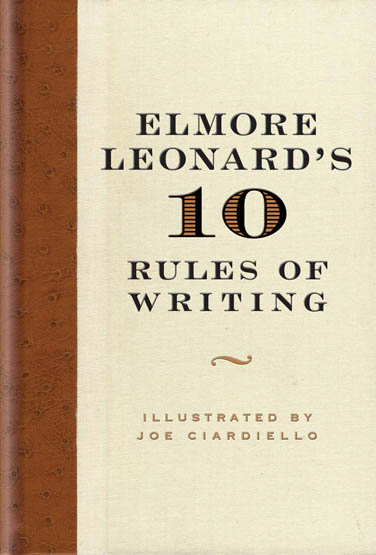
A few months back, The Guardian (inspired by Elmore Leonard’s The 10 Rules of Writing) published the article “Ten Rules for Writing Fiction,” in which they surveyed 29 renowned authors for their own list of dos and don’ts.  This was a fascinating read for me.  At first, it overwhelmed me, because of course as I scanned down the screen I was tripping over everything that I apparently do wrong…and yet, the more author lists that I read, the more I noticed how varied their perspectives were.  For being a list of “rules,” it if anything taught me there is no consistent formula set in stone.

While there are no doubt sound universal suggestions out there we should adhere to, I think we also need to find solace in the fact that there couldn’t possibly be a one-size-fits all approach to writing a good book.  We are all unique and have something different to bring to the table, and that’s something that should be celebrated in our writing as well.  I particularly like how Ollin Morales (Courage 2 Create blog) phrased it in his comment on Agatha’s post:

“I’d rather write a book that I love and everybody hates, than one that everybody loves and I hate.”

True dat.  And I also commend the truth Corra McFeydon just shared in her A Lit Major’s Notebook blog, a post appropriately titled, “The Truth.”  It is here that Corra, also in the process of writing a novel, admits that she does not desire to be a professional writer because, right now at least, it’s killing her spirit in what she loved about writing in the first place.  Seeking to break free from the rules and schedules that constrict her, she asserts:

“That’s why my novel will be written when the spirit hits me — as a product of my intensity, my laughter, and my free spirit — even though apparently that’s not how to be successful.”

I began this project for me, and if it remains just for myself after I’ve at least given it a shot at going elsewhere, so be it if I’m happy with the end product.  But even abiding by our own expectations entails discipline as we make time for our writing and edit it until it becomes the best version of itself.  I think most of the rules I’m opting to follow these days are self-imposed based on my own standards (which are quite high—I’m an English teacher after all, and grade myself constantly ;)).

That being said, one external rule I’m trying to stick to is the advised first-time-author word count of 100,000—not in my first draft that I’m wrapping up presently, but when I go back through to polish up.  Yet another blog post I recently read that I really appreciate for its straightforward guidance on how to cut, let’s say, 19,000 words for a final manuscript is, well, “How to Cut 19,000 Words” from the ‘Lethal Inheritance’ blog—Tahlia Newland tells us how she did just that when her agent asked her trim down her YA fantasy novel of same name.  I was at first absolutely psyched out that cutting words meant cutting entire paragraphs and chapters—and sometimes it does and perhaps will, but it’s reassuring to know that it can be achieved on a sentence/word level as well, an edit so subtle you’d hardly miss a thing.

I’m curious:  Which writing rules do YOU swear by?  And which rules do you think are totally bogus?

Argh.  Can you even imagine Jane Austen sweating it out like this?  I can’t imagine she was slapped in the face by rules at every turn, as we are at every page we flip and link we click.  But then again…