Category Archives: Genres

The Manuscript Manicure – Part I: Macro-Editing

Hiya! I’m back to redeem that I.O.U. I gave you last week. See, my word’s good as gold ;)…

As I mentioned, I attended a writing workshop with Room to Write over the weekend that was geared toward prepping a novel manuscript for submission. The full-day conference was divided into two primary parts—Editing and Publication—the first of which I’ll address in part now and break the rest down into separate posts. But, first, I’ll start with some general notes I jotted along the way to get us in the proper mindset:

One thing they stressed is that, above all:

“Editing is a creative process.”

Yes, it involves the nitty-gritty technical stuff, but we’re not merely playing the role of English teacher grading for grammar with red pen in hand—revising our work requires every bit of imagination and innovative thought as writing our initial draft does. For as they said, when the first draft is finished:

“You’re only just beginning.”

Ah yes, it does feel that way doesn’t it…my question is, when the hell does it end???

Anyway, in order to become our own editor, we have to become a “self-conscious” one. No, not as in insecurity-ridden—I think I’ve already mastered that one just fine :). What they mean is to be conscious of the kind of writer we are and the audience we’re writing for. The better aware we are of this, the better  we’ll be able to edit our work with this focus in mind.

Macro-editing is concerned with the overall  novel as a cohesive work. It’s our opportunity to step back from our first draft and contemplate whether it has achieved what we wanted it to and is structured effectively. They encouraged us to print a hardcopy of the manuscript to initiate this stage, as reading your words on the page is truly a different experience from reading them on screen. (I wouldn’t have expected this, but wow. There’s so much more that I catch with that ms in hand.) You will also want to list your themes, summarize your entire book in three sentences, and keep these with you as you journey back through your text to ensure you aren’t straying from any critical elements.

Key aspects your self-conscious-editing self should look for (not only in the novel as a whole, but in every chapter and scene as well) are:

– A compelling beginning, a hook that makes the reader want to continue. The first chapter in particular should be compelling in an action sense, but also in a literary way—it needs to be beautifully written. Subsequent chapters likewise need their own hooks and should be varied in how they start (i.e., beginning with dialogue, beginning in the middle of action, etc.)

– Action, drama, or “trouble,” as they called it.

– Appropriate pacing.

Three-dimensional characters that are brought to life and desire something;

— Characters are “thinly veiled versions of the writer” (sound familiar?), but we must immediately establish distinction between them and from ourselves if they are to appear as separate people; if they’re all clones of us, then they’re clones of each other.
— If you can “see” the character in your mind (consider gathering clippings from magazines and such for reference), then they will come across on the page.
– Provide physical descriptions of your three main characters, enough to help visualize their traits, but not full-bodied detail. Leave something to your readers’ imagination.
— Characters should be consistent from start to finish (i.e., if you reveal or yourself learn something new about them later in the novel, are these traits present at the beginning as well? If not, try to introduce them at least subtly).
— We should see growth in the main character.

– Clear sense of when and where each scene partakes.

– Long sections of description/exposition that could be cut.

Changing up the writing between exposition, narrative, and dialogue.

– A sense of atmosphere and appeal to the senses that lends texture.

– Something in each chapter that surprises the reader.

Continuity between scenes and chapters; ensure nothing is missing.

– Evaluate the “shape” of your novel/chapter in terms of story arc. Shapes can vary, but there should in general be a rising sense of action/conflict until the climax, then a dip toward resolution (so check for any sagging in the middle).

– Evaluate the ending and ensure a sense of resolution. They advised us to look at six novels we personally enjoy and look at their endings as a guide for managing this successfully. They also admitted that, in the interest of keeping your ending brief (the resolution should just be a “flick” after the climax) as well as ensuring your reader understands what has happened, the resolution may indeed warrant more telling than showing.

Throughout your macro-editing assessment, then, you will want to sit back and assess whether this is the story you wanted to write in the first place. I suppose it doesn’t hurt if ends up morphing into something even cooler than you thought it could be, but if it seems to fall short in some way, pinpoint where it diverges and contemplate how to get it back on track. Another very important point to consider outside of yourself is if it is the story your reader will want to read—how will they experience it?

I’d better cut this off here until my next installment. Many thanks to author Avril Joy for guiding us through this session of the workshop! More to come…

PART II Micro-editing

PART III – Submitting a Manuscript

PART IV – On Publishers & Publicizing


From Sentiments to Sentences – Part II


Hiya!  I’m back from where I left off yesterday. Hopefully I didn’t leave anyone in a great deal of suspense, as this post will only reek of anticlimax :).

What I was about to continue yammering on about last night, at any rate, was that sentimentality is not the only way my past informs my writing.  To start, yes, I’ve had a lovely life—I’d be an ungrateful twit not to acknowledge that and count my blessings every day (I know, la-dee-frickin’-da, right?)—yet to be honest it concerned me this would hurt my writing, make it too naive, idealized, and anything otherwise be too two-dimensional and cliché.  And that’s a very valid concern…

I couldn’t help but peek ahead in my very-neglected Room to Write book, where on page 90 Bonni Goldberg says:

“Where we come from influences both what we write and how we write. […] This is why six people can describe the same tree differently. Each person sees it through a unique set of experiences.”

And then she warns that:

“Cliché seeps into writing when writers forget or neglect to bring who they are into the piece.”

This reinforces what eventually got me over the above concern.  Everyone’s life brings something to the writing desk, and maybe some of things I don’t understand first-hand consequently don’t have a place in my writing. Maybe this, then, helps me narrow down my focus, find my creative niche where what I do know can be optimized.  OR maybe what I don’t know presents that extra intellectual-emotional challenge that could be enriching to explore further through research and imagination, as when a method actor immerses into a new role.  In that way, I don’t have to be so pigeon-holed after all.

Then there is the simple fact that, despite general trend, my life of course hasn’t been entirely rosy! I know pain, heartache, depression, and have sharpened my teeth around anger and resentment pretty well in my day…I may idealize the past out of sentimentality, but I’ve also brought in the darker emotions from the tougher experiences I’ve had—case in point being the “writing-as-therapy” I mentioned yesterday. As a result, my protagonist shared in my own downturn, and in a way we worked through it together.  Then, when I succeeded in pulling out of mine, I could outstretch my hand to lift her out of hers.

I’m not going to do the writing prompt today, but the exercise on that above-mentioned page from Room to Write asks us to write about our origins, beginning with, “I come from.” In doing so, we’re to also consider the sensory details coinciding with our memories that, by virtue of experiencing them, have impacted who we are.

Now, to put my teacher-cap back on briefly, I can’t help but recall from this a poem I had to teach my sophomores during a unit on discovering our cultural identities and identifying how they shape our individual frames of reference:

Where I’m From, by George Ella Lyon

I am from clothespins,
from Clorox and carbon-tetrachloride.
I am from the dirt under the back porch.
(Black, glistening,
it tasted like beets.)
I am from the forsythia bush
the Dutch elm
whose long-gone limbs I remember
as if they were my own.

I’m from fudge and eyeglasses,
from Imogene and Alafair.
I’m from the know-it-alls
and the pass-it-ons,
from Perk up! and Pipe down!
I’m from He restoreth my soul
with a cottonball lamb
and ten verses I can say myself.

I’m from Artemus and Billie’s Branch,
fried corn and strong coffee.
From the finger my grandfather lost
to the auger,
the eye my father shut to keep his sight.

Under my bed was a dress box
spilling old pictures,
a sift of lost faces
to drift beneath my dreams.
I am from those moments–
snapped before I budded —
leaf-fall from the family tree.

In “An Interview with George Ella Lyon,” the poet says:

“If I weren’t from Appalachia (or from my family and my genetic expression and my experience — I don’t know how to separate these), my writing — and I —  might be bolder.  I might live in New York or L.A. and push it more. As it is, I’ve chosen to stay close to home and to be somewhat restricted in what I’ve written and/or published.  I anguish a lot about hurting or betraying family members…On the other hand, if I weren’t from Appalachia, my work might not have the same support of noncompetitive colleagues, of a community of memory, and of strong voices from my childhood that still speak in my head.  Certainly it wouldn’t have its roots in the rocky creeks and high horizons, the enfolding spirit of trees that I call home.”

Though kids inevitably groaned over reading and writing poetry, I always loved this activity because they’d surprise themselves—by recalling and isolating the simplest of images, smells, sounds, tastes, and textures, they’d craft their own “Where I’m From” poems that offered profound insight into who they were, and I think in the end they were proud, learning that if they seized the power to really know themselves, they could harness the power to write.

Such a simple exercise here, yet so dense as we draw out the good along with all the bad to build the organs and flesh around the skeletons of our characters and infuse them with blood and soul.

And YOU, my dears? How does your sense of self inform your writing?


From Sentiments to Sentences – Part I

Sentimentality is both a blessing and a curse.

I’ve demonstrated before to what extent I can cling onto the past in my guest post for Real Bloggers United, “CSI: Chronically Sentimental Individual.”  Now, in the spirit of the recently passed Halloween, let’s just say my memories continue to “haunt” me…

But in good ways (hence, a “blessing”), though sometimes they hurt so good (hence, a “curse”).  I first conceived this topic last week when my parents’ visit came to an end and they returned Stateside.  Though the effect has had a few days to wear off, I remember how I walked home from the tube and almost couldn’t bear how everything I saw reminded me of them because of our recent walks around the neighborhood together.  Forget that I’ve traversed that same route for over two years now and between their two visits they haven’t even been in London a total of two months…the memories with them seemed to replace my collective everyday experience.  Same went for when I returned to the flat and sobbed over little things like the coffee remaining in the French press that we’d shared earlier that morning.  I know, I know…it’s passed now, though tonight I’m jolted with another stroke of sweet sentimentality from home, as I just checked my Facebook messages and saw one from a former student I taught my last year in the States. She was a freshman at the time and is now a grown-up senior about to graduate…simply cannot believe it! My babies! Anyways, she had the sweetest things to say, which made me really pine for those happy teaching years.

In view of such “ghosts” from my past, I find that they appear in some incarnation or another in my writing, perhaps in special homage of these special people and moments.  “Write what you know,” they always say, and I do, knowing full well I am clearly not alone.  I’m constantly reading intros to novels that state how they’re the “most autobiographical” of the author’s works, and, really, isn’t every work of fiction arguably so?  Just ways of telling our truths “slant”?

At the time I started my current manuscript, I was in need of emotional healing to follow leaving home and career, so the tale I began to spin was much more so a “therapy” than an ambition. I didn’t care if it was unoriginal; I let my first chapters draw very much from my own background, which resurrected the spirit of my earlier happiness and allowed it drift and swirl around me in my new atmosphere. The words brought it alive, brought the people and the values back to me and reminded me who I was in an otherwise unfamiliar context that sapped me of purpose. The story certainly evolved from there into a terrain highly unlike anything on which I myself have embarked, but those early chapters gave my protagonist her core, and in doing so assured me of mine.

Among the sentimental inspirations from real life, there are very direct ones that creep up in sentences reflecting the comforting closeness of my family like:

“They weren’t the stuff best-sellers and blockbusters were made of, and prayed they never would emulate what society spent its money on or turned its channel to.”

“Her mom multi-tasked concern for her child with rescuing bacon strips from their spitting inferno.  She wore her short, hairsprayed curls like a helmet ready to combat any threats to her family head-on.”

I’ve also incorporated actual snippets from childhood diaries and adulthood travel journals. Plucked entirely out of their original contexts, though, it’s crazy the way they fit in and communicate something entirely new and different and had inspired new offshoots of sheerly imaginative thought, not that from experience.  It’s been like dismantling a clock and using some of its gears to operate, ooh, maybe something like the Happiness Machine in Ray Bradbury’s Dandelion Wine (which, in keeping with our theme here, is a valentine to Bradbury’s own childhood).

It’s all about our frames of reference.  No one could possibly perceive the world in exactly the same way that we do individually because we occupy separate space and move differently through it. This gives us our own private reality, then, and this is what writers constantly tap into to construct their fictional realities.  And there’s more I’d like to say on this, but am realizing this is getting long, so I’ll break it into two parts.  Fair enough?  Cool.  See you tomorrow.


Revisal of the Shittest

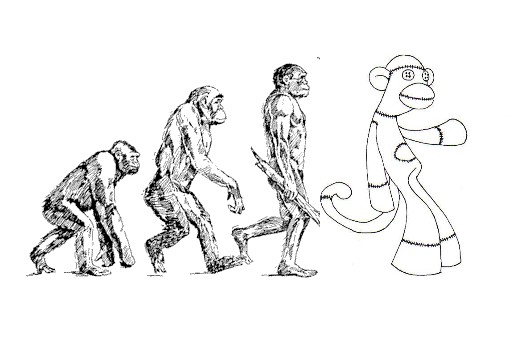
“I believe imagination is like a Darwinian system.”

sock monkey image from cthulhufhtagn.deviantart.com

In the above quotation from the novel Sophie’s World (which I finally got through a week ago), Alberto Knox—the story’s philosopher—discusses with Sophie the nature of creativity and how it follows the natural selection of Darwinism:

“Thought-mutants occur in the consciousness one after the other, at least if we refrain from censoring ourselves too much.  But only some of these thoughts can be used.  Here, reason comes into its own.  It, too, has a vital function.  When the day’s catch is laid on the table we must not forget to be selective.”

Oh, that Alberto and his way with analogies…sorry, can’t help being sarcastic toward this book. Disregarding the tremendous education on philosophy it provides (which in itself is good reason to read the novel, and I’m glad that I did), it’s the fictional aspect of the plot that pricked into my skin like so many fleas in my fur. An interesting attempt to provide an entertaining means of digesting large concepts and history, the fictitious story line that distinguishes this as a “novel” versus “textbook” fell a little flat for me. The dialogue was unbelievably forced (most of Sophie’s comments/questions simply served as breaks or segues in the long lectures), and though it takes an interesting twist mid-way through, the characters and thin plot just didn’t endear themselves. Quite frankly, I found Sophie to be a precocious little twit. But I digress…

In any case, what he’s getting at here is that imagination generates the ideas, but reason weeds out the “mutants” and selects the best ones to carry on.  The plot twist in the book also ushered in some self-reflexive commentary on writing and the manipulative power the writer has over those ideas, settings, and characters in his/her charge. As far as the creative process in general, Alberto continues to say (with another analogy in practically the same breath as the first…):

“Maybe the imagination creates what is new, but the imagination does not make the actual selection.  The imagination does not ‘compose.’ A composition—and every work of art is one—is created in a wondrous interplay between imagination and reason, or between mind and reflection.  For there will always be an element of chance in the creative process.  You have to turn the sheep loose before you can start to herd them.”

This “wondrous interplay” is what laboriously polishes our inspired first drafts into final manuscripts. It’s what also keeps us in check so we don’t overly pillage our paragraphs of the words and thoughts that breathe soul into them; all too often, reason defeats imagination when there should instead be a balance of power.

Unlike the negligent Dr. Frankenstein, however, we do need to be mindful of what we bring into being. Our stories inspire us, they speak to us, they surprise us, yes, but they also rely on us to nurture and shape them, to help find a suitable place in the world for them. It’s still essential to follow the writing rules so we don’t feed our stories after midnight or get them wet, thereby leaving the sweet Mogwais of our imagination to metamorphose into Gremlins of loose redundancy and holes. That said, I don’t mean to be harsh on our uncensored minds, and perhaps my title isn’t fair in calling our first drafts “shit”…but far be it from me to pass up a good rhyme, and, anyways, sometimes they just really are ;).  (I think Sophie’s World, for example, might’ve benefited from another read-through…)

Serendipitously, at the same time as I’d read the chapter quoted here and mulled over this intellectual tightrope, Tahlia (author of Lethal Inheritance who blogs on the site of same name) posted “Do we write a story or uncover it?“—here, she asks how much we write using our rational intellect versus not thinking and just going with the flow.  It seems we universally tread this fine line, leaving us with this:  To think or not to think…that is the question when it comes to the evolution of our story.


So, uh…Did You Bring Any Protection?

*blush*  Get your minds out of the gutter.  What kind of monkey do you think I am?!

“The best lightning rod for your protection is your own spine.” – Ralph Waldo Emerson

I have long neglected my little writing prompts that originally kicked off this blog, mainly because they’re aim was to get me over writer’s block, and it worked!  I’ve been cranking until I’m crossed eyes these recent days on revising my manuscript, and for the time being am keen to step away for a bit to clear my head.  So…

The Prompt:

Today page 43 of Room to Write asks us to list the protections we use in our everyday lives or, indeed, our writing.  We are to then have our main character embody this protection in a scene or simply write a new piece without using writing-protections (e.g., a different place than the usual, without a word/page limit, etc.).

Henry VIII's armour

Response:

My everyday protections include:

– smiling

– expression through writing versus speaking

– diving behind a book or in front of a computer/tv

– my giant headphones and iPod

– sarcasm

– my forked tongue, when need be

– stubbornness, which includes a common refusal to say, “sorry”

– quiet pensiveness, reclusiveness

Hm, given that codpiece on Henry's armour, perhaps he could've used this protection as well...

– over-analysis

– verbatim recall of prior conversations (one of my more superb defenses)

– cold silence or, conversely, inane babble

– hats, cardigans, and sunglasses

– take-away caffeine (somehow just holding the steaming paper cup is a fortification, regardless what’s inside)

– sleep

– my quilt

– a hybrid superiority/inferiority complex that’s a bit difficult to describe…

I’ll stop there and address the second part of this exercise by first peeling off one key writing-protection of mine:  the ability to revise.  So I’m just going to write this off the cuff and not obsess over how it comes out, leaving it raw in its first draft form.

So, that said, I have certainly infused a lot of the above protections into my protagonist, who I’ll continue to address by the pseudonym “Margaret” (whoops, there I go, still protecting…and for whatever reason protecting the fictional :)).  I could probably find one-to-one matches for almost everything on the list, but here’s just a few examples:

“Margaret beamed one of her fake smiles in maneuvering in ninety-degree angles toward her.”

“Writing was so much easier than calling; writing gave control, the ability to pause, reread, and revise.  Margaret didn’t trust herself with speaking any longer; the restraint in talking to her parents was difficult enough, and they alone embodied the innocence necessary to not pick up on vocal cues.  Her not-so innocent friends and brother, on the other hand, were risks she couldn’t take.”

“Shaking off the mundane tasks of Everyday-Land and shoving in a thumbnail to spear a dog-eared page, Margaret tiptoed into her alternate universe at the delicious creaking sound of a hardcover binding blooming into action.”

“She’d banked an increasing number of slumbering hours ever since that first day […] and she wiled away the afternoons on indulgences like prolonged soaks in the tub and otherwise luxurious daytime lounging.  The solitary nature of her days quieted her mind to her earlier paranoia, distortions in perception that she’d ascribed to stress-induced fatigue.  [It] all dissipated before her like the steam that rose off the bubbles in her lap.”

The sun shied away behind the clouds, making Margaret’s sunglasses redundant, so she reluctantly removed them.”

“She’d lately taken to […] a route of anonymity that concealed her among side streets rather than parade her before rows of shops and sidewalk cafés.  She didn’t want to be observed, though sometimes played a mental game that she was hiding from the paparazzi lusting to lavish her with attention—somehow desiring to be a Nobody while still feeling like a Somebody.”

And that kitten definitely has claws when she needs ’em to shield her inner vulnerability.

Reflection:

As much as this character isn’t supposed to be me, it’s interesting to look back on her through this lens and realize how cognizant I am of my defense-mechanisms, as reflected in this mirror.  I reveled before in the fact that writing can be a protective filter of our thoughts by virtue of its revision stage, yet it is also something that leaves us exposed, unveiling raw emotion, intellect, and imagination.  I’m sure I’m not the only one who felt (and continues to feel) timid about posting a blog, putting those ideas out there for anyone to read and judge.  Getting something “in writing,” after all, carries that sense of no-turning-back, as though signed in our blood or chiseled in stone.  There’s both a structured permanence and organic fluidity to it that just fascinates me, but I’ll leave that to another blog topic on another day.  For now, I suppose these blogs do allow us to go back and edit, but I’ll keep my promise and not exercise that protection ;).  In fact, I’m not even going to let myself read this over before I press “Publish.”  Ha, take that!

What are your protective layers?


The Telltale Taboos

“Substitute ‘damn’ every time you’re inclined to write ‘very;’ your editor will delete it and the writing will be just as it should be.” – Mark Twain

The revision continues, so this is just a quickie.  That’s right, I’m gonna just love ya then leave ya, blog-slut that I am…

I’ve done a once-over combing through my manuscript and trimmed out a few thousand words so far.  As I still contemplate how I’m going to tweak that damn ending—sorry, I mean “very” ending—no, I mean “damn” ending—no, I mean just “ending,” period ;)—I’m approaching another wave.  But before I do another complete read-through, I’m strategically using my Word application’s “Find” tool to seek out and evaluate the use of a few common culprits that threaten to weaken our writing.

While there are many ways to slice-and-dice revision (including eliminating those adverbs and “to be” verbs), here’s a sample of overused, taboo words to check for in your manuscript as a quick-fix:

very

always

really

when

then

that

suddenly

just

began / started (With these, don’t use it if whatever is “beginning/starting” doesn’t stop before the action is carried out. Oh my gaawwd, I can’t believe how many ‘began’s I’ve found…naughty Monkey!)

For what that’s worth.  It’s not to say we shouldn’t use these words at all, just not overly so—it’s worth a scan to become cognizant of our usage and determine whether there isn’t a more direct, active means of engaging our reader through other word choices/sentence structure.

Also [I’m adding this retroactively in response to Sharmon’s good point in the comment below], I personally reduced those words in my 3rd-person narration, but left most of them in my dialogue, as those words are likely overused in our writing because they’re what we use often when we speak!  So, it’s arguable from that standpoint that they contribute toward authentic dialogue, no?

What words would you add to the list?

[As an aside, can’t help but share that the Mark Twain quotation reminds me of a time from my consulting days when the guy in the cubicle across from mine started swearing, walked away, then promptly returned with a colleague.  “Fix it,” he said to the guy, pointing at his computer.  Our friend/coworker giggled as he did so.  Afterwards, I learned that the guy had tampered with my cubicle-mate’s Word settings such that every time he typed the word “the” in his client report, it auto-corrected to, well, a term for male genitalia.  Ah, Finance wasn’t always so boring…]


Procrastination Potpourri


The good news: I’ve been slacking on my blog because I’ve cranked up the work on my manuscript.

The bad news: I’ve been slacking on my blog.  Which means neglect of your blogs as well as mine.  Please hang in there with me!  I value so much what I take away from your blogs and comments, so I wouldn’t dare stay away for long; I’m just not the most consistent right now.

To make up for the Monkey imitating a Sloth again, I’ve got a wee smorgasbord of miscellany today.  First off, I am super pleased to say I’ve been productive in slashing word count and getting closer to revamping that ending that I just haven’t been thrilled with for a while.  I have also finished writing the secondary story that interweaves with my main plot, which is much briefer in scale, but had yet to transfer from me noggin to the written word.  That was such a treat to work on for a change in voice, characters, and situation.

But enough about that.  I don’t know how I manage to get on all these freaking email lists, but one lil’ nugget delivered to my Inbox recently was promoting a new book titled Getting Published.  While that highly obscure title hardly clarifies what the text might be about, I thought perhaps I’d pass it on to the blogosphere in the rare event it ends up being somewhat relevant to writing and getting that writing published…ya think?  Actually, now that I think about it, I’m lying…1) I do remember how I got on this mailing list, having emailed an enquiry to the Writers Workshop once over a year ago, and 2) despite that evasive title, I might have some glimmering of an idea as to what the book’s about, as quoth the author:

At the moment, there’s nothing on the market that tells a budding writer what they need to know about the industry. How to select agents, how to engage with agents, what a book deal looks like, what the financial issues are, what the (multitudinous) publishing issues are.

Because agents don’t tell you this either – and nor will your publisher – plenty of ‘professional’ authors are ill-informed about the industry from which they hope to eke a living. I’ve tried my level best to make this the most comprehensive and truthful book of its kind, and I very much hope you like it.

A&C Black have generously agreed to place significant chunks of the book online, so you can get a feel for the book before deciding whether to buy it. We’ve put a full listing of those extracts here. The nice people at A&C Black have also managed to secure a 25% off promotion from Amazon, so if you want to buy the book there, please make my day.

Despite my devoting a sizable chunk of this post to it, I honestly have no insider knowledge on this publication and whether it will deliver what it promises or not, but no harm in sharing.

And, oh, but wait!  There is MORE good news!  Utterly lovely blog awards and recognition.  So a *mwah* and *mwah* to Ollin for the recent blog tag and Milo for the Versatile Blogger Award.  Per the responsibilities attached to the game-o-Blog Tag, my responses follow—and I’ll make this a twofer by tagging AND awarding the Versatile Blogger Award to the 6 bloggers listed below:

1. If you could have any superpower, what would you have? Why?

I would be able to hyper-space anywhere, any time, within seconds. Given my volume of travel, I am getting reeeallly sick of airports and commuting to/from them.  I would also love to pop into my parents’ house across the ocean every time I’m thinking of them and wanna give them a hug.

2. Who is your style icon?

classic: Audrey Hepburn
contemporary: Gwyneth Paltrow
[and, okay—if I cared to get dolled up each day—Jennifer Love Hewitt’s character Melinda Gordon on Ghost Whisperer :)]

3. What is your favorite quote?

Toss-up between:

“So long as books are open, minds can never be closed” – Ronald Reagan
“Be silly. Be honest. Be kind.” – Ralph Waldo Emerson

4. What is the best compliment you’ve ever received?

Well, for as satisfying as it was when my non-domestic self finally learned to cook and my husband said I’d gone from “zero to hero” in the kitchen, I’d probably have to go with all the folks who have told me over the years that I’m a good writer.  That gave me the boost I needed to start believing in that for myself and work even harder to become a better writer.

5. What playlist/cd is in your CD player/iPod right now?

This minute, I’m leaving it to the artificial intelligence of my iTunes’ “Indie Rock” Genius Mix.  It kicked off with Joy Division and is presently playing The Smiths’ “Cemetry Gates.”

6. Are you a night owl or a morning person?

Oh, without doubt I am a child of the night.  Left to my own devices these days, I’m always awake into the wee hours of the morning writing/revising or curling up with a good book or flick.

7. Do you prefer dogs or cats?

As I have confessed in a previous blog award acceptance speech:

“Although I love animals (I am, after all, a monkey), I am not a pet person. At all. But if I had to align myself with either the infamous Dog People or Cat People in a finger-snapping gang face-off of “West Side Story” proportions, I would probably go Cat.”

8. What is the meaning behind your blog name?

It dates back to a joke my older brother told me when I was little kid…it had me rolling on the ground for at least a half-hour, howling, and to this day makes me giggle to tears.  I usually resist telling it, as not everyone may find it remotely funny and, moreover, find it disturbing that I do ;).

And now for the tag/awardees:

NickiNicki Elson’s Not-So-Deep Thoughts

EvaWrite in Berlin

CourtneyBurn Your Diary

Cities of the Mind

Agatha – Here Be Dragons (who has already been tagged, but is now awarded)

Milo – In Media Res (who has already been awarded, but is now tagged)

*   *   *   *   *

All right, then.  I’m offline for the rest of today, but am hankering to return to my writing prompts soon, so keep an ear peeled for my next screech.


The Writing on the Cubicle Wall

I was just reading, albeit belatedly, a beautifully structured and written memoir of September 11, 2001 on Liza‘s Reading Makes Me Happy blog.  She lists her memories of it and asks her readers to share what they remember as well.  I just left the poor gal a lengthy comment that was like a post in itself, so I thought I may as well share it here:

“I remember first hearing about it on the radio, sitting in my car driving across Chicago. The morning show was talking about a plane that had hit the WTC and still wondering if it had been an accident…until the second one hit. I remember my mother’s worried voice on my answering machine when I got back to my apartment and how I tried to tune in on my 18-year-old television! The antenna reception was awful, and the picture began flipping just before I heard the cries of the newscasters. I remember smacking my TV to get a clear picture of what had raised the alarm, and it clicked into place just before the first building finished collapsing. I remember dressing for work, tentatively, then driving on Lake Shore Drive toward the office, listening to how they still didn’t know if there were more planes out there or what their targets would be. From my view, I saw the Sears Tower and my own office building, Chicago’s 3rd tallest in which my office was on the 74th floor. I remember seeing all the workers emptying into the street, so I passed my exit and headed straight for the highway out to my parents’ house in the suburbs…where I remember watching the footage on the news for hours on end with mouth agape and trying to grasp the reality with my mom and dad that we were at war.”

I prayed and grieved all over again this last Saturday, yet I hadn’t retraced my own footsteps of nine years ago so clearly until writing out this comment.  There is so much more that is momentous about that day beyond little me and my own little everyday world, but in the wake of my previous post about my latest professional and personal endeavors, I am reminded how that day was so pivotal in bringing me to this point.

I remember the growing discontent I’d had in my world of Finance, but how I’d stick it out with no real impetus for change.  I was rotating along as a good cog in the wheel should, but otherwise doing nothing I was passionate about.  So then I remember sitting on my parents’ sofa that day and watching replays of the planes flying into the Twin Towers—they looked so much like my own office building, that I thought, “I’ll be damned if that’s the place where I die!”  I would not leave this world that way, not sitting in my cubicle, oh please no.

By September 11, 2002, I had started my masters program in Education, having quit my consulting job that year to teach literature and writing.

Fast-forward to 2008, when my high school was in the midst of a Columbine-type scare:  a threat had been found written in a bathroom stall that was alarmingly specific as to how many guns (and what type) would be used to kill how many students and how many teachers and on what day.  School wasn’t called off, but teachers and students were at liberty to make their own decision as to whether they’d attend; for the protection of those that came, police would be patrolling.  Faculty was understandably distressed, but what were we going to do, bail on our students?  Call in substitute teachers so then they could be in the line of fire?

Regardless of whether the threat was real, I never questioned that I’d be there.  I thought back to 9/11 and my sentiments about dying in my office…I then looked upon my students’ faces and realized there was no better place to be if that was going to be my time.

That’s when I knew I’d gotten my life moving in the right direction, ever closer to my passions of reading, writing, and helping other people along the way—otherwise, I’d still be pathetically comparing my life to the movie Office Space and not doing anything about it.  There is much to take away from such a national/global tragedy, not the least of which is an appreciation for every additional day that we get to breathe.  Others certainly don’t lose their lives just so we can piss away ours.


If Truth Be Told…


Halfway through Sophie’s World, and it keeps prompting new thoughts.  Well, more accurately, the history of philosophy that it shares does.

Though dear Sophie and I have already progressed to the 18th century, Plato’s ancient allegory of the cave continues to flicker in my mind like the flame casting shadows onto the back of the cave wall.  If you aren’t familiar with the story, the basic idea is this: 

Visualize a cave with people seated with their backs to its opening.  They are therefore only able to see the back of the cave wall, which is dancing with the shadows of objects held behind the people and in front a fire.  The people are unable to turn around, thus only know the world from these vague shadows of what’s transpiring beyond them outside of the cave.  

In this myth, the actual objects (which would be seen in clearer detail if the people turned around to look at them directly) represent the world of ideas, whereas the shadows are only our perception of the material world.  Plato believed that true knowledge could not be gained through our senses, but, rather, our reason.  Thus, the enlightened ones who try to see beyond their physical world into the realm of ideas will see with clarity and truth.

So why do most of us keep our backs to the cave opening, staring into the darkness and shadows?  Is it because we choose not to see or aren’t able to?  When I think of this myth literally, I pretend that I’m the one to stand up and look around at what is creating the shadows.  My eyes having been adjusted to the dark all this time, I’d think they’d be pierced by the bright fire/daylight.  This then makes me think of the Emily Dickinson poem:

Tell all the Truth but tell it slant —
Success in Circuit lies
Too bright for our infirm Delight
The Truth’s superb surprise

As Lightning to the Children eased
With explanation kind
The Truth must dazzle gradually
Or every man be blind —

Methinks Miss Dickinson and Colonel Jessep share something in common—though Emily might agree we ordinary folk are entitled to the truth, neither believes we can handle it.  For that matter, how would everyone else in my cave respond if I suddenly told them what I saw?  Would they believe me?  Be shocked by it?  Deny it?

Me-then thinks perhaps stories are a way we writers try to help the medicine go down.  Hey, Plato’s allegory is a case in point, is it not?  Stories help us to better understand truths through visualization and creative “slant”—no, not lies, just not necessarily the facts either when it comes to fiction.  And I shouldn’t imply that it’s “sugar-coating”; indeed, stories well-told will intensify rather than dilute, expressed in engaging, vivid ways that make a reader receptive to even the grittier stuff.

Years ago, I attended a lecture  by Tim O’Brien in which he discussed his novel The Things They Carried.  Written in the first person and narrated by a character whose name was also Tim and who also fought in Vietnam, the book reads like it’s the author’s memoir.  O’Brien clarified, however, that while much of the novel is based on his real life, it is a novel.  Flip to the inside cover and see that it is denoted as a work of fiction (there are many semi-autobiographical narratives that are, which many don’t realize until Oprah exposes it mercilessly on her show…*ahem* A Million Little Pieces *cough*…Night is arguably another—and oh, hey, just look whose book club it’s in…).

Basically, O’Brien said he had to stray from writing the factual truth in order to tell the absolute Truth.  He likened it to catching your first fish; sure, it might be scrawny, but your excitement is massive.  In order to get someone else as excited about your catch as you are, you might stretch your hands further apart from the few inches of, “It was this big,” to the two-foot length of, “It was THIS BIG!!”  Describing a tiny bluegill as a giant catfish isn’t factually true, but your friend’s commensurate reaction is the Truth of what you actually felt.  Likewise, O’Brien believed that for anyone who didn’t experience Vietnam to feel remotely the way he felt when he was there, he needed to tell it differently.

So my question for YOU is this:  what Truths do you write or read about?  Which of your stories (or those you’ve read) do you think do a particularly effective job of helping the reader “handle the truth” and why?


What Happens in a Meadow at Dusk?

“[L]ong before the child learns to talk properly—and long before it learns to think philosophically—the world will have become a habit.  A pity, if you ask me.”  – Sophie’s World

I’m currently reading a book that I’ve had sitting on my bookshelf for years.  I literally moved it across an ocean two years ago, and still it had sat mutely, patiently, until I finally plucked it out and cracked it open a few days ago:  Sophie’s World.  I’m only a quarter of the way through it, so will withhold offering a critique, but so far I’m enjoying the questions it raises—it’s essentially taking your own correspondence course in philosophy, without getting graded 🙂    Less than twenty pages in, I was struck by the above quotation…I hadn’t really reflected on how the world becomes a “habit” as we age:

“The world itself becomes a habit in no time at all.  It seems as if in the process of growing up we lose the ability to wonder about the world.  And in doing so, we lose something central—something philosophers try to restore.  For somewhere inside ourselves, something tells us that life is a huge mystery.  This is something we once experienced, long before we learned to think the thought.”

At this point, the “philosopher” instructing our protagonist, Sophie, has been pointing out how infants and young children look about at everything surrounding them with wonder, getting excited about even the little things we adults come to take for granted through familiarity.

I’m not going to wax philosophical on this, but what it did make me think about is how writers seem to be blessed with the ability to behold the world with that same wonder we did as children.  We have to, really, in order to continue creating our own little worlds. 

The writer is someone for whom a bus ride is not merely from Point A to Point B; rather, it’s an exercise in character study as we little voyeurs observe those in such close proximity that it almost seems weirder to pretend that they’re not there (as the masses do on the London Underground…the eye aversion is almost unbearable – and on sidewalks, too!  This Chi-town gal misses eye-contact *sigh*).  Anyways, we watch these people, speculate on where they’re going, where they’re coming from, what their whole backstory might be.  We get ideas in our noggins as to the perfect character to insert into our current tales or on which to base a whole new novel…all thanks to paying some attention to the real people right under our noses.

We notice subtleties, the body language that suggests insecurities or the butterfly that carries so many metaphors aloft the breezes of its wings.  We notice with a painter’s eye that the clouds aren’t just white and that the sofa is illuminated differently when the sun shines in from that late-afternoon angle.  We notice the people who smile to themselves when they think no one’s looking and that a tree can look sad, hopeful, or maternal.  We notice what a gust of fresh air feels like in our lungs, through our hair, and the new story ideas that the sensation can conjure.

We can describe what happens in a meadow at dusk.

We behold the world with wonder, and the beauty is that not only are we richer for it, but we have the calling that compels us to write it down so that others might experience the world through our eyes and look at it as though for the first time through their own.  There is not always beauty in this awareness; in fact, we may reveal the darker sides of humanity and tell gritty, disturbing stories without that happy ending.  But what there will always be is Truth – I’m talking the capital ‘T’ truth so long as we write, to the best of our abilities, what it is we wonder at through our genuine voices.  That is what makes a story authentic and universal, for something has told us that “life is a huge mystery,” and now that we can think the thought, we can write it.