Monthly Archives: October 2010

Monkeys in My Tree

Just a quickie, folks, to notify that the wacky monkeys I descended from (a.k.a., Mom & Dad) have swung from a loooong vine across the Atlantic ocean to visit me.  We’ve just returned from a delightful weekend in the Cotswolds and Stratford-upon-Avon and are recovering from a not-so-delightful extended train ride back to London last night—our train hit someone on the tracks, the poor soul :(…Then tomorrow we’re off to rrrrOMA! for a few days.

Hopefully I’m not wearing the poor Ps out already; we’d had to flee town for this past weekend already because my genius husband and I managed to dumb-ass double-book ourselves, so a couple of our friends flew in from Italy last Wednesday before my parents arrived from Chicago the following morning.  Our wee abode officially bursting beyond capacity, I chose to head for the hills (or the “wolds,” I should say) to give everyone a bit of breathing room.  Since our first guests arrived in March of 2009, this is the 17th round of guests that we’ve hosted in London.  Not counting parental repeats, 30 different people have rested their heads at what we’ve long been calling the B&B.  I should’ve bought a guestbook from the getgo had I any freaking idea how many people would suddenly come out of the woodwork and want to stay with us once we moved somewhere cool.  I think our next home had better be in Nebraska.

Anyways, all whingeing aside, I’m having the best time with my parents, and I’m giddy because my Dear Reader has been emailing back her second round of feedback on my manuscript ending.  I’ve got some work cut out for me on that, but I’m so excited to revisit it and make it the strongest version of itself.  I have a November workshop on manuscript submission as my deadline for getting things as polished and perdy as can be :).

In the meantime, as long as my tree here continues to be occupied and me swinging hither and yon as Hostess with the Mostess, I’ll be out of commission in the blogosphere for several more days.  I shall miss you and your wonderful insights until then—*mwah*!!


The Soundscape of a Novel

“The making of a good compilation tape is a very subtle art…First of all, you’re using someone else’s poetry to express how you feel.  This is a delicate thing.” —High Fidelity


*sigh*…the Mix Tape.  How I remember practicing that delicate art in high school and college…mostly, I made tapes for myself (hey, you have to love yourself before you can love someone else :)), but I can think of at least one I made for a boy…*blush*. I didn’t need to read or see High Fidelity first to innately understand the delicacy in balancing out those tracks—it’s a lot like writing, really, in that you need to start out with an attention-getter and then try to avoid redundancy in carefully pacing yourself through the highs and lows of fast and slow. The words should carry meaning, and you need to establish mood and tone.

But I didn’t necessarily adhere to all those rules this time.

You see, as I try to hold my anxiety at bay while the last 15,000 words of my manuscript rest in my trusted Reader’s hands for review and feedback, I’ve been playing around with giving my novel a soundtrack, as inspired by the Milk Fever Blog post, “The Soundtrack.” The preliminary playlist that I’ve compiled is in order of story progression, not the sacred aesthetic rules of the Mix Tape as referenced above. Basically, I thought through the themes and atmosphere of my key scenes, as well as any songs specifically referenced in the text, and have listed the songs as these elements appear.  Though humor keeps some of my scenes relatively light, needless to say my protagonist undergoes some pretty crazy stuff that just doesn’t warrant many feel-good tunes.

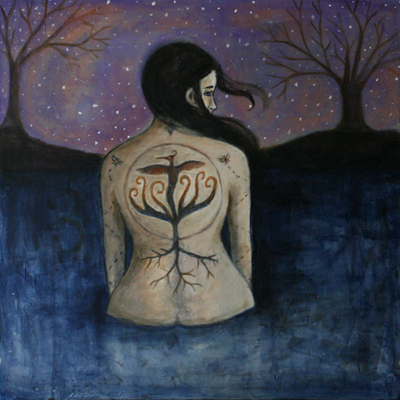
At any rate, I bring you “Monkey Manuscript: The Musical”—ta da!  You can access this first-pass playlist for my as-yet-untitled manuscript online by clicking the image (a painting I only just stumbled on today that is strikingly in keeping with my tale’s motifs, so would make ideal cover art). Titles and artists are also listed below:


"Ophelia," by Leah Piken Kolidas (www.bluetreeartgallery.com)


The “Untitled” Soundtrack:

The Ghost in You – Pscychedelic Furs

We Are All Made of Stars – Moby

Charlotte Sometimes – The Cure

Dreams Never End – New Order

The Fear – Lily Allen

Goody Two Shoes – Adam Ant

10:15 Saturday Night – The Cure

Cemetry Gates – The Smiths

Peace and Hate – The Submarines

Sexy Boy – Air

Dead Souls – Joy Division

Shiver – Coldplay

Start to Melt – Peter Bjorn and John

She’s Lost Control – Joy Division

Where is My Mind? – The Pixies

All Cats Are Grey – The Cure

Black Mirror – Arcade Fire

Cold Hands (Warm Heart) – Brendan Benson

Quick, Painless and Easy – Ivy

Last Goodbye – Jeff Buckley

Slow Life – Grizzly Bear

Edge of the Ocean – Ivy


Revisal of the Shittest

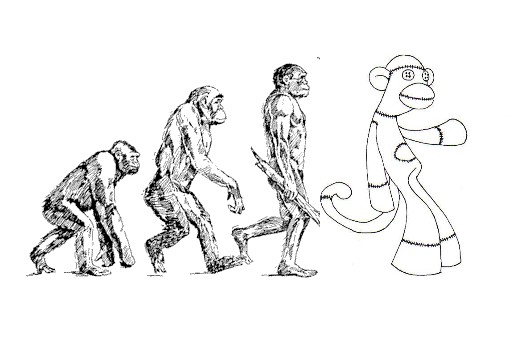
“I believe imagination is like a Darwinian system.”

sock monkey image from cthulhufhtagn.deviantart.com

In the above quotation from the novel Sophie’s World (which I finally got through a week ago), Alberto Knox—the story’s philosopher—discusses with Sophie the nature of creativity and how it follows the natural selection of Darwinism:

“Thought-mutants occur in the consciousness one after the other, at least if we refrain from censoring ourselves too much.  But only some of these thoughts can be used.  Here, reason comes into its own.  It, too, has a vital function.  When the day’s catch is laid on the table we must not forget to be selective.”

Oh, that Alberto and his way with analogies…sorry, can’t help being sarcastic toward this book. Disregarding the tremendous education on philosophy it provides (which in itself is good reason to read the novel, and I’m glad that I did), it’s the fictional aspect of the plot that pricked into my skin like so many fleas in my fur. An interesting attempt to provide an entertaining means of digesting large concepts and history, the fictitious story line that distinguishes this as a “novel” versus “textbook” fell a little flat for me. The dialogue was unbelievably forced (most of Sophie’s comments/questions simply served as breaks or segues in the long lectures), and though it takes an interesting twist mid-way through, the characters and thin plot just didn’t endear themselves. Quite frankly, I found Sophie to be a precocious little twit. But I digress…

In any case, what he’s getting at here is that imagination generates the ideas, but reason weeds out the “mutants” and selects the best ones to carry on.  The plot twist in the book also ushered in some self-reflexive commentary on writing and the manipulative power the writer has over those ideas, settings, and characters in his/her charge. As far as the creative process in general, Alberto continues to say (with another analogy in practically the same breath as the first…):

“Maybe the imagination creates what is new, but the imagination does not make the actual selection.  The imagination does not ‘compose.’ A composition—and every work of art is one—is created in a wondrous interplay between imagination and reason, or between mind and reflection.  For there will always be an element of chance in the creative process.  You have to turn the sheep loose before you can start to herd them.”

This “wondrous interplay” is what laboriously polishes our inspired first drafts into final manuscripts. It’s what also keeps us in check so we don’t overly pillage our paragraphs of the words and thoughts that breathe soul into them; all too often, reason defeats imagination when there should instead be a balance of power.

Unlike the negligent Dr. Frankenstein, however, we do need to be mindful of what we bring into being. Our stories inspire us, they speak to us, they surprise us, yes, but they also rely on us to nurture and shape them, to help find a suitable place in the world for them. It’s still essential to follow the writing rules so we don’t feed our stories after midnight or get them wet, thereby leaving the sweet Mogwais of our imagination to metamorphose into Gremlins of loose redundancy and holes. That said, I don’t mean to be harsh on our uncensored minds, and perhaps my title isn’t fair in calling our first drafts “shit”…but far be it from me to pass up a good rhyme, and, anyways, sometimes they just really are ;).  (I think Sophie’s World, for example, might’ve benefited from another read-through…)

Serendipitously, at the same time as I’d read the chapter quoted here and mulled over this intellectual tightrope, Tahlia (author of Lethal Inheritance who blogs on the site of same name) posted “Do we write a story or uncover it?“—here, she asks how much we write using our rational intellect versus not thinking and just going with the flow.  It seems we universally tread this fine line, leaving us with this:  To think or not to think…that is the question when it comes to the evolution of our story.


So, uh…Did You Bring Any Protection?

*blush*  Get your minds out of the gutter.  What kind of monkey do you think I am?!

“The best lightning rod for your protection is your own spine.” – Ralph Waldo Emerson

I have long neglected my little writing prompts that originally kicked off this blog, mainly because they’re aim was to get me over writer’s block, and it worked!  I’ve been cranking until I’m crossed eyes these recent days on revising my manuscript, and for the time being am keen to step away for a bit to clear my head.  So…

The Prompt:

Today page 43 of Room to Write asks us to list the protections we use in our everyday lives or, indeed, our writing.  We are to then have our main character embody this protection in a scene or simply write a new piece without using writing-protections (e.g., a different place than the usual, without a word/page limit, etc.).

Henry VIII's armour

Response:

My everyday protections include:

– smiling

– expression through writing versus speaking

– diving behind a book or in front of a computer/tv

– my giant headphones and iPod

– sarcasm

– my forked tongue, when need be

– stubbornness, which includes a common refusal to say, “sorry”

– quiet pensiveness, reclusiveness

Hm, given that codpiece on Henry's armour, perhaps he could've used this protection as well...

– over-analysis

– verbatim recall of prior conversations (one of my more superb defenses)

– cold silence or, conversely, inane babble

– hats, cardigans, and sunglasses

– take-away caffeine (somehow just holding the steaming paper cup is a fortification, regardless what’s inside)

– sleep

– my quilt

– a hybrid superiority/inferiority complex that’s a bit difficult to describe…

I’ll stop there and address the second part of this exercise by first peeling off one key writing-protection of mine:  the ability to revise.  So I’m just going to write this off the cuff and not obsess over how it comes out, leaving it raw in its first draft form.

So, that said, I have certainly infused a lot of the above protections into my protagonist, who I’ll continue to address by the pseudonym “Margaret” (whoops, there I go, still protecting…and for whatever reason protecting the fictional :)).  I could probably find one-to-one matches for almost everything on the list, but here’s just a few examples:

“Margaret beamed one of her fake smiles in maneuvering in ninety-degree angles toward her.”

“Writing was so much easier than calling; writing gave control, the ability to pause, reread, and revise.  Margaret didn’t trust herself with speaking any longer; the restraint in talking to her parents was difficult enough, and they alone embodied the innocence necessary to not pick up on vocal cues.  Her not-so innocent friends and brother, on the other hand, were risks she couldn’t take.”

“Shaking off the mundane tasks of Everyday-Land and shoving in a thumbnail to spear a dog-eared page, Margaret tiptoed into her alternate universe at the delicious creaking sound of a hardcover binding blooming into action.”

“She’d banked an increasing number of slumbering hours ever since that first day […] and she wiled away the afternoons on indulgences like prolonged soaks in the tub and otherwise luxurious daytime lounging.  The solitary nature of her days quieted her mind to her earlier paranoia, distortions in perception that she’d ascribed to stress-induced fatigue.  [It] all dissipated before her like the steam that rose off the bubbles in her lap.”

The sun shied away behind the clouds, making Margaret’s sunglasses redundant, so she reluctantly removed them.”

“She’d lately taken to […] a route of anonymity that concealed her among side streets rather than parade her before rows of shops and sidewalk cafés.  She didn’t want to be observed, though sometimes played a mental game that she was hiding from the paparazzi lusting to lavish her with attention—somehow desiring to be a Nobody while still feeling like a Somebody.”

And that kitten definitely has claws when she needs ’em to shield her inner vulnerability.

Reflection:

As much as this character isn’t supposed to be me, it’s interesting to look back on her through this lens and realize how cognizant I am of my defense-mechanisms, as reflected in this mirror.  I reveled before in the fact that writing can be a protective filter of our thoughts by virtue of its revision stage, yet it is also something that leaves us exposed, unveiling raw emotion, intellect, and imagination.  I’m sure I’m not the only one who felt (and continues to feel) timid about posting a blog, putting those ideas out there for anyone to read and judge.  Getting something “in writing,” after all, carries that sense of no-turning-back, as though signed in our blood or chiseled in stone.  There’s both a structured permanence and organic fluidity to it that just fascinates me, but I’ll leave that to another blog topic on another day.  For now, I suppose these blogs do allow us to go back and edit, but I’ll keep my promise and not exercise that protection ;).  In fact, I’m not even going to let myself read this over before I press “Publish.”  Ha, take that!

What are your protective layers?