Category Archives: Musings on Writing

Mad Me?

* * SPOILER ALERT * * – Ye be warned if you haven’t yet seen Hitchcock’s Psycho.

YouTube embedding is being finicky...please click photo to access clip!

I was watching Mad Men last night and marveling over how much I continue to sympathize with the character of Don Draper.  Am I mad?  The guy has cheated on his wife for the first three seasons, even after she bears his third child, and still those dramatic shots of Don sitting in isolation as the camera gradually zooms out still pluck out a melancholy little banjo tune on a heartstring or two.

This brings to mind a post I recently read on Milo James Fowler’s In Media Res blog that discusses how the villains in books, TV, or film tend to fascinate us, to the point where we might find ourselves cheering for them.  When I read this, I immediately thought of Alfred Hitchcock’s Psycho, and how the director’s genius for creating suspense through cinematography and Anthony Perkins’s stutteringly shy Norman Bates always leaves me biting my fingernails each time Norman is close to getting caught.  The part directly following the infamous shower scene, for example, shows Norman pushing a car (with Marion’s  dead body inside) into a swamp.  As slowly as if the water was molasses, the car glub-glubs down until, suddenly, it just stops.  Norman swallows in anxiety, and after several looong seconds, the car continues to gurgle down into the swamp’s depths, now fully concealed.  There is something about the shot-reaction-shot sequence here that makes the viewer (I know it can’t just be me) tense on Norman’s behalf and want the car to keep sinking just as much as he does.  Why is that?!

Not that Don Draper exudes the villainy of a murderer with a curling black mustache and a damsel in distress bound in rope underfoot…but that’s precisely my point.  For me, if a villain is in the least bit complicated with a sense of vulnerability, I will sympathize.  The Don Draper character mesmerizes me because I can’t quite slide him into a specific slot; he is complicated by a darker past and an inner struggle between being a good person that does right by others and a psychopath that acts in complete disregard of them.  Norman Bates is a mentally unstable young man whose psychosis is likewise triggered by a difficult childhood; in his conversations with Marion before her death, we see the friendly, likable side of him that is tormented by the wicked personality of his mother that he’s invented in his mind.

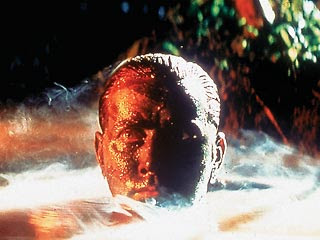
It’s the classic struggle of the good versus evil within each of us, after all, and a great many fascinating stories have been written around this internal conflict, the most engaging of which (for me) tending to be when the protagonists and antagonists of the plot at times blur into each other.  (As you can see in the photos above, Francis Ford Coppola’s Apocalypse Now is one of many films utilizing the imagery of duality—here, both Martin Sheen and Marlon Brando’s faces are half in light and half in shadow—as who is the “hero” and who is the “villain” is called into question.) As it stands, Don is a flawed protagonist just as much as Norman is a well-intentioned antagonist.

So, in the end, what I think makes me want to pat someone like Don on the back and console him with a glass of Scotch along with a Lucky Strike cigarette is the fact that, while I cannot directly empathize with his choices/actions, I can sympathize (to small degree) with where he’s coming from.  Just something to ponder as we craft our own “Good Guys” and “Bad Guys” in our stories, those complex characters that we willingly invite  to ride the carousel of our minds…


On Imagination

[I see that YouTube has removed this video for whatever reason, so please refer to this post’s comment sections for a transcript of Will Smith’s monologue in the film Six Degrees of Separation.]

It only took me about 15 years to finally view the film Six Degrees of Separation for the first time last night.  What an evening of captivation that made for…you could say it quite captured my imagination.  As far as what “imagination” itself is, the film (an adaptation of John Guare’s stage play of same name) is frank in its perspectives on the concept in the above scene, which gives me pause to reflect on how this can apply to one’s writing.

“The imagination has been so debased that the imagination…being imaginative, rather than being the linchpin of our existence, now stands as a synonym for something outside ourselves.”

To many, “fiction” and “creative writing” may connote creating new, original worlds comprised of new, original creatures that lift us out of our reality.  Admittedly, I often characterize my choice of reading fiction over nonfiction as my “escape” from my everyday.  Yet, to be fair, my disbelief can only be suspended so far—at some point, I need to be able to see something recognizable within the text if I am to relate to it and learn from it and thereby stay engaged with it.

I remember making a pop-up book for a grad school assignment (yes, grad as in graduate school, not grade school!) that asked us to create a visual representation of our “reading life.”  I fashioned my book such that, with every turn of the page, a different symbol would pop up (that’s no easy feat to engineer, by the way…it took ages) that depicted one particular function reading serves in my life.  Among other things, I had an airplane to represent that idea of escape, a telescope for seeing beyond my immediate frame of reference, and a staff of music notes for the musicality or harmony books can provide through their themes or lyrical style.  And yet…

“Why has imagination become a synonym for style?  I believe the imagination is the passport that we create to help take us into the real world.  I believe the imagination is merely another phrase for what is most uniquely us.”

One symbol I also distinctly recall inserting into the pages of my pop-up book was a mirror.  As I explained to my peers during my presentation, reading is a way of holding a mirror in front of myself because it may either convey or conflict with my perspectives, and in that confrontation, there is reflection, be it validating my beliefs or modifying them through the acquisition of new knowledge or ways of thinking.  It tells me something about myself, and I in turn form my interpretations of plot, character, etc. in terms of what I know from my own life experience and attitudes.  And while I’m certainly infusing certain personal meaning into what I write, I do hope that it strikes a chord with other readers’ lives such that they derive their own meaning.

I’ve felt the sting of insecurity before over incorporating aspects that are true to my life in my stories, as though that meant I was being unoriginal—after all, if I am truly creative, shouldn’t it all stem purely out of my imagination?  Consolingly, I have since reached understanding that it’s actually the moment we stop seeing ourselves in our writing that we’ve stopped being imaginative.

This brings to mind something I just read today by Josh Hanagarne (a newly published author) on his World’s Strongest Librarian blog.  With regard to his new novel, The Knot, Josh says:

“I am this book.  This book means everything to me.  It is pure me, […] easily the most personal thing I am able to share with you.”

I think when it’s all said and done, whether we get published or not, we should all be able to feel this way about what we’ve written.  So, in closing, I offer you this line from the film:

“To face ourselves – that’s the hard thing.  The imagination…that’s God’s gift to make the act of self-examination bearable.”

As writers, to what extent are our stories a means of self-examination?  Where do you see yourself in your characters, your truths in their “fictitious” circumstances and dialogue?  Do you find that the writing process is therapeutic in making your analysis of self “bearable”?  Might it do the same for your readers?


Digging a Rut into a Wishing Well

Meh.  I’m starting to sink into the funk I babbled about previously in “My Inner Critical Beeyotch.”  The dealio is that I’ve approached the point in my project where I really need to start bringing everything to climax and a concise resolution; the mental obstacle that I’m encountering now is not a writing block, but, rather, a plotting block.  In fact, my problem is the opposite of writer’s block, as ideas and words are flowing really naturally now, but I think what’s working against me is that, as far as the books I like to read, I gravitate to the lengthier novels that I lose myself in for a nice chunk of time, the ones with gradual character and plot development, that steep you into some of the minutiae to help you feel more intimate with the characters, like you’re really accompanying them through a personal journey.  I’ve been consequently following a pace that feels natural and necessary to me, knowing full well the word count still wouldn’t come close to some of those beasts I have on my bookshelf.  Unfortunately, the tidbit of advice that keeps coming to my attention through various sources is that word length for first-time authors should not exceed 90,000-100,000 words.  Um, well…I’m already in that vicinity and feel like I have a ways to go.

Here’s what I’m struggling with:  I started this project as something for me, a creative outlet I’ve been wanting to plug into for years and am only first now seizing the opportunity.  At the outset, I told myself it was first and foremost for me, but if I finished it and was pleased enough, it wouldn’t hurt to try to make something more of it by submitting it to agents in pursuit of that pipe dream of getting published.  Why just let it sit there on the computer, right?  But that said, I don’t want to be overly inhibited by keeping my eye on the publishing prize. I want to create, not sell out, but I also want to be realistic.

Should I just keep writing as I have been to get the ideas out, get the conflicts resolved, knowing full well I’ll have to go back and take an ax to a massive amount of it?  I suppose it’s better to have the clay to mold with, as Bonni Goldberg discusses on page 9 of Room to Write (see “More Messiness From the Membrane“), as I can always take away.  I need to remember my workshop guidance:  “Kill your darlings, kill your darlings, kill your darlings…”

All right, then.  Chill, Monkey, and focus on the next writing prompt.

The Prompt:

Page 21 of Room to Write asks us to record our wishes.  As Goldberg says:

“Wishes are voices of the imagination, taking you out of the realm of reality on a daily basis.  For this reason, in creative writing, it is worth paying attention to them.”

We can write our secret wishes, our past or long-time favorites, or the one that is nudging us this very minute.  I will follow this last one, for obvious reasons.

Response:

Today I wish for clarity of mind…that I can sift and sort and structure my swarming ideas into a manageable plot to continue writing…that I will hold fast to my original goals surrounding theme and mood…and that my instinct will guide me through my pacing and revision.  I wish that the end product will be something I am utterly proud of and content to share with those closest to me, with the added bonus of being something marketable, so that I may also share my story with the world. I wish for the patience, inspiration, and discipline to see me through toward this end in the meantime.

Reflection:

Ah, it’s nice to let that out.  No shame in wishing.  What do YOU wish for?


The Beginning of the End

To conclude my brief series of posts relating back to valuable lessons reinforced by last weekend’s Room to Write writing conference, how fitting will it be to end with endings.

I shall be brief.

Basically, a couple things were emphasized:

First, not all loose ends need to be tied up in a pretty, perfect bow; for the central conflict, yes, but other conclusions might be better left to the reader’s imagination—think Rhett Butler walking out on Scarlett O’Hara.  Do they  eventually get back together?  Your romantic optimism/pessimism will determine that, but Margaret Mitchell didn’t need to in order to effectively give her epic saga adequate closure.

Second, the ending of a story/novel should connect back to everything significant about the beginning.  The successful novels that we reviewed all shared in this aspect—they related back to character, setting, and conflict in creative ways, providing a sense of balance and resolution to our story’s main conflict.

In this way, the beginning and end stand together as “book ends” with all that good stuff in between, and as our climax tops out and falls toward denouement, we should keep that falling action brief—end it with a “flick,” as author Wendy Robertson put it succinctly with a visual flick of her wrist.  And as author Avril Joy stressed to me during some one-to-one consultation time, if I’m rising toward the climax of my novel (which I presently am), I should resolve it in a matter of a few pages or a chapter and not drag the ending out further than that.

I’m going to execute that advice in not dragging the ending to this post out…on that note, cheers, and keep writing!


Walking the Talk

My previous post addressed beginnings of stories/novels, yet before I get to endings, it is worthwhile to comment on the dialogue that might not only span all the in-between but, in fact, could very well be our means of beginning and ending if utilized effectively.  Yet again, I am drawing from the specific advice proffered at the writing conference I attended last weekend (sponsored by the organization Room to Write), lessons we may have learned time and again through various sources, but that I found particularly insightful when distilled during this focused workshop.

To begin with, dialogue is essential to a successful novel because it:

– teaches us about characters and what they might be feeling the second they open their mouths through tone, accent, dialect, and word choice.

– conveys information

– moves the story forward and quickens its pace

– gives immediacy/brings readers in by appealing to senses of sight and sound

– creates white space, which gives us a chance to visually “breathe”

To maintain this significant impact of dialogue, we must therefore keep the following in mind:

– When using dialogue to convey information that we do not through narration, keep the information provided brief.  Otherwise, it may come across as more than would be natural in a conversation.

– Voices engaged in dialogue need to be distinguished from one another—

* Test this distinction by reading dialogue out loud.

* Consider overdoing sense of voice (e.g., through dialect or word choice), as you can always go back and take it away.  Spelling phonetically or using curse words to add color to a character’s voice can be effective in distinguishing him/her, yet it can also be distracting from what they’re actually saying.

* With this previous point in mind, be aware that while dialogue more closely resembles natural speech, even in the best of books it is not exactly the same as we would really talk…and that’s okay.  Again, it may be due to avoiding distractions in exact pronunciation or errors in grammatical syntax (we don’t obey convention 100% when we talk vs. write).  Yet I also feel it may relate to the artistry of language that we might infuse through our characters’ speech—think of the TV series Mad Men…those characters certainly do not speak like ordinary people, but there is something clean and lyrical in everything they say that is a joy to listen to and truly raises the program to a higher plane of thought and reflection.

* Not every line of dialogue needs to be tagged.  This is more easily done, though, when only 2 characters are involved and it’s easier for the reader to track who is speaking the alternating lines.

* Regarding tags, you are better off using plain and simple “said.”  Also, avoid adverbs—whatever description you could provide of how a character says something should already come across through the dialogue itself.

– Incorporate the “business” that goes with the dialogue. (In the excerpt we read from Ian Rankin’s Let it Bleed, for example, one character prepared a cup of coffee for the other as they conversed.)  In doing so, you will:

* help the reader “see” the scene by bringing in movement and showing versus telling through the characters’ actions

* reinforce the reality of the situation, make it more authentic to real life

So, talking of talking, I’ll stop my yammering on this topic.  It is a critical one, though, to writing an effective, engaging, and believable piece, so bear these pointers in mind while also just having fun with bringing your characters to life when you grant them the gift of individual voice.


In the Beginning, There Was the Blank Page…

…or, these days, the blank computer screen.  Every true writer’s mind has a story just dying to get out of it, yet this doesn’t necessarily make getting started any easier.  Following up directly on my previous post regarding the writing conference I attended last weekend (sponsored by the organization Room to Write), one of the topics we addressed was beginnings, which cannot be more critical to a story, particularly if you want to get it published.

First of all, as far as how you begin to write each day, the key is:  1) ensuring that you do write every day, even if just a few sentences; and, 2) the authors leading the conference particularly advised us to write first thing in the morning.  That is when our heads can be freshest and leave us feeling for the rest of the day that we’ve already accomplished something massive (so you don’t have to feel guilty taking that nap 🙂 ).  While I wish I could discipline myself to haul my keester out of bed earlier than the minimum allowable time for getting ready for work, I have to admit I have my most significant rush of ideas in the morning as I shower, as though I’m massaging them out of me noggin as I shampoo my hair.  I always hate that I have to leave for work soon after then, just when I’m in the groove and risk losing the momentum by the time I return home drained from the daily toil.

As far as the actual beginning of our story or novel, we must note that the first chapter (indeed, first page) is the “imprint of the entire book.” The sense of place and voice established in that first page predicts the rest of the book.  My tutors also stressed the impact of including a sense of smell right from the getgo, as it creates a lingering impression unlike the other senses (and is unfortunately one of the most underutilized, as I’ve mentioned before in my “Smell No Evil” post).

With regard to place, we were advised to give places names, even if it’s a fake name to anonymize an actual place.  In this way, a place, if prevalent enough to the story, can become a character in itself.  Closely related in terms of setting, the time period in which our story takes place should be implied well enough to give a clear sense, yet we don’t have to preach to the reader when exactly it is.

With regard to the sample of best-selling novels we read in preparation for the course, we evaluated the following common denominators that we noted across each of their beginnings:

– Drama or sense of impending danger

– Character (be it the main character’s name or an archetype to be represented throughout)

– Setting (again, the sense of time and place)

– Conflict (at least a sense of the issue at the crux of the story)

– “Filmic”—i.e., achieves ready visualization and engagement through drama and descriptive language

Finally, we may have a strong temptation to overly explain some aspect of the story right out the gate, be it the character, setting, conflict, etc.  To avoid this, we need to give our reader credit and exercise restraint—we can always introduce this information in a creative way later on.

I do believe I am at the end of discussing beginnings, so meet me here next time for a few words on dialogue.


POVs of the Published

Since I’m relatively out of commission this week as I’m visiting Stateside and busy mixin’-n-minglin’ with all my loved ones (not to mention that my dear hosts, my parents, have an excruciatingly slow dial-up connection to contend with), the rest of my posts in the upcoming days are admittedly pre-scheduled snippets of what I learned from my Room to Write writing conference last weekend.   To follow up on my previous post, I’d like to expound a little more on a few of the quotations uttered during that workshop that I identified of value in their simple truths:

“80% of the meaning of a novel comes from the reader and 20% from the writer.”

Anyone who writes knows that even fiction is autobiographical in some way.  Writers are the originators of their stories and draw from their life experiences and personal frames of reference to structure and weave these tales, yet it is inevitable that different readers will pull different meaning away from even the same text.

This is something I stressed to my high school students constantly when we approached a new story or novel—my favorite task to assign to them would be maintaining margin notes (provided they, and not the library, were the owners of their books!).  These would be basic symbols that they could quickly transcribe with pencil in hand as they read so that they would not have to interrupt their reading too much—e.g., a “!” for something that surprised them, a “?” for something that confused them or prompted a topic for discussion, or a “*” for a line that resonated with them in some way, be it its content, beauty in phrasing, or some other aspect rendering it significant to them.  In doing this, the outcome is often the same—while there may be some passages that elicit a common reaction from all of them (as the author surely intended), there were always those that garnered different attention, whether spurring both like and dislike or perhaps overlooked entirely by some while having heartfelt impact on others.

That is where the reader’s life experience and personal frame of reference forms unique interpretations, as when a spectator in an art gallery looks upon an abstract painting or scultpure and sees in it the infinite wisdom of millenia of human history whereas the person next to him/her snorts at it with irreverence and comments that a child could have achieved the same result.  Beauty is in the eye of the beholder, as they say, and so is meaning.  We need to give our readers credit that they can fill any gaps we leave and not bind and chain them to a narrow view through our lens alone.

“Writers taste life twice–once when they live it, once when they write it.”

I just thought this was such a lovely sentiment as it conveys the sweet gift of life writers truly can enjoy…it’s almost like a form of immortality, getting to multiply one’s life experience in this way.  Of course, when writing fiction, we are not necessarily chronicling the factual details of our lives, but we certainly draw from the essence of what we live through to fuel our stories with authenticity and heart—and, yes, the wee tidbits that really do happen to us that we can incorporate are not only special ways of documenting those moments for posterity, but likewise add a genuine touch of reality to what could otherwise entail too much suspension of belief…not to mention that sometimes crazy things happen to us that one simply could not make up!

On revision:  “Kill your darlings–if you love it, delete it.”

I found this advice so interesting in its irony.  One would think that you should leave something in because you love it, but what I infer from this statement is a warning against being blinded by favoritism to what may not be suitable for a particular story.  I have heard this uttered by other published authors as well as they related times when they wrote a scene that they thought was so powerful and well-written, yet had to concede it did not further/enhance their plot in necessary ways.

It isn’t about destroying a scene or passage entirely, but, rather, removing it from one particular text with the hope that it will possibly offer better relevance to another work that you write.  I catch myself all too often wanting to put something in a story for the sake of squeezing it in somewhere because I think it’s such a marvelous observation or insight—and that may be true, but if it comes across as forced, it is really belittling the rest of what I’ve written and probably not optimizing its own efficacy.  So there you have it…we be warned.

On research:  “Write, don’t research.”

This quotation was of particular relief to me.  While one of my favorite genres to read is historical fiction, for example, I am not ambitious enough at this stage to undertake writing it myself because the research involved seems so intensive.  As a lifelong learner, I think it’s a fun and enriching aspect of writing, however, and certainly do carry out a degree of research for my own projects.  Yet in doing so, I’ve been paranoid that a lot of it does tend to be online, as if I’m taking the lazy route.  It’s terribly convenient to be able spelunk the web to verify a fact on the very same screen as the work in progress, though I’ve often second-guessed whether this is the professional way to approach it.

Well, I learned from my lovely mentors that the internet should indeed be valued as a legitimate resource provided you are using discretion in which websites you consult—Wikipedia, for example, is the notorious taboo online reference to avoid (and, naturally, it’s always the first cyber stop my students would make, much to my chagrin).  Qualify your sources for their credibility:  verify the author/institution that sponsors it, and cross-reference its claim against other sources.  Sites like Wikipedia allow any average schmo to post information without checks in place for validity, so it should be a no-go zone for your research of any purpose.

I do consult print books the old-fashioned way to verify bits and pieces of historical information, which reassures me that I’m not approaching this totally amateurly…and yet, what’s at the heart of the above quotation is that we should first and foremost write our story rather than pressure ourselves with the research from the getgo.  This isn’t to say we can blatantly disregard fact and rewrite our own histories, but simply that if we get too caught up in researching the details, we might inhibit our writing and the depth of feeling that could infuse it through our imaginations.  We were told that if we close our eyes and imagine the experience of what we want to research, we might surprise ourselves with how our accurate our imaginations are.

One example given to a fellow aspiring author related to a scene on a sailboat tha she is writing.  She was advised to just conjure in her mind what it would feel like to be on that boat, how the motion and the air and the spit of water might feel.  Just in doing this, she can create a more authentic experience than merely cataloguing the parts of the boat and sailing terms.  Certainly, checking her facts as far as what technical aspects she may reference is important, but this is not something she’d need to prioritize initially.  Rather, she should write the scene, then research and correct for the details as necessary retroactively.

So that’s my two cents on the UK authors’ two pence offered at the writing workshop.  Hopefully it offers useful nuggets of guidance for your own writing.  Coming up in my next three blog posts will be further advice provided on beginnings, endings, and dialogue.  Cheers!


Fresh Air, Fresh Faces, Fresh Ideas

Ahhh…as I expel the diesel-perfumed air that I inhaled all day today in London, my mental lungs proceed to gulp in the intoxicating purity of the breezes breathed in this past weekend in the Northeast England countryside.  I mentioned in my previous post that I was venturing out of the city for a writing-focused retreat sponsored by the organization Room to Write.  I truly don’t think that I can duly convey what the experience came to mean to me and will not attempt to do so–rather, I will hold that close to my heart and simply say that I had the privilege of being brought into the fold of some of the loveliest, most accomplished, talented, yet modest and genuinely good-natured  folks with whom I could have ever interacted.  Sipping tea with them in the conservatory of a Victorian country estate amidst an endless supply of sandwiches, scones, and fruit on a day colored by blue skies, green gardens, and brown deer was sheer heaven…it’s so me (in my dreams), and I could have pinched myself.  Hopefully my Midwest American accent was not as piercing on their ears as the sun was in our eyes 🙂

As I tuck that sweet and shimmering memory in my breast pocket, I shall tend to some matters of business.  I promised that I’d share some valuable advice learned over the weekend, and I’m a lady of my word.  As I’m heading Stateside in the morning for a week—and consequently going to subject myself to 7 days of my parents’ torturously slow dial-up internet connection that I truly think would run faster if a hamster generated it by running in its wheel—I’ll break it up into smaller bits written in advance, but to be scheduled to post across subsequent days.  Fair enough?

All right then, I’d like to start simply with some gems of quotations that I picked up.  I will repeat them as direct quotations here, though most are probably just my close paraphrases of the actual content, and I apologize in advance to the plagiarism gods for not specifically citing their speaker of origin (as the facilitators may have been quoting from elsewhere in at least a couple cases) .  Whatever…you’ll get the point, capiche?

“80% of the meaning of a novel comes from the reader and 20% from the writer.”

“Writers taste life twice–once when they live it, once when they write it.”

On revision:  “Kill your darlings–if you love it, delete it.”

On research:  “Write, don’t research.”

I will follow up in a later post with a bit of elaboration on these…I have an early flight and had better catch some sleep.  In the meantime, keep writing!


My Inner Critical Beeyotch

Today is one of those days when I feel discouraged to write, even if simply in response to a basic prompt as practice. What I should be doing is working on my project or at least expanding on my previous blog post with the level of characterization detail I had omitted the first time around. But I don’t seem to be, do I? It’s not standard writer’s block, though…my ideas for my project are there and swarming around and ready to be written…yet there’s this paralysis in me noggin induced by insecurity in the face of all that’s been written by all the writers out there.

Why does this happen?  I throw the question out there because I know I am not alone in this.  How do I know?

Well, before I answer that question, I think what first triggered all this today was reading Waiter Rant on the bus home from work.  This should be a non-threat book in that it’s a nonfiction account of a guy’s experience waiting tables, something I should be able to read without comparing it to my own writing style and content (which has become a nasty occurrence whenever I read novels).  The author is a good writer, though; he’s not just ranting and chronicling like it’s Dear Diary and he just wants to catalog humorous facts—he actually has a flair for descriptive and figurative language that illuminates the people and incidents involved to a very engaging degree, and he structures it effectively.  And then suddenly it does become relevant content when he’s recalling a conversation with a fellow waiter who comments on his talent for writing, as evidenced by his blog of same name, the very one that eventually became the book due to its massive popularity.

Which reminds me of the close-to-zero viewership of my own blog, which then makes me question why anyone would ever want to read it .  Nor my stories or ongoing book project.  But it’s all fairly new and more for me anyway, so since when do I even care, right?  Right.

With that assurance, I then come home tonight and happen to stumble on other blogs that truly reduce me to clearance at 8 cents per dozen.  The cyber-smorgasbord of blogs to be had addressing the same content as both my professional and personal blogs is intimidating—all the creative talent scattered far and wide sowing their seeds so quickly and with such frequency and making it seem effortless.  I automatically feel inferior again…

Seriously, it’s one of those days that feels like everything keeps coming back to reflection on the art of writing, but not in the empowering way.

And that was just today’s insecurity blast.  At other times it comes on that occasion when my otherwise delightful immersing of self in a bookshop–a moment that is one of hand-clapping and salivating wonderment over all the literary possibilities my fingertips might fondle on those bookshelves–becomes instead like a swift slap in the face by every hardcover and paperback to be had there, taunting me from their holier-than-thou pedestals as if to say, “We made it up here.  You’re still down there, and your writing is still just in your My Documents folder on a Mac.”  (Yes, the books are quite bitchy when I’m in this frame of mind)  Or I read the book jacket of a best-selling author’s latest novel and freak out that it follows a similar theme in a similar environment to the tale that I’m presently weaving, making me feel stupidly unoriginal and, even worse, like I’m crafting a version that could only be sub-par to this writer who has already had her first book adapted to a major motion picture.

It’s like looking at everyone else’s success as it accentuates my singular failure, and there is nothing more detrimental to the process of writing than letting that creep in and seize hold of your grey matter and squish it between its fingers.

So to get back to my earlier question of how I know I’m not alone in this—and, more importantly, that it’s okay—just as I’m revisiting Twitter tonight and esteem-crushingly marveling at everyone else’s links to genius, I came across this little pearl tweeted by Electric Literature, a blog post by Maud Newton.  Posting this just yesterday, what she addresses is exactly what I’m talking about above—the crippling insecurity one feels as compared to their favorite writers.  Oh gaawwd, I don’t even dare tread that path…it’s bad enough that I’ve come to measure myself against amateur bloggers…so needless to say, it’s very encouraging to see how this is a pervasive issue for writers, among both the published and the aspiring.

So I read this and I still manage to feel paralyzed, first looking at my writing project to see–if I’m not inclined to create new stuff–if I can at least read through what I did write over the weekend and revise it.  Not feelin’ it.  So then I click out of Word and onto this blog to either embellish on the character sketch of a real person that I initiated a few days ago or sketch myself as a character, as the next page of Room to Write directs.  Yet, again…nothin’.  With reluctance I then turn to the following page to just get the 3-Strikes-I’m-Out over with so I can shut down the computer and sulk behind a book to just leave it to the professionals and what they’ve already written when…aha.

Yes, I say to you that, lo and behold, page 13 is an A-Haaaa!! sort of serendipitous moment for me.

I am an avid observer of coincidence who becomes increasingly convinced by the day that there is, in fact, no such thing…so imagine my inner gasp when I see that page 13 of Room to Write involves confronting our CRITICAL INNER VOICE.  As Bonni Goldberg says here, “A critical inner voice taunts you as you create. […] The best that most of us can do is acknowledge it and keep writing anyway.”  Folks, I will delve into this today as an exercise/exorcism:  exercising my creative confidence as I exorcise the demon of doubt from my psyche.

The Prompt:

Page 13 of Room to Write, then, asks us to convert our inner critic into a character.  Consider its gender, appearance, smell, and favorite writers (if it doesn’t think that we‘re good, who is?).

Response:

My inner voice is female.  At the risk of stereotyping (for the record, I’m a female, so reserve the right to generalize my kind based in my own observances of self), I say this because she has bitchy tendencies to coincide with her vulnerable questioning of me.  She needs me to be secure, support her, and in this need comes a desperation and doubt that I can.  So, instead of inspiring me, she tears me down, tries to hurt me to make her seem stronger, smarter.  Classic insecure female, in my opinion.  Next, she’ll be asking me if I think her ass looks fat in those jeans.  Well, it does.  She is pale and sweaty and pimply with puss oozing out and her posture is horrendously arched.  She quivers like a nervous over-bred lap dog and would jump at her own shadow if she ever did dare step into the light.  She yanks on my sleeves to pull my hands away from the keyboard and dangles carrot-shaped published works within my vision but outside of my reach to reinforce that which I cannot have.  She is bug-eyed in Coke-bottle thick glasses, deteriorating my sight with her own myopia.  Her mousy brown, thinning, yet wiry tresses with the texture of pubic hair strike like foot-long lightening away from her head, and I can smell the swampy sourness of her body odor when overactive glands from overactive pessimism spit out their secretions to moisten her dirtied linen blouse.  Her preoccupation with bullying me absorbs her time away from tending to herself, though when she does indulge herself with her books (storing up on intellectual ammo to pierce and puncture me with later), among them are Fitzgerald, Dickens, Austen, Hemingway, Rowling, Niffenegger, Maguire.

Reflection:

Ick.  Nasty little broad, isn’t she?  Well, that felt good.  This feels better.  I just described someone I loathe and would never aspire to be, so why should I be so concerned about what this chick would think of me?  She clearly has more problems of her own.  So step off, ya floozy, and leave me be with my writing.

With that activity and brief reflection complete, I’d like to close this post with 2 points of inspiration that Maud Newton’s blog directed me to.  First, in the post itself, she gives a precious word of advice—basically, keep a crappy novel that you’ve read nearby, always, so just when you’re feeling down, you can skim through it and remember how crappy that book is that still managed to get published.  Second, her post provides a link to an LA Times article, which in turn quotes Ted Solotaroff from his essay, “Writing in the Cold:  The First Ten Years”:

“Writing itself, if not misunderstood and abused, becomes a way of empowering the writing self. It converts anger and disappointment into deliberate and durable aggression, the writer’s main source of energy. It converts sorrow and self-pity into empathy, the writer’s main means of relating to otherness. Similarly, his wounded innocence turns into irony, his silliness into wit, his guilt into judgment, his oddness into originality, his perverseness into his stinger.”

Put that in your pipe and smoke it, Inner Critical Voice.

*


The Impact of Words

The Prompt:

Page 4 of Room to Write asks us to describe the first incident in which we were affected profoundly by words.  In describing this, we should address what led up to the encounter, our physical reaction to it, and anything else that was happening simultaneously.  We’re free to fill in the gaps with fiction, if we please, and perhaps construct it as a poem.  I’m going for prose, but you do what you will.

Response/Reflection:
I can’t swear that it was the first time words ever profoundly affected me, just that it’s the earliest memory that my pea-brain can pinpoint right now.  It’s arguable, after all, that I was first profoundly affected when I first learned how to read, but I don’t recall there ever being a “Eureka!” swell of emotion then; it’s more so the appreciation that I can attach to it now in retrospect.  I think of the metallic-spined Golden Books that kicked off my reading career, and my red paperback of The Story of Ferdinand that certainly made its place in my heart–but, again, a meaning established in my adult years when I so needed to hear truths put simply in my ever-increasingly complicated world.  And I wish I could remember the first orally articulated words that may have moved me, but I think it would have to be when I myself took on the challenge of words, the composition of them in forms of my own choosing if not creation, that stands out as most pivotal to the writing life I’ve embarked on since.

I think it was fourth grade when I submitted my first “book” into the running for my elementary school’s Young Authors Contest.  It was an anthology, actually, a collection of poetry that I carefully entitled, Poems of Modern Style.  I suppose I classified them as “modern” based on the youthful and pop cultural content they covered (the ’80s punk aesthetic being a component) as well as the fact that I did, with the exception of a few haikus, create my own poetic structures to follow.  It’s difficult to recall what exactly led up to these choices; I can only assume I chose the poetic medium because I couldn’t think of a plot around which to develop a decent story of any length (not to mention I’d probably noted the failure of my previous year’s prose piece, something about a lost bunny or puppy trying to find its way home.  The dialogue was painfully monotonous; I clearly knew nothing of dialogue tags at age 7).  So I suppose I had a range of miscellaneous ideas floating through my head that did not necessarily follow a cohesive theme, yet could adequately be dumped under that catch-all descriptor of “modern.”

The poetic form gave me the freedom to explore all these ideas in flowing form or fragmented sketches.  Yes, I was 8 years old and an avid Shel Silverstein reader that was of the school of thought that all poems had to rhyme, so constrained myself in this respect, but it was rules like rhyming or the number of syllables measured in those haikus that really did prompt me to stretch and squish and swap words to comply with those forms without sacrificing meaning.  That would be, then, when I caught the first glimmer of understanding how word-rich the English language is, that there are so many degrees of meaning even among synonyms that we are at liberty to play around with all sorts of words in trying to find the specific ones that truly convey what we’re seeking to say, whether in isolation or combination.  Poetry forced me to think more deliberately, weigh each word’s worth more when there were so few alloted to a line and so few lines beyond that.  Sure, I certainly remember cranking a couple of those out, feeling satisfied enough on the first try and ready to move on, but there were others that taught me the value of revision and being a discerning reader of my own writing.  I further recall that I had drawn illustrations to accompany each poem, demonstrating that interplay between word and image and how they create meaning in synergy…or maybe it was also because I loved to draw and thought it made the pages pretty.  (It did.)  I painstakingly copied the final versions down onto construction paper of alternating rainbow colors and bound it all together to submit for the judging.

This process acquainted me with the eye-strain and sore hand muscles that accompany writing, but also with how these symptoms of pain were salved by the flutter in my stomach that signaled both the thrill of creative achievement and the anxiety over what others may think once I placed my baby in their arms.  And even the agony of anxiety was utterly diminished when they announced the results:  I was a finalist.  I didn’t end up winning, but I had made the top four, and that was the first external recognition I’d received of my words that wasn’t just a grade on an essay.  Perhaps I shouldn’t have relied on outside reinforcement, but it was the validating boost this shy girl needed to affirm that what I’d worked so hard on and genuinely enjoyed all by myself was something of merit that others could enjoy too.  In the short-term, it inspired me to tackle an illustrated “novella” as a sixth-grader two years later for that same contest (I won, even got to go “on tour” reading select chapters in different classrooms) and cemented a love affair with words that will stay with me for a lifetime.