
Category Archives: Writing Elements

The Manuscript Manicure – Part I: Macro-Editing

Hiya! I’m back to redeem that I.O.U. I gave you last week. See, my word’s good as gold ;)…

As I mentioned, I attended a writing workshop with Room to Write over the weekend that was geared toward prepping a novel manuscript for submission. The full-day conference was divided into two primary parts—Editing and Publication—the first of which I’ll address in part now and break the rest down into separate posts. But, first, I’ll start with some general notes I jotted along the way to get us in the proper mindset:

One thing they stressed is that, above all:

“Editing is a creative process.”

Yes, it involves the nitty-gritty technical stuff, but we’re not merely playing the role of English teacher grading for grammar with red pen in hand—revising our work requires every bit of imagination and innovative thought as writing our initial draft does. For as they said, when the first draft is finished:

“You’re only just beginning.”

Ah yes, it does feel that way doesn’t it…my question is, when the hell does it end???

Anyway, in order to become our own editor, we have to become a “self-conscious” one. No, not as in insecurity-ridden—I think I’ve already mastered that one just fine :). What they mean is to be conscious of the kind of writer we are and the audience we’re writing for. The better aware we are of this, the better  we’ll be able to edit our work with this focus in mind.

Macro-editing is concerned with the overall  novel as a cohesive work. It’s our opportunity to step back from our first draft and contemplate whether it has achieved what we wanted it to and is structured effectively. They encouraged us to print a hardcopy of the manuscript to initiate this stage, as reading your words on the page is truly a different experience from reading them on screen. (I wouldn’t have expected this, but wow. There’s so much more that I catch with that ms in hand.) You will also want to list your themes, summarize your entire book in three sentences, and keep these with you as you journey back through your text to ensure you aren’t straying from any critical elements.

Key aspects your self-conscious-editing self should look for (not only in the novel as a whole, but in every chapter and scene as well) are:

– A compelling beginning, a hook that makes the reader want to continue. The first chapter in particular should be compelling in an action sense, but also in a literary way—it needs to be beautifully written. Subsequent chapters likewise need their own hooks and should be varied in how they start (i.e., beginning with dialogue, beginning in the middle of action, etc.)

– Action, drama, or “trouble,” as they called it.

– Appropriate pacing.

Three-dimensional characters that are brought to life and desire something;

— Characters are “thinly veiled versions of the writer” (sound familiar?), but we must immediately establish distinction between them and from ourselves if they are to appear as separate people; if they’re all clones of us, then they’re clones of each other.
— If you can “see” the character in your mind (consider gathering clippings from magazines and such for reference), then they will come across on the page.
– Provide physical descriptions of your three main characters, enough to help visualize their traits, but not full-bodied detail. Leave something to your readers’ imagination.
— Characters should be consistent from start to finish (i.e., if you reveal or yourself learn something new about them later in the novel, are these traits present at the beginning as well? If not, try to introduce them at least subtly).
— We should see growth in the main character.

– Clear sense of when and where each scene partakes.

– Long sections of description/exposition that could be cut.

Changing up the writing between exposition, narrative, and dialogue.

– A sense of atmosphere and appeal to the senses that lends texture.

– Something in each chapter that surprises the reader.

Continuity between scenes and chapters; ensure nothing is missing.

– Evaluate the “shape” of your novel/chapter in terms of story arc. Shapes can vary, but there should in general be a rising sense of action/conflict until the climax, then a dip toward resolution (so check for any sagging in the middle).

– Evaluate the ending and ensure a sense of resolution. They advised us to look at six novels we personally enjoy and look at their endings as a guide for managing this successfully. They also admitted that, in the interest of keeping your ending brief (the resolution should just be a “flick” after the climax) as well as ensuring your reader understands what has happened, the resolution may indeed warrant more telling than showing.

Throughout your macro-editing assessment, then, you will want to sit back and assess whether this is the story you wanted to write in the first place. I suppose it doesn’t hurt if ends up morphing into something even cooler than you thought it could be, but if it seems to fall short in some way, pinpoint where it diverges and contemplate how to get it back on track. Another very important point to consider outside of yourself is if it is the story your reader will want to read—how will they experience it?

I’d better cut this off here until my next installment. Many thanks to author Avril Joy for guiding us through this session of the workshop! More to come…
PART II Micro-editing

PART III – Submitting a Manuscript

PART IV – On Publishers & Publicizing


From Sentiments to Sentences – Part II


Hiya!  I’m back from where I left off yesterday. Hopefully I didn’t leave anyone in a great deal of suspense, as this post will only reek of anticlimax :).

What I was about to continue yammering on about last night, at any rate, was that sentimentality is not the only way my past informs my writing.  To start, yes, I’ve had a lovely life—I’d be an ungrateful twit not to acknowledge that and count my blessings every day (I know, la-dee-frickin’-da, right?)—yet to be honest it concerned me this would hurt my writing, make it too naive, idealized, and anything otherwise be too two-dimensional and cliché.  And that’s a very valid concern…

I couldn’t help but peek ahead in my very-neglected Room to Write book, where on page 90 Bonni Goldberg says:

“Where we come from influences both what we write and how we write. […] This is why six people can describe the same tree differently. Each person sees it through a unique set of experiences.”

And then she warns that:

“Cliché seeps into writing when writers forget or neglect to bring who they are into the piece.”

This reinforces what eventually got me over the above concern.  Everyone’s life brings something to the writing desk, and maybe some of things I don’t understand first-hand consequently don’t have a place in my writing. Maybe this, then, helps me narrow down my focus, find my creative niche where what I do know can be optimized.  OR maybe what I don’t know presents that extra intellectual-emotional challenge that could be enriching to explore further through research and imagination, as when a method actor immerses into a new role.  In that way, I don’t have to be so pigeon-holed after all.

Then there is the simple fact that, despite general trend, my life of course hasn’t been entirely rosy! I know pain, heartache, depression, and have sharpened my teeth around anger and resentment pretty well in my day…I may idealize the past out of sentimentality, but I’ve also brought in the darker emotions from the tougher experiences I’ve had—case in point being the “writing-as-therapy” I mentioned yesterday. As a result, my protagonist shared in my own downturn, and in a way we worked through it together.  Then, when I succeeded in pulling out of mine, I could outstretch my hand to lift her out of hers.

I’m not going to do the writing prompt today, but the exercise on that above-mentioned page from Room to Write asks us to write about our origins, beginning with, “I come from.” In doing so, we’re to also consider the sensory details coinciding with our memories that, by virtue of experiencing them, have impacted who we are.

Now, to put my teacher-cap back on briefly, I can’t help but recall from this a poem I had to teach my sophomores during a unit on discovering our cultural identities and identifying how they shape our individual frames of reference:

Where I’m From, by George Ella Lyon

I am from clothespins,
from Clorox and carbon-tetrachloride.
I am from the dirt under the back porch.
(Black, glistening,
it tasted like beets.)
I am from the forsythia bush
the Dutch elm
whose long-gone limbs I remember
as if they were my own.

I’m from fudge and eyeglasses,
from Imogene and Alafair.
I’m from the know-it-alls
and the pass-it-ons,
from Perk up! and Pipe down!
I’m from He restoreth my soul
with a cottonball lamb
and ten verses I can say myself.

I’m from Artemus and Billie’s Branch,
fried corn and strong coffee.
From the finger my grandfather lost
to the auger,
the eye my father shut to keep his sight.

Under my bed was a dress box
spilling old pictures,
a sift of lost faces
to drift beneath my dreams.
I am from those moments–
snapped before I budded —
leaf-fall from the family tree.

In “An Interview with George Ella Lyon,” the poet says:

“If I weren’t from Appalachia (or from my family and my genetic expression and my experience — I don’t know how to separate these), my writing — and I —  might be bolder.  I might live in New York or L.A. and push it more. As it is, I’ve chosen to stay close to home and to be somewhat restricted in what I’ve written and/or published.  I anguish a lot about hurting or betraying family members…On the other hand, if I weren’t from Appalachia, my work might not have the same support of noncompetitive colleagues, of a community of memory, and of strong voices from my childhood that still speak in my head.  Certainly it wouldn’t have its roots in the rocky creeks and high horizons, the enfolding spirit of trees that I call home.”

Though kids inevitably groaned over reading and writing poetry, I always loved this activity because they’d surprise themselves—by recalling and isolating the simplest of images, smells, sounds, tastes, and textures, they’d craft their own “Where I’m From” poems that offered profound insight into who they were, and I think in the end they were proud, learning that if they seized the power to really know themselves, they could harness the power to write.

Such a simple exercise here, yet so dense as we draw out the good along with all the bad to build the organs and flesh around the skeletons of our characters and infuse them with blood and soul.

And YOU, my dears? How does your sense of self inform your writing?


The Soundscape of a Novel

“The making of a good compilation tape is a very subtle art…First of all, you’re using someone else’s poetry to express how you feel.  This is a delicate thing.” —High Fidelity


*sigh*…the Mix Tape.  How I remember practicing that delicate art in high school and college…mostly, I made tapes for myself (hey, you have to love yourself before you can love someone else :)), but I can think of at least one I made for a boy…*blush*. I didn’t need to read or see High Fidelity first to innately understand the delicacy in balancing out those tracks—it’s a lot like writing, really, in that you need to start out with an attention-getter and then try to avoid redundancy in carefully pacing yourself through the highs and lows of fast and slow. The words should carry meaning, and you need to establish mood and tone.

But I didn’t necessarily adhere to all those rules this time.

You see, as I try to hold my anxiety at bay while the last 15,000 words of my manuscript rest in my trusted Reader’s hands for review and feedback, I’ve been playing around with giving my novel a soundtrack, as inspired by the Milk Fever Blog post, “The Soundtrack.” The preliminary playlist that I’ve compiled is in order of story progression, not the sacred aesthetic rules of the Mix Tape as referenced above. Basically, I thought through the themes and atmosphere of my key scenes, as well as any songs specifically referenced in the text, and have listed the songs as these elements appear.  Though humor keeps some of my scenes relatively light, needless to say my protagonist undergoes some pretty crazy stuff that just doesn’t warrant many feel-good tunes.

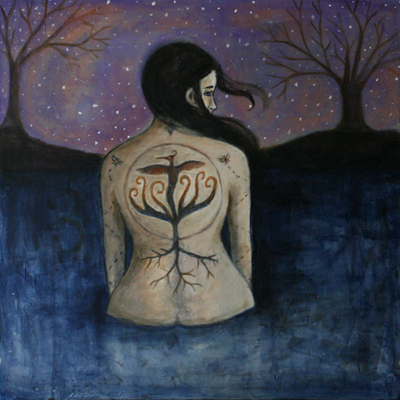
At any rate, I bring you “Monkey Manuscript: The Musical”—ta da!  You can access this first-pass playlist for my as-yet-untitled manuscript online by clicking the image (a painting I only just stumbled on today that is strikingly in keeping with my tale’s motifs, so would make ideal cover art). Titles and artists are also listed below:


"Ophelia," by Leah Piken Kolidas (www.bluetreeartgallery.com)


The “Untitled” Soundtrack:

The Ghost in You – Pscychedelic Furs

We Are All Made of Stars – Moby

Charlotte Sometimes – The Cure

Dreams Never End – New Order

The Fear – Lily Allen

Goody Two Shoes – Adam Ant

10:15 Saturday Night – The Cure

Cemetry Gates – The Smiths

Peace and Hate – The Submarines

Sexy Boy – Air

Dead Souls – Joy Division

Shiver – Coldplay

Start to Melt – Peter Bjorn and John

She’s Lost Control – Joy Division

Where is My Mind? – The Pixies

All Cats Are Grey – The Cure

Black Mirror – Arcade Fire

Cold Hands (Warm Heart) – Brendan Benson

Quick, Painless and Easy – Ivy

Last Goodbye – Jeff Buckley

Slow Life – Grizzly Bear

Edge of the Ocean – Ivy


So, uh…Did You Bring Any Protection?

*blush*  Get your minds out of the gutter.  What kind of monkey do you think I am?!

“The best lightning rod for your protection is your own spine.” – Ralph Waldo Emerson

I have long neglected my little writing prompts that originally kicked off this blog, mainly because they’re aim was to get me over writer’s block, and it worked!  I’ve been cranking until I’m crossed eyes these recent days on revising my manuscript, and for the time being am keen to step away for a bit to clear my head.  So…

The Prompt:

Today page 43 of Room to Write asks us to list the protections we use in our everyday lives or, indeed, our writing.  We are to then have our main character embody this protection in a scene or simply write a new piece without using writing-protections (e.g., a different place than the usual, without a word/page limit, etc.).

Henry VIII's armour

Response:

My everyday protections include:

– smiling

– expression through writing versus speaking

– diving behind a book or in front of a computer/tv

– my giant headphones and iPod

– sarcasm

– my forked tongue, when need be

– stubbornness, which includes a common refusal to say, “sorry”

– quiet pensiveness, reclusiveness

Hm, given that codpiece on Henry's armour, perhaps he could've used this protection as well...

– over-analysis

– verbatim recall of prior conversations (one of my more superb defenses)

– cold silence or, conversely, inane babble

– hats, cardigans, and sunglasses

– take-away caffeine (somehow just holding the steaming paper cup is a fortification, regardless what’s inside)

– sleep

– my quilt

– a hybrid superiority/inferiority complex that’s a bit difficult to describe…

I’ll stop there and address the second part of this exercise by first peeling off one key writing-protection of mine:  the ability to revise.  So I’m just going to write this off the cuff and not obsess over how it comes out, leaving it raw in its first draft form.

So, that said, I have certainly infused a lot of the above protections into my protagonist, who I’ll continue to address by the pseudonym “Margaret” (whoops, there I go, still protecting…and for whatever reason protecting the fictional :)).  I could probably find one-to-one matches for almost everything on the list, but here’s just a few examples:

“Margaret beamed one of her fake smiles in maneuvering in ninety-degree angles toward her.”

“Writing was so much easier than calling; writing gave control, the ability to pause, reread, and revise.  Margaret didn’t trust herself with speaking any longer; the restraint in talking to her parents was difficult enough, and they alone embodied the innocence necessary to not pick up on vocal cues.  Her not-so innocent friends and brother, on the other hand, were risks she couldn’t take.”

“Shaking off the mundane tasks of Everyday-Land and shoving in a thumbnail to spear a dog-eared page, Margaret tiptoed into her alternate universe at the delicious creaking sound of a hardcover binding blooming into action.”

“She’d banked an increasing number of slumbering hours ever since that first day […] and she wiled away the afternoons on indulgences like prolonged soaks in the tub and otherwise luxurious daytime lounging.  The solitary nature of her days quieted her mind to her earlier paranoia, distortions in perception that she’d ascribed to stress-induced fatigue.  [It] all dissipated before her like the steam that rose off the bubbles in her lap.”

The sun shied away behind the clouds, making Margaret’s sunglasses redundant, so she reluctantly removed them.”

“She’d lately taken to […] a route of anonymity that concealed her among side streets rather than parade her before rows of shops and sidewalk cafés.  She didn’t want to be observed, though sometimes played a mental game that she was hiding from the paparazzi lusting to lavish her with attention—somehow desiring to be a Nobody while still feeling like a Somebody.”

And that kitten definitely has claws when she needs ’em to shield her inner vulnerability.

Reflection:

As much as this character isn’t supposed to be me, it’s interesting to look back on her through this lens and realize how cognizant I am of my defense-mechanisms, as reflected in this mirror.  I reveled before in the fact that writing can be a protective filter of our thoughts by virtue of its revision stage, yet it is also something that leaves us exposed, unveiling raw emotion, intellect, and imagination.  I’m sure I’m not the only one who felt (and continues to feel) timid about posting a blog, putting those ideas out there for anyone to read and judge.  Getting something “in writing,” after all, carries that sense of no-turning-back, as though signed in our blood or chiseled in stone.  There’s both a structured permanence and organic fluidity to it that just fascinates me, but I’ll leave that to another blog topic on another day.  For now, I suppose these blogs do allow us to go back and edit, but I’ll keep my promise and not exercise that protection ;).  In fact, I’m not even going to let myself read this over before I press “Publish.”  Ha, take that!

What are your protective layers?


Schoolhouse Crock

In the wake of my previous post on “taboo” words, I came to a horrifying realization: writers are going to put Lolly’s, Inc. from Schoolhouse Rock out of business!!!

A three-generation family business…I just don’t know if I can live with the guilt!

I therefore reemphasize what I said last time about still using the supposed no-no words like adverbs—just do so within reason—and I think dialogue or 1st-person narration deserves some leeway as well if it’s authentic to how a person would really speak.  So I guess I’ll still be unpacking my adjectives, too, but with discretion.

Working through this experience has introduced me to writer rules that *gasp!* I wasn’t necessarily teaching my high school students…when it came to dialogue tags, I confess I’d tell them that “said” is boring, so their characters should “exclaim” or “sneer” or even “smirk” something—I gave them a worksheet, in fact, that listed up to 50 different tags!  Gah!  And in looking at said worksheet, go figure the examples I used for dialogue punctuation:

I asked, “Did you see the monkey fall out of tree?”
Did you just say, “The monkey fell out of the tree”?
I screamed, “The monkey is going to fall out of the tree!”
He had the nerve to ask me, “Why didn’t you catch the monkey when it fell?”!

I will say this in my defense (not of subjecting my students to endless monkeys in their grammar examples ;), but of how I taught descriptive language):

– First of all, children and adults alike who are not naturally expressive in their writing do benefit a great deal from first learning what vast options their language provides them so they can later practice restraint when making more sophisticated stylistic decisions.

– Second, I certainly wasn’t teaching them that more words are better, merely that each of the words they are using should pack a punch.  It’s not about being redundant, it’s—for example—saying that someone “saunters” rather than “walks” or that the fish in the garbage smells “putrid” rather than “bad.”  These one-to-one swaps are sufficient in themselves to strengthen a sentence.

Thus, in their revision workshops, I’d ask them to comb through their writing and seek out any general nouns, verbs, adjectives, or adverbs and replace them with more specific ones.  They were also to identify which senses their descriptions appealed to and strive to address all five at some point.

“Writers with style never just eat breakfast.  They munch on granola, wolf down hotcakes, savor Frosted Flakes, or gorge on jelly doughnuts.” – Art Peterson, The Writer’s Workout Book: 113 Stretches Toward Better Prose

I must say it’s very fun, let alone ironic, playing the pupil and trying to follow my own and others’ lessons, and I’m grateful for the new perspective I’ll eventually bring back to the classroom.  I’m not only strengthening as a writer, but also as a teacher.


What Happens in a Meadow at Dusk?

“[L]ong before the child learns to talk properly—and long before it learns to think philosophically—the world will have become a habit.  A pity, if you ask me.”  – Sophie’s World

I’m currently reading a book that I’ve had sitting on my bookshelf for years.  I literally moved it across an ocean two years ago, and still it had sat mutely, patiently, until I finally plucked it out and cracked it open a few days ago:  Sophie’s World.  I’m only a quarter of the way through it, so will withhold offering a critique, but so far I’m enjoying the questions it raises—it’s essentially taking your own correspondence course in philosophy, without getting graded 🙂    Less than twenty pages in, I was struck by the above quotation…I hadn’t really reflected on how the world becomes a “habit” as we age:

“The world itself becomes a habit in no time at all.  It seems as if in the process of growing up we lose the ability to wonder about the world.  And in doing so, we lose something central—something philosophers try to restore.  For somewhere inside ourselves, something tells us that life is a huge mystery.  This is something we once experienced, long before we learned to think the thought.”

At this point, the “philosopher” instructing our protagonist, Sophie, has been pointing out how infants and young children look about at everything surrounding them with wonder, getting excited about even the little things we adults come to take for granted through familiarity.

I’m not going to wax philosophical on this, but what it did make me think about is how writers seem to be blessed with the ability to behold the world with that same wonder we did as children.  We have to, really, in order to continue creating our own little worlds. 

The writer is someone for whom a bus ride is not merely from Point A to Point B; rather, it’s an exercise in character study as we little voyeurs observe those in such close proximity that it almost seems weirder to pretend that they’re not there (as the masses do on the London Underground…the eye aversion is almost unbearable – and on sidewalks, too!  This Chi-town gal misses eye-contact *sigh*).  Anyways, we watch these people, speculate on where they’re going, where they’re coming from, what their whole backstory might be.  We get ideas in our noggins as to the perfect character to insert into our current tales or on which to base a whole new novel…all thanks to paying some attention to the real people right under our noses.

We notice subtleties, the body language that suggests insecurities or the butterfly that carries so many metaphors aloft the breezes of its wings.  We notice with a painter’s eye that the clouds aren’t just white and that the sofa is illuminated differently when the sun shines in from that late-afternoon angle.  We notice the people who smile to themselves when they think no one’s looking and that a tree can look sad, hopeful, or maternal.  We notice what a gust of fresh air feels like in our lungs, through our hair, and the new story ideas that the sensation can conjure.

We can describe what happens in a meadow at dusk.

We behold the world with wonder, and the beauty is that not only are we richer for it, but we have the calling that compels us to write it down so that others might experience the world through our eyes and look at it as though for the first time through their own.  There is not always beauty in this awareness; in fact, we may reveal the darker sides of humanity and tell gritty, disturbing stories without that happy ending.  But what there will always be is Truth – I’m talking the capital ‘T’ truth so long as we write, to the best of our abilities, what it is we wonder at through our genuine voices.  That is what makes a story authentic and universal, for something has told us that “life is a huge mystery,” and now that we can think the thought, we can write it.


The Shotgun-Shack Story: Nowhere to Hide

The-Breakfast-Club-movies-21223076-1558-800

I’ve been sitting on a topic for a while that a recent blog post on Lethal Inheritance  has spurred me to finally write.  In Tahlia’s post, “Is writing the second novel easier than the first?“, she discusses how she has started writing her second book while her first manuscript awaits publishing.  She mentions ways in which this second story line differs from the first:

“[I]t takes place almost entirely in one set of adjoining suites in a castle, whereas Lethal Inheritance’s scenery is always changing. Thirdly, it’s character, relationship and emotion driven, rather than action driven. For me, that’s a harder brief, and that’s why I’m not sure at this stage if I can make it work.”

To which I responded:

“What I’ve been working on to date falls in that [same] category; there are not dramatic changes in setting or adrenaline-rushing action as it’s very concentrated on the psychological/emotional variations in my protagonist as she questions identity and her perceptions of reality.”

I proceeded to say that, though this is the type of story I’m personally drawn to, I realize it doesn’t necessarily have the mass-market appeal that would get it snatched up for publication.  And that’s okay—I am definitely writing the story I want to write; I started rereading it from the beginning yesterday and am all the more convinced of that.

So, today I’m dedicating this post to those incredible stories out there that capture our attention without catering to the modern-day ADD bred by MTV-esque rapid editing and car chases and explosions.  I’m not saying I’m not likewise entertained by the action-packed tales, just that they are not the only ones capable of, in fact, entertaining.

I attended a writing seminar last year in which a panel of agents, publishers, and authors spoke on the craft of writing in conjunction with getting published.  Someone in the audience had asked about commercial versus literary fiction, and an author responded that “commercial” fiction is story-driven whereas “literary” fiction prioritizes language and ideas—it is read for the beauty of the words and provocation of thought.  She attested that many authors try to combine both.

This got me thinking, then, about the more character-driven stories that I enjoy.  Where films go, I noticed a trend in my collection of one-setting movies; indeed, some partake in just one room.  Think about that!  One room.  If a film or novel can captivate you all the way through by virtue of situation and dialogue without having to change settings, that is a brilliantly written manuscript, in my opinion.

Don’t believe me?  Try watching Rear Window, 12 Angry Men, Rope, or, hey, even The Breakfast Club—all of which take place in a single room (with the exception of maybe a minute or two outside)—and tell me that you aren’t entertained.  These are carried by characterization and dialogue, just like other favorites of mine:  Before Sunrise and its sequel Before Sunset (which both admittedly change settings, but the respective cities of Vienna and Paris are just backdrops to the characters’ ongoing conversation), The Anniversary Party (an ensemble cast in a Hollywood couple’s home), and Gosford Park (in the vein of the Agatha Christie books I loved as a kid that transpire in a single setting—a mansion in And Then There Were None and a train in Murder on the Orient Express).  And it doesn’t take dramatic, in-your-face action and cutting from setting to setting to get the blood rushing, as not only evidenced by these mysteries and the two aforementioned Hitchcock films (Rear Window and Rope), but in haunting thrillers like Dead Calm and The Others as well…which coincidentally both star Nicole Kidman, the first taking place on a sailboat and the second in yet another old English mansion.

In speaking on setting, the visual examples of this most readily come to my mind through film, but the success in capturing even a viewer’s attention in this case comes down to the writing.  The writer scripts the dialogue and envisions the setting and behavior of the characters—in film, the director then works to capture this audiovisually.  Yet in a novel, it is all on the writer to convey these elements entirely in words.

Stripping away the attractive actors, elaborate sets, and soundtracks does not render mere words dull, nor is a single/minimal-setting book a bore.  If that were the case, where would that leave the classic works of authors like Austen or Bronte, whose stories don’t deviate far from the character’s homes.  Think of the chill sent down the spine by novellas like Henry James’s The Turn of the Screw or Poe’s The Fall of the House of Usher (houses), the adrenaline and fury aboard Hemingway’s The Old Man and the Sea (boat), or the intimate existential conversation in Salinger’s Franny & Zoe (the entire second part moves only from the bathroom to the living room) or Boethius’s 6th-century The Consolation of Philosophy (a prisoner speaks with Fortune in his cell).

What is it about the single-setting that so fascinates me?  I suppose it’s in part the appreciation I feel for the effectiveness of story-telling that doesn’t rely on bells and whistles.  And it’s the great experiment of what happens when you isolate people in a room—throw in a dash of tension, stir, and bring to a boil.  It becomes a study of humanity when characters aren’t able to escape each other or even themselves:

There is much heart, soul-seeking, and thrill to be had within four walls.  A writer can most certainly pull it off, though the impact can only be as strong as the writing itself in bringing it from the corners of a room to the corners of the mind.

How about you, readers and writers—do you gravitate toward the story-driven or character-driven?  What are some examples that successfully combine both?


Show Me, Show Me, Show Me How You Do That Meme

These have been busy days causing much blog-neglecting, so for now I shall finally snag the writing activity from Corra McFeydon’s A Lit Major’s Notebook blog as I told her I would.  I had also told her I had a Spotlight Award waiting for her when her blog was up and running again, which is still out there for the offering, though I know she will graciously not accept 😉

This is in keeping with some of the writing prompts I follow that allow for brevity…it’s like an ink-blot test, really, offering insight through metaphorical self-perception:

– If I were a season, I’d be autumn.
– If I were a month, I’d be October.
– If I were a day of the week, I’d be Thursday.
– If I were a time of day, I’d be 23:00.
– If I were a planet, I’d be Saturn. (I like a good accessory).
– If I were a direction, I’d be West.
– If I were a tree, I’d have the perfect branch to sit and imagine on. (and there’d be a monkey in me)
– If I were a flower, I’d be dried jasmine blooming at the bottom of a tea cup.
– If I were a fruit, I’d be a tomato.
– If I were a land animal, I’d be a cat, sleeping in a sunny window.
– If I were a sea animal, I’d be manatee, fooling sailors that I’m a mermaid.
– If I were a bird, I’d be a mockingbird.
– If I were a piece of furniture, I’d be a chaise lounge.
– If I were a liquid, I’d be red wine.
– If I were a stone, I’d be sedimentary.
– If I were a tool, I’d be a level.
– If I were a kind of weather, I’d be alternating showers and sunshine, UK-style.
– If I were a musical instrument, I’d be a piano.
– If I were a color, I’d be burnt sienna (consult your Crayola box).
– If I were a facial expression, I’d be a raised eyebrow.
– If I were an emotion, I’d be anxiety.
– If I were a sound, I’d be fingers tapping on a keyboard/piano keys in inspiration or a flat surface in impatience.
– If I were an element, I’d have an even atomic number.
– If I were a car, I’d be a Volkswagen.
– If I were a food, I’d be cheese.
– If I were a place, I’d be lined in dark wood paneling and floor-to-ceiling bookshelves, flickering in candlelight.
– If I were a flavor, I’d be spicy.
– If I were a scent, I’d be spicy 🙂
– If I were an object, it would be fun to be unidentified and flying, too.
– If I were a body part, I’d be the eyes.
– If I were a song, I’d be “Just Like Heaven” by The Cure.
– If I were a pair of shoes, I’d be black ballet flats.
– If I were transportation, I’d be my own two feet.
– If I were a fairy tale, I wouldn’t want any contemporary retellings of me to star J-Lo.
– If I were a holiday, I’d be spent traveling.

Oh yeah, and if I were a song, I’d also most certainly want you to rock out to me (men, apply that guyliner):


Here’s Mud in Yer Eye!

My first Nanoism is out:  #194


Same Difference

The Prompt:

Page 39 of Room to Write asks us to draw at least 25 comparisons between 2 different things:  something that’s around you right now, and something else that’s either an object, person, or concept.

I’m going to compare the old Victorian church outside my window to marriage 😉

Response:

1.  Soulful, can inspire

2.  Houses both joy and grief

3.  Immense, sometimes imposing

4.  Intricately constructed; always something new to see from a different angle

5.  What appears outside is not always indicative of/relevant to what’s occurring inside

6.  Wears with time

7.  Built one brick at a time

8.  Requires faith and commitment

9.  Can be alive with song and community

10. Is empty when neglected, hollow and echoey

11. Fundamentally the same structure throughout time, yet must adapt the way it operates to change

12.  Needs to be scheduled into a busy life

13.  The lushness surrounding it periodically gets chopped away, but does grow back, and more lushly for it

14.  Is a vessel of new life, on varying levels

15.  You get out of it what you put into it

16.  Can house hypocrisy

17.  Can’t please everyone all of the time

18.  Needs constant maintenance

19.  Provides sanctuary

20.  Provides education

21.  Requires attentiveness—not just hearing, but listening

22.  Requires reciprocal communication

23.  Requires an open heart and mind

24.  Cannot operate without thankless hard work

25.  Comes around collecting, making you pay now and then

Reflection:

These were the first 25 things to come to mind, and I’m sure that some of them are redundant with each other—I found it getting really hard by around 18 or so!  A very fun and brain-flexing activity, though, when trying to assess all that is similar between things otherwise so dissimilar to one another.  Writing involves an abundance of comparisons, after all, as such devices as metaphor and simile help us communicate more vividly and stylistically, drawing parallels within the universe to illustrate the connectedness of all things.