Writing a blog post here to tell you what I’m going to write in blog posts next week. Why do something so asinine? Because I’m shorter on time than I’d like to be today, and after my previous lapse in blogging, I really wanted to get a post in this week to represent, yo.
What I was going to write about this week (and will now have to next week) was the beginning of my editing process on someone else’s manuscript now that I’ve received my first assignment as freelance developmental editor. I respectfully will refrain from discussing this author’s specific plot and leave it purely to the general suggestions I’ve noted that are likewise duly filed away in me noggin for my own manuscript (and may be useful for yours).
Which brings me to another topic I was going to write about…my manuscript status. Not super interesting at this stage, other than I’ve had it printed and bound as-is to whisk away to the English countryside for another workshop with the Room to Write organization I met in March. This is the first time I’ve seen those words in print, and I’ll be damned if I didn’t catch a typo and sentences begging to be cut on first cracking it open. It’ll never end will it…Ah well, the focus of the workshop is manuscript revision and submission, so it’s just as well that mine is still a work-in-progress.
Which brings me to what I was going to write about next week anyway: the workshop. I promise to share what insights I take away from it (and I can cram an extra scone in my pocket for ya if you’d like).
Ah, and in catching up on some of your blogs, I see that I’m going to fulfill the reqs of receiving the “Honest Scrap” award from Milo James Fowler over at the always-enjoyable In Media Res blog. Thank you, Milo! So now next week in addition to the usual fur balls, I’ll be coughing up 10 random things about myself.
Just a quickie, folks, to notify that the wacky monkeys I descended from (a.k.a., Mom & Dad) have swung from a loooong vine across the Atlantic ocean to visit me. We’ve just returned from a delightful weekend in the Cotswolds and Stratford-upon-Avon and are recovering from a not-so-delightful extended train ride back to London last night—our train hit someone on the tracks, the poor soul :(…Then tomorrow we’re off to rrrrOMA! for a few days.
Hopefully I’m not wearing the poor Ps out already; we’d had to flee town for this past weekend already because my genius husband and I managed to dumb-ass double-book ourselves, so a couple of our friends flew in from Italy last Wednesday before my parents arrived from Chicago the following morning. Our wee abode officially bursting beyond capacity, I chose to head for the hills (or the “wolds,” I should say) to give everyone a bit of breathing room. Since our first guests arrived in March of 2009, this is the 17th round of guests that we’ve hosted in London. Not counting parental repeats, 30 different people have rested their heads at what we’ve long been calling the B&B. I should’ve bought a guestbook from the getgo had I any freaking idea how many people would suddenly come out of the woodwork and want to stay with us once we moved somewhere cool. I think our next home had better be in Nebraska.
Anyways, all whingeing aside, I’m having the best time with my parents, and I’m giddy because my Dear Reader has been emailing back her second round of feedback on my manuscript ending. I’ve got some work cut out for me on that, but I’m so excited to revisit it and make it the strongest version of itself. I have a November workshop on manuscript submission as my deadline for getting things as polished and perdy as can be :).
In the meantime, as long as my tree here continues to be occupied and me swinging hither and yon as Hostess with the Mostess, I’ll be out of commission in the blogosphere for several more days. I shall miss you and your wonderful insights until then—*mwah*!!
“The making of a good compilation tape is a very subtle art…First of all, you’re using someone else’s poetry to express how you feel. This is a delicate thing.” —High Fidelity
*sigh*…the Mix Tape. How I remember practicing that delicate art in high school and college…mostly, I made tapes for myself (hey, you have to love yourself before you can love someone else :)), but I can think of at least one I made for a boy…*blush*. I didn’t need to read or see High Fidelity first to innately understand the delicacy in balancing out those tracks—it’s a lot like writing, really, in that you need to start out with an attention-getter and then try to avoid redundancy in carefully pacing yourself through the highs and lows of fast and slow. The words should carry meaning, and you need to establish mood and tone.
But I didn’t necessarily adhere to all those rules this time.
You see, as I try to hold my anxiety at bay while the last 15,000 words of my manuscript rest in my trusted Reader’s hands for review and feedback, I’ve been playing around with giving my novel a soundtrack, as inspired by the Milk Fever Blog post, “The Soundtrack.” The preliminary playlist that I’ve compiled is in order of story progression, not the sacred aesthetic rules of the Mix Tape as referenced above. Basically, I thought through the themes and atmosphere of my key scenes, as well as any songs specifically referenced in the text, and have listed the songs as these elements appear. Though humor keeps some of my scenes relatively light, needless to say my protagonist undergoes some pretty crazy stuff that just doesn’t warrant many feel-good tunes.
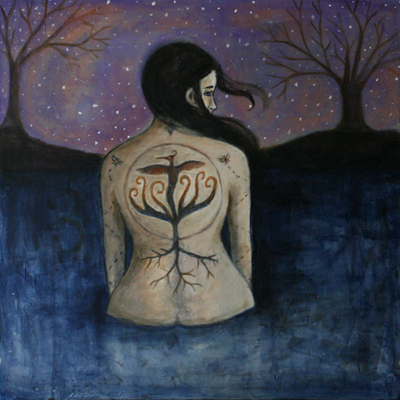
At any rate, I bring you “Monkey Manuscript: The Musical”—ta da! You can access this first-pass playlist for my as-yet-untitled manuscript online by clicking the image (a painting I only just stumbled on today that is strikingly in keeping with my tale’s motifs, so would make ideal cover art). Titles and artists are also listed below:
"Ophelia," by Leah Piken Kolidas (www.bluetreeartgallery.com)
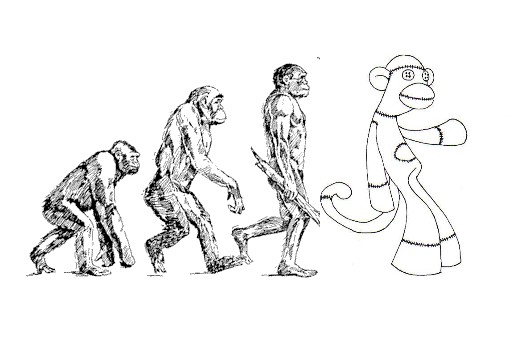
“I believe imagination is like a Darwinian system.”
sock monkey image from cthulhufhtagn.deviantart.com
In the above quotation from the novel Sophie’s World (which I finally got through a week ago), Alberto Knox—the story’s philosopher—discusses with Sophie the nature of creativity and how it follows the natural selection of Darwinism:
“Thought-mutants occur in the consciousness one after the other, at least if we refrain from censoring ourselves too much. But only some of these thoughts can be used. Here, reason comes into its own. It, too, has a vital function. When the day’s catch is laid on the table we must not forget to be selective.”
Oh, that Alberto and his way with analogies…sorry, can’t help being sarcastic toward this book. Disregarding the tremendous education on philosophy it provides (which in itself is good reason to read the novel, and I’m glad that I did), it’s the fictional aspect of the plot that pricked into my skin like so many fleas in my fur. An interesting attempt to provide an entertaining means of digesting large concepts and history, the fictitious story line that distinguishes this as a “novel” versus “textbook” fell a little flat for me. The dialogue was unbelievably forced (most of Sophie’s comments/questions simply served as breaks or segues in the long lectures), and though it takes an interesting twist mid-way through, the characters and thin plot just didn’t endear themselves. Quite frankly, I found Sophie to be a precocious little twit. But I digress…
In any case, what he’s getting at here is that imagination generates the ideas, but reason weeds out the “mutants” and selects the best ones to carry on. The plot twist in the book also ushered in some self-reflexive commentary on writing and the manipulative power the writer has over those ideas, settings, and characters in his/her charge. As far as the creative process in general, Alberto continues to say (with another analogy in practically the same breath as the first…):
“Maybe the imagination creates what is new, but the imagination does not make the actual selection. The imagination does not ‘compose.’ A composition—and every work of art is one—is created in a wondrous interplay between imagination and reason, or between mind and reflection. For there will always be an element of chance in the creative process. You have to turn the sheep loose before you can start to herd them.”
This “wondrous interplay” is what laboriously polishes our inspired first drafts into final manuscripts. It’s what also keeps us in check so we don’t overly pillage our paragraphs of the words and thoughts that breathe soul into them; all too often, reason defeats imagination when there should instead be a balance of power.
Unlike the negligent Dr. Frankenstein, however, we do need to be mindful of what we bring into being. Our stories inspire us, they speak to us, they surprise us, yes, but they also rely on us to nurture and shape them, to help find a suitable place in the world for them. It’s still essential to follow the writing rules so we don’t feed our stories after midnight or get them wet, thereby leaving the sweet Mogwais of our imagination to metamorphose into Gremlins of loose redundancy and holes. That said, I don’t mean to be harsh on our uncensored minds, and perhaps my title isn’t fair in calling our first drafts “shit”…but far be it from me to pass up a good rhyme, and, anyways, sometimes they just really are ;). (I think Sophie’s World, for example, might’ve benefited from another read-through…)
Serendipitously, at the same time as I’d read the chapter quoted here and mulled over this intellectual tightrope, Tahlia (author of Lethal Inheritance who blogs on the site of same name) posted “Do we write a story or uncover it?“—here, she asks how much we write using our rational intellect versus not thinking and just going with the flow. It seems we universally tread this fine line, leaving us with this: To think or not to think…that is the question when it comes to the evolution of our story.
“Substitute ‘damn’ every time you’re inclined to write ‘very;’ your editor will delete it and the writing will be just as it should be.” – Mark Twain
The revision continues, so this is just a quickie. That’s right, I’m gonna just love ya then leave ya, blog-slut that I am…
I’ve done a once-over combing through my manuscript and trimmed out a few thousand words so far. As I still contemplate how I’m going to tweak that damn ending—sorry, I mean “very” ending—no, I mean “damn” ending—no, I mean just “ending,” period ;)—I’m approaching another wave. But before I do another complete read-through, I’m strategically using my Word application’s “Find” tool to seek out and evaluate the use of a few common culprits that threaten to weaken our writing.
While there are many ways to slice-and-dice revision (including eliminating those adverbs and “to be” verbs), here’s a sample of overused, taboo words to check for in your manuscript as a quick-fix:
very
always
really
when
then
that
suddenly
just
began/ started (With these, don’t use it if whatever is “beginning/starting” doesn’t stop before the action is carried out. Oh my gaawwd, I can’t believe how many ‘began’s I’ve found…naughty Monkey!)
For what that’s worth. It’s not to say we shouldn’t use these words at all, just not overly so—it’s worth a scan to become cognizant of our usage and determine whether there isn’t a more direct, active means of engaging our reader through other word choices/sentence structure.
Also [I’m adding this retroactively in response to Sharmon’s good point in the comment below], I personally reduced those words in my 3rd-person narration, but left most of them in my dialogue, as those words are likely overused in our writing because they’re what we use often when we speak! So, it’s arguable from that standpoint that they contribute toward authentic dialogue, no?
What words would you add to the list?
[As an aside, can’t help but share that the Mark Twain quotation reminds me of a time from my consulting days when the guy in the cubicle across from mine started swearing, walked away, then promptly returned with a colleague. “Fix it,” he said to the guy, pointing at his computer. Our friend/coworker giggled as he did so. Afterwards, I learned that the guy had tampered with my cubicle-mate’s Word settings such that every time he typed the word “the” in his client report, it auto-corrected to, well, a term for male genitalia. Ah, Finance wasn’t always so boring…]
I recently read a post on the Here Be Dragons blog entitled, “Are We Having Fun Yet?” in which the author, Agatha, shares a refreshing, honest rant over the agony that can be refining a manuscript into its final draft. She references Stephen King’s book On Writing (which many keep recommending and my slack-ass has yet to read) and specifically addresses a few writing rules that are compounding her frustration, such as how to approach that infamous first chapter (i.e., beginning at the beginning of the action to hook the reader rather than leading in with too much description of setting) and the debatable requirement that there be tension on every single page.
This got me thinking about all the RULES we new writers are trying so diligently to follow to not only write that novel, but also craft it into something marketable so it has a shot at getting published. We scour the blogosphere for the sage wisdom of literary agents and published authors, and we look to our most beloved books for guidance. It goes without saying that the pressure this places on us is tremendous, especially when we look back to the precious first drafts we wrote from our hearts and realize they are violating rules left and right…
Suddenly the Adverb becomes our arch nemesis, and we’re playing Whack-a-Mole against any dialogue tags other than Said.
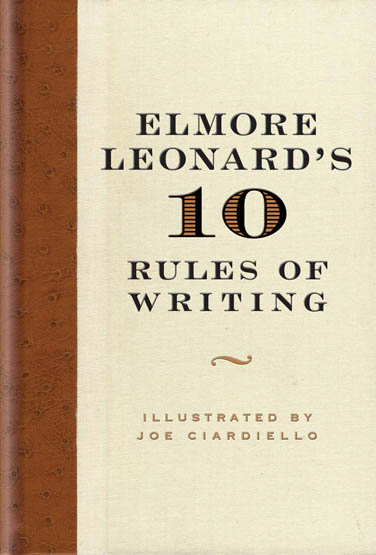
A few months back, The Guardian (inspired by Elmore Leonard’s The 10 Rules of Writing) published the article “Ten Rules for Writing Fiction,” in which they surveyed 29 renowned authors for their own list of dos and don’ts. This was a fascinating read for me. At first, it overwhelmed me, because of course as I scanned down the screen I was tripping over everything that I apparently do wrong…and yet, the more author lists that I read, the more I noticed how varied their perspectives were. For being a list of “rules,” it if anything taught me there is no consistent formula set in stone.
While there are no doubt sound universal suggestions out there we should adhere to, I think we also need to find solace in the fact that there couldn’t possibly be a one-size-fits all approach to writing a good book. We are all unique and have something different to bring to the table, and that’s something that should be celebrated in our writing as well. I particularly like how Ollin Morales (Courage 2 Create blog) phrased it in his comment on Agatha’s post:
“I’d rather write a book that I love and everybody hates, than one that everybody loves and I hate.”
True dat. And I also commend the truth Corra McFeydon just shared in her A Lit Major’s Notebook blog, a post appropriately titled, “The Truth.” It is here that Corra, also in the process of writing a novel, admits that she does not desire to be a professional writer because, right now at least, it’s killing her spirit in what she loved about writing in the first place. Seeking to break free from the rules and schedules that constrict her, she asserts:
“That’s why my novel will be written when the spirit hits me — as a product of my intensity, my laughter, and my free spirit — even though apparently that’s not how to be successful.”
I began this project for me, and if it remains just for myself after I’ve at least given it a shot at going elsewhere, so be it if I’m happy with the end product. But even abiding by our own expectations entails discipline as we make time for our writing and edit it until it becomes the best version of itself. I think most of the rules I’m opting to follow these days are self-imposed based on my own standards (which are quite high—I’m an English teacher after all, and grade myself constantly ;)).
That being said, one external rule I’m trying to stick to is the advised first-time-author word count of 100,000—not in my first draft that I’m wrapping up presently, but when I go back through to polish up. Yet another blog post I recently read that I really appreciate for its straightforward guidance on how to cut, let’s say, 19,000 words for a final manuscript is, well, “How to Cut 19,000 Words” from the ‘Lethal Inheritance’ blog—Tahlia Newland tells us how she did just that when her agent asked her trim down her YA fantasy novel of same name. I was at first absolutely psyched out that cutting words meant cutting entire paragraphs and chapters—and sometimes it does and perhaps will, but it’s reassuring to know that it can be achieved on a sentence/word level as well, an edit so subtle you’d hardly miss a thing.
I’m curious: Which writing rules do YOU swear by? And which rules do you think are totally bogus?
Argh. Can you even imagine Jane Austen sweating it out like this? I can’t imagine she was slapped in the face by rules at every turn, as we are at every page we flip and link we click. But then again…



 world for them. It’s still essential to follow the



 The Fallen Monkey