Just a quickie, folks, to notify that the wacky monkeys I descended from (a.k.a., Mom & Dad) have swung from a loooong vine across the Atlantic ocean to visit me. We’ve just returned from a delightful weekend in the Cotswolds and Stratford-upon-Avon and are recovering from a not-so-delightful extended train ride back to London last night—our train hit someone on the tracks, the poor soul :(…Then tomorrow we’re off to rrrrOMA! for a few days.
Hopefully I’m not wearing the poor Ps out already; we’d had to flee town for this past weekend already because my genius husband and I managed to dumb-ass double-book ourselves, so a couple of our friends flew in from Italy last Wednesday before my parents arrived from Chicago the following morning. Our wee abode officially bursting beyond capacity, I chose to head for the hills (or the “wolds,” I should say) to give everyone a bit of breathing room. Since our first guests arrived in March of 2009, this is the 17th round of guests that we’ve hosted in London. Not counting parental repeats, 30 different people have rested their heads at what we’ve long been calling the B&B. I should’ve bought a guestbook from the getgo had I any freaking idea how many people would suddenly come out of the woodwork and want to stay with us once we moved somewhere cool. I think our next home had better be in Nebraska.
Anyways, all whingeing aside, I’m having the best time with my parents, and I’m giddy because my Dear Reader has been emailing back her second round of feedback on my manuscript ending. I’ve got some work cut out for me on that, but I’m so excited to revisit it and make it the strongest version of itself. I have a November workshop on manuscript submission as my deadline for getting things as polished and perdy as can be :).
In the meantime, as long as my tree here continues to be occupied and me swinging hither and yon as Hostess with the Mostess, I’ll be out of commission in the blogosphere for several more days. I shall miss you and your wonderful insights until then—*mwah*!!
“The making of a good compilation tape is a very subtle art…First of all, you’re using someone else’s poetry to express how you feel. This is a delicate thing.” —High Fidelity
*sigh*…the Mix Tape. How I remember practicing that delicate art in high school and college…mostly, I made tapes for myself (hey, you have to love yourself before you can love someone else :)), but I can think of at least one I made for a boy…*blush*. I didn’t need to read or see High Fidelity first to innately understand the delicacy in balancing out those tracks—it’s a lot like writing, really, in that you need to start out with an attention-getter and then try to avoid redundancy in carefully pacing yourself through the highs and lows of fast and slow. The words should carry meaning, and you need to establish mood and tone.
But I didn’t necessarily adhere to all those rules this time.
You see, as I try to hold my anxiety at bay while the last 15,000 words of my manuscript rest in my trusted Reader’s hands for review and feedback, I’ve been playing around with giving my novel a soundtrack, as inspired by the Milk Fever Blog post, “The Soundtrack.” The preliminary playlist that I’ve compiled is in order of story progression, not the sacred aesthetic rules of the Mix Tape as referenced above. Basically, I thought through the themes and atmosphere of my key scenes, as well as any songs specifically referenced in the text, and have listed the songs as these elements appear. Though humor keeps some of my scenes relatively light, needless to say my protagonist undergoes some pretty crazy stuff that just doesn’t warrant many feel-good tunes.
At any rate, I bring you “Monkey Manuscript: The Musical”—ta da! You can access this first-pass playlist for my as-yet-untitled manuscript online by clicking the image (a painting I only just stumbled on today that is strikingly in keeping with my tale’s motifs, so would make ideal cover art). Titles and artists are also listed below:
"Ophelia," by Leah Piken Kolidas (www.bluetreeartgallery.com)
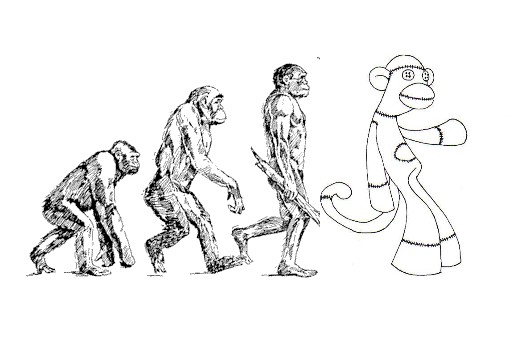
“I believe imagination is like a Darwinian system.”
sock monkey image from cthulhufhtagn.deviantart.com
In the above quotation from the novel Sophie’s World (which I finally got through a week ago), Alberto Knox—the story’s philosopher—discusses with Sophie the nature of creativity and how it follows the natural selection of Darwinism:
“Thought-mutants occur in the consciousness one after the other, at least if we refrain from censoring ourselves too much. But only some of these thoughts can be used. Here, reason comes into its own. It, too, has a vital function. When the day’s catch is laid on the table we must not forget to be selective.”
Oh, that Alberto and his way with analogies…sorry, can’t help being sarcastic toward this book. Disregarding the tremendous education on philosophy it provides (which in itself is good reason to read the novel, and I’m glad that I did), it’s the fictional aspect of the plot that pricked into my skin like so many fleas in my fur. An interesting attempt to provide an entertaining means of digesting large concepts and history, the fictitious story line that distinguishes this as a “novel” versus “textbook” fell a little flat for me. The dialogue was unbelievably forced (most of Sophie’s comments/questions simply served as breaks or segues in the long lectures), and though it takes an interesting twist mid-way through, the characters and thin plot just didn’t endear themselves. Quite frankly, I found Sophie to be a precocious little twit. But I digress…
In any case, what he’s getting at here is that imagination generates the ideas, but reason weeds out the “mutants” and selects the best ones to carry on. The plot twist in the book also ushered in some self-reflexive commentary on writing and the manipulative power the writer has over those ideas, settings, and characters in his/her charge. As far as the creative process in general, Alberto continues to say (with another analogy in practically the same breath as the first…):
“Maybe the imagination creates what is new, but the imagination does not make the actual selection. The imagination does not ‘compose.’ A composition—and every work of art is one—is created in a wondrous interplay between imagination and reason, or between mind and reflection. For there will always be an element of chance in the creative process. You have to turn the sheep loose before you can start to herd them.”
This “wondrous interplay” is what laboriously polishes our inspired first drafts into final manuscripts. It’s what also keeps us in check so we don’t overly pillage our paragraphs of the words and thoughts that breathe soul into them; all too often, reason defeats imagination when there should instead be a balance of power.
Unlike the negligent Dr. Frankenstein, however, we do need to be mindful of what we bring into being. Our stories inspire us, they speak to us, they surprise us, yes, but they also rely on us to nurture and shape them, to help find a suitable place in the world for them. It’s still essential to follow the writing rules so we don’t feed our stories after midnight or get them wet, thereby leaving the sweet Mogwais of our imagination to metamorphose into Gremlins of loose redundancy and holes. That said, I don’t mean to be harsh on our uncensored minds, and perhaps my title isn’t fair in calling our first drafts “shit”…but far be it from me to pass up a good rhyme, and, anyways, sometimes they just really are ;). (I think Sophie’s World, for example, might’ve benefited from another read-through…)
Serendipitously, at the same time as I’d read the chapter quoted here and mulled over this intellectual tightrope, Tahlia (author of Lethal Inheritance who blogs on the site of same name) posted “Do we write a story or uncover it?“—here, she asks how much we write using our rational intellect versus not thinking and just going with the flow. It seems we universally tread this fine line, leaving us with this: To think or not to think…that is the question when it comes to the evolution of our story.
*blush* Get your minds out of the gutter. What kind of monkey do you think I am?!
“The best lightning rod for your protection is your own spine.” – Ralph Waldo Emerson
I have long neglected my little writing prompts that originally kicked off this blog, mainly because they’re aim was to get me over writer’s block, and it worked! I’ve been cranking until I’m crossed eyes these recent days on revising my manuscript, and for the time being am keen to step away for a bit to clear my head. So…
The Prompt:
Today page 43 of Room to Writeasks us to list the protections we use in our everyday lives or, indeed, our writing. We are to then have our main character embody this protection in a scene or simply write a new piece without using writing-protections (e.g., a different place than the usual, without a word/page limit, etc.).
Henry VIII's armour
Response:
My everyday protections include:
– smiling
– expression through writing versus speaking
– diving behind a book or in front of a computer/tv
– my giant headphones and iPod
– sarcasm
– my forked tongue, when need be
– stubbornness, which includes a common refusal to say, “sorry”
– quiet pensiveness, reclusiveness
Hm, given that codpiece on Henry's armour, perhaps he could've used this protection as well...
– over-analysis
– verbatim recall of prior conversations (one of my more superb defenses)
– cold silence or, conversely, inane babble
– hats, cardigans, and sunglasses
– take-away caffeine (somehow just holding the steaming paper cup is a fortification, regardless what’s inside)
– sleep
– my quilt
– a hybrid superiority/inferiority complex that’s a bit difficult to describe…
I’ll stop there and address the second part of this exercise by first peeling off one key writing-protection of mine: the ability to revise. So I’m just going to write this off the cuff and not obsess over how it comes out, leaving it raw in its first draft form.
So, that said, I have certainly infused a lot of the above protections into my protagonist, who I’ll continue to address by the pseudonym “Margaret” (whoops, there I go, still protecting…and for whatever reason protecting the fictional :)). I could probably find one-to-one matches for almost everything on the list, but here’s just a few examples:
“Margaret beamed one of her fake smiles in maneuvering in ninety-degree angles toward her.”
“Writing was so much easier than calling; writing gave control, the ability to pause, reread, and revise. Margaret didn’t trust herself with speaking any longer; the restraint in talking to her parents was difficult enough, and they alone embodied the innocence necessary to not pick up on vocal cues. Her not-so innocent friends and brother, on the other hand, were risks she couldn’t take.”
“Shaking off the mundane tasks of Everyday-Land and shoving in a thumbnail to spear a dog-eared page, Margaret tiptoed into her alternate universe at the delicious creaking sound of a hardcover binding blooming into action.”
“She’d banked an increasing number of slumbering hours ever since that first day […] and she wiled away the afternoons on indulgences like prolonged soaks in the tub and otherwise luxurious daytime lounging. The solitary nature of her days quieted her mind to her earlier paranoia, distortions in perception that she’d ascribed to stress-induced fatigue. [It] all dissipated before her like the steam that rose off the bubbles in her lap.”
“The sun shied away behind the clouds, making Margaret’s sunglasses redundant, so she reluctantly removed them.”
“She’d lately taken to […] a route of anonymity that concealed her among side streets rather than parade her before rows of shops and sidewalk cafés. She didn’t want to be observed, though sometimes played a mental game that she was hiding from the paparazzi lusting to lavish her with attention—somehow desiring to be a Nobody while still feeling like a Somebody.”
And that kitten definitely has claws when she needs ’em to shield her inner vulnerability.
Reflection:
As much as this character isn’t supposed to be me, it’s interesting to look back on her through this lens and realize how cognizant I am of my defense-mechanisms, as reflected in this mirror. I reveled before in the fact that writing can be a protective filter of our thoughts by virtue of its revision stage, yet it is also something that leaves us exposed, unveiling raw emotion, intellect, and imagination. I’m sure I’m not the only one who felt (and continues to feel) timid about posting a blog, putting those ideas out there for anyone to read and judge. Getting something “in writing,” after all, carries that sense of no-turning-back, as though signed in our blood or chiseled in stone. There’s both a structured permanence and organic fluidity to it that just fascinates me, but I’ll leave that to another blog topic on another day. For now, I suppose these blogs do allow us to go back and edit, but I’ll keep my promise and not exercise that protection ;). In fact, I’m not even going to let myself read this over before I press “Publish.” Ha, take that!
In the wake of my previous post on “taboo” words, I came to a horrifying realization: writers are going to put Lolly’s, Inc. from Schoolhouse Rock out of business!!!
A three-generation family business…I just don’t know if I can live with the guilt!
I therefore reemphasize what I said last time about still using the supposed no-no words like adverbs—just do so within reason—and I think dialogue or 1st-person narration deserves some leeway as well if it’s authentic to how a person would really speak. So I guess I’ll still be unpacking my adjectives, too, but with discretion.
Working through this experience has introduced me to writer rules that *gasp!* I wasn’t necessarily teaching my high school students…when it came to dialogue tags, I confess I’d tell them that “said” is boring, so their characters should “exclaim” or “sneer” or even “smirk” something—I gave them a worksheet, in fact, that listed up to 50 different tags! Gah! And in looking at said worksheet, go figure the examples I used for dialogue punctuation:
I asked, “Did you see the monkey fall out of tree?”
Did you just say, “The monkey fell out of the tree”?
I screamed, “The monkey is going to fall out of the tree!”
He had the nerve to ask me, “Why didn’t you catch the monkey when it fell?”!
I will say this in my defense (not of subjecting my students to endless monkeys in their grammar examples ;), but of how I taught descriptive language):
– First of all, children and adults alike who are not naturally expressive in their writing do benefit a great deal from first learning what vast options their language provides them so they can later practice restraint when making more sophisticated stylistic decisions.
– Second, I certainly wasn’t teaching them that more words are better, merely that each of the words they are using should pack a punch. It’s not about being redundant, it’s—for example—saying that someone “saunters” rather than “walks” or that the fish in the garbage smells “putrid” rather than “bad.” These one-to-one swaps are sufficient in themselves to strengthen a sentence.
Thus, in their revision workshops, I’d ask them to comb through their writing and seek out any general nouns, verbs, adjectives, or adverbs and replace them with more specific ones. They were also to identify which senses their descriptions appealed to and strive to address all five at some point.
“Writers with style never just eat breakfast. They munch on granola, wolf down hotcakes, savor Frosted Flakes, or gorge on jelly doughnuts.” – Art Peterson, The Writer’s Workout Book: 113 Stretches Toward Better Prose
I must say it’s very fun, let alone ironic, playing the pupil and trying to follow my own and others’ lessons, and I’m grateful for the new perspective I’ll eventually bring back to the classroom. I’m not only strengthening as a writer, but also as a teacher.
“Substitute ‘damn’ every time you’re inclined to write ‘very;’ your editor will delete it and the writing will be just as it should be.” – Mark Twain
The revision continues, so this is just a quickie. That’s right, I’m gonna just love ya then leave ya, blog-slut that I am…
I’ve done a once-over combing through my manuscript and trimmed out a few thousand words so far. As I still contemplate how I’m going to tweak that damn ending—sorry, I mean “very” ending—no, I mean “damn” ending—no, I mean just “ending,” period ;)—I’m approaching another wave. But before I do another complete read-through, I’m strategically using my Word application’s “Find” tool to seek out and evaluate the use of a few common culprits that threaten to weaken our writing.
While there are many ways to slice-and-dice revision (including eliminating those adverbs and “to be” verbs), here’s a sample of overused, taboo words to check for in your manuscript as a quick-fix:
very
always
really
when
then
that
suddenly
just
began/ started (With these, don’t use it if whatever is “beginning/starting” doesn’t stop before the action is carried out. Oh my gaawwd, I can’t believe how many ‘began’s I’ve found…naughty Monkey!)
For what that’s worth. It’s not to say we shouldn’t use these words at all, just not overly so—it’s worth a scan to become cognizant of our usage and determine whether there isn’t a more direct, active means of engaging our reader through other word choices/sentence structure.
Also [I’m adding this retroactively in response to Sharmon’s good point in the comment below], I personally reduced those words in my 3rd-person narration, but left most of them in my dialogue, as those words are likely overused in our writing because they’re what we use often when we speak! So, it’s arguable from that standpoint that they contribute toward authentic dialogue, no?
What words would you add to the list?
[As an aside, can’t help but share that the Mark Twain quotation reminds me of a time from my consulting days when the guy in the cubicle across from mine started swearing, walked away, then promptly returned with a colleague. “Fix it,” he said to the guy, pointing at his computer. Our friend/coworker giggled as he did so. Afterwards, I learned that the guy had tampered with my cubicle-mate’s Word settings such that every time he typed the word “the” in his client report, it auto-corrected to, well, a term for male genitalia. Ah, Finance wasn’t always so boring…]
The good news: I’ve been slacking on my blog because I’ve cranked up the work on my manuscript.
The bad news: I’ve been slacking on my blog. Which means neglect of your blogs as well as mine. Please hang in there with me! I value so much what I take away from your blogs and comments, so I wouldn’t dare stay away for long; I’m just not the most consistent right now.
To make up for the Monkey imitating a Sloth again, I’ve got a wee smorgasbord of miscellany today. First off, I am super pleased to say I’ve been productive in slashing word count and getting closer to revamping that ending that I just haven’t been thrilled with for a while. I have also finished writing the secondary story that interweaves with my main plot, which is much briefer in scale, but had yet to transfer from me noggin to the written word. That was such a treat to work on for a change in voice, characters, and situation.
But enough about that. I don’t know how I manage to get on all these freaking email lists, but one lil’ nugget delivered to my Inbox recently was promoting a new book titled Getting Published. While that highly obscure title hardly clarifies what the text might be about, I thought perhaps I’d pass it on to the blogosphere in the rare event it ends up being somewhat relevant to writing and getting that writing published…ya think? Actually, now that I think about it, I’m lying…1) I do remember how I got on this mailing list, having emailed an enquiry to the Writers Workshop once over a year ago, and 2) despite that evasive title, I might have some glimmering of an idea as to what the book’s about, as quoth the author:
At the moment, there’s nothing on the market that tells a budding writer what they need to know about the industry. How to select agents, how to engage with agents, what a book deal looks like, what the financial issues are, what the (multitudinous) publishing issues are.
Because agents don’t tell you this either – and nor will your publisher – plenty of ‘professional’ authors are ill-informed about the industry from which they hope to eke a living. I’ve tried my level best to make this the most comprehensive and truthful book of its kind, and I very much hope you like it.
A&C Black have generously agreed to place significant chunks of the book online, so you can get a feel for the book before deciding whether to buy it. We’ve put a full listing of those extracts here. The nice people at A&C Black have also managed to secure a 25% off promotion from Amazon, so if you want to buy the book there, please make my day.
Despite my devoting a sizable chunk of this post to it, I honestly have no insider knowledge on this publication and whether it will deliver what it promises or not, but no harm in sharing.
And, oh, but wait! There is MORE good news! Utterly lovely blog awards and recognition. So a *mwah* and *mwah* to Ollin for the recent blog tag and Milo for the Versatile Blogger Award. Per the responsibilities attached to the game-o-Blog Tag, my responses follow—and I’ll make this a twofer by tagging AND awarding the Versatile Blogger Award to the 6 bloggers listed below:
1. If you could have any superpower, what would you have? Why?
I would be able to hyper-space anywhere, any time, within seconds. Given my volume of travel, I am getting reeeallly sick of airports and commuting to/from them. I would also love to pop into my parents’ house across the ocean every time I’m thinking of them and wanna give them a hug.
2. Who is your style icon?
classic: Audrey Hepburn
contemporary: Gwyneth Paltrow
[and, okay—if I cared to get dolled up each day—Jennifer Love Hewitt’s character Melinda Gordon on Ghost Whisperer :)]
3. What is your favorite quote?
Toss-up between:
“So long as books are open, minds can never be closed” – Ronald Reagan
“Be silly. Be honest. Be kind.” – Ralph Waldo Emerson
4. What is the best compliment you’ve ever received?
Well, for as satisfying as it was when my non-domestic self finally learned to cook and my husband said I’d gone from “zero to hero” in the kitchen, I’d probably have to go with all the folks who have told me over the years that I’m a good writer. That gave me the boost I needed to start believing in that for myself and work even harder to become a better writer.
5. What playlist/cd is in your CD player/iPod right now?
This minute, I’m leaving it to the artificial intelligence of my iTunes’ “Indie Rock” Genius Mix. It kicked off with Joy Division and is presently playing The Smiths’ “Cemetry Gates.”
6. Are you a night owl or a morning person?
Oh, without doubt I am a child of the night. Left to my own devices these days, I’m always awake into the wee hours of the morning writing/revising or curling up with a good book or flick.
“Although I love animals (I am, after all, a monkey), I am not a pet person. At all. But if I had to align myself with either the infamous Dog People or Cat People in a finger-snapping gang face-off of “West Side Story” proportions, I would probably go Cat.”
8. What is the meaning behind your blog name?
It dates back to a joke my older brother told me when I was little kid…it had me rolling on the ground for at least a half-hour, howling, and to this day makes me giggle to tears. I usually resist telling it, as not everyone may find it remotely funny and, moreover, find it disturbing that I do ;).
“Multi-tasking – Screwing everything up simultaneously.” – Anonymous
Well, let’s hope I don’t screw up everything…
I recently shifted to freelancing for my existing employer, so with the exception of one day a week, I can do my work from home. Yes, that is quite awesome, and I’m not saying I’m not enjoying it. What I’ve discovered, though, is how much more it stresses me out to not have that set schedule. Do I get my work stuff out of the way first thing in the morning, or do I work on my manuscript when I’m still fresh? Should I write my work blog first or save the writing energy for this one, and do either before or after folding the laundry and scrubbing the shower? Should I tend to the Monkey or the manuscript? My work email or my personal email or my Monkey email or my other personal email that I also need to use for work? I literally have tabs open for everything at once and been starting something in one window and switching to tweak something in a different one before the first thing is done. Though it’s stupidly minor, somehow it helps me to do all my personal/writing-related and work-related schtuff through separate browsers…then I can bookmark accordingly and not have it all staring me down at once.
Soon to be thrown into this loop is *hopefully* dipping my toe back into the classroom to substitute-teach once a week 🙂 And, as of Friday, I’ve accepted a position as Developmental Editor for a new publishing company (also work that will be done remotely)—so once I become certified, I’ll have other people’s fiction manuscripts thrown my way while I’m still trying to finish my own! I absolutely embrace the opportunity, though, and think it will 1) be refreshing to step outside my own writing at those times it bogs me down, and 2) teach me so much that I can relate back to my own story. I am super, super psyched about helping others fulfill their writing dreams in this new way. You can be sure I’ll be keeping you posted on this blog how that goes…
So that’s my update. I am suffering a massive professional split personality right now, and it’s that much more potent because these are all things I’m personally passionate about and for the most part incorporating into my own home. So is this exciting that I’ve achieved the point where what I do is so much of who I am day-to-day, or am I going to go batty without the work-life division that helps maintain the work-life balance? I think it can be the former as long as I keep myself disciplined yet remember it’s okay and necessary to put the work aside and walk away when I need to live. I know how to prioritize, and I know how to accomplish things bit by bit. Yeah, I think it’ll be a good thing.
But I don’t know, I’m too busy to think about it now, so I’ll schedule a time to think about it later…
“I can’t think about that right now. If I do, I’ll go crazy. I’ll think about that tomorrow.” – Scarlett O’Hara
Any of you have some tried-and-true time-management strategies that work well for you?
Halfway through Sophie’s World, and it keeps prompting new thoughts. Well, more accurately, the history of philosophy that it shares does.
Though dear Sophie and I have already progressed to the 18th century, Plato’s ancient allegory of the cave continues to flicker in my mind like the flame casting shadows onto the back of the cave wall. If you aren’t familiar with the story, the basic idea is this:
Visualize a cave with people seated with their backs to its opening. They are therefore only able to see the back of the cave wall, which is dancing with the shadows of objects held behind the people and in front a fire. The people are unable to turn around, thus only know the world from these vague shadows of what’s transpiring beyond them outside of the cave.
In this myth, the actual objects (which would be seen in clearer detail if the people turned around to look at them directly) represent the world of ideas, whereas the shadows are only our perception of the material world. Plato believed that true knowledge could not be gained through our senses, but, rather, our reason. Thus, the enlightened ones who try to see beyond their physical world into the realm of ideas will see with clarity and truth.
So why do most of us keep our backs to the cave opening, staring into the darkness and shadows? Is it because we choose not to see or aren’t able to? When I think of this myth literally, I pretend that I’m the one to stand up and look around at what is creating the shadows. My eyes having been adjusted to the dark all this time, I’d think they’d be pierced by the bright fire/daylight. This then makes me think of the Emily Dickinson poem:
Tell all the Truth but tell it slant —
Success in Circuit lies
Too bright for our infirm Delight
The Truth’s superb surprise
As Lightning to the Children eased
With explanation kind
The Truth must dazzle gradually
Or every man be blind —
Methinks Miss Dickinson and Colonel Jessep share something in common—though Emily might agree we ordinary folk are entitled to the truth, neither believes we can handle it. For that matter, how would everyone else in my cave respond if I suddenly told them what I saw? Would they believe me? Be shocked by it? Deny it?
Me-then thinks perhaps stories are a way we writers try to help the medicine go down. Hey, Plato’s allegory is a case in point, is it not? Stories help us to better understand truths through visualization and creative “slant”—no, not lies, just not necessarily the facts either when it comes to fiction. And I shouldn’t imply that it’s “sugar-coating”; indeed, stories well-told will intensify rather than dilute, expressed in engaging, vivid ways that make a reader receptive to even the grittier stuff.
Years ago, I attended a lecture by Tim O’Brien in which he discussed his novel The Things They Carried. Written in the first person and narrated by a character whose name was also Tim and who also fought in Vietnam, the book reads like it’s the author’s memoir. O’Brien clarified, however, that while much of the novel is based on his real life, it is a novel. Flip to the inside cover and see that it is denoted as a work of fiction (there are many semi-autobiographical narratives that are, which many don’t realize until Oprah exposes it mercilessly on her show…*ahem* A Million Little Pieces *cough*…Night is arguably another—and oh, hey, just look whose book club it’s in…).
Basically, O’Brien said he had to stray from writing the factual truth in order to tell the absolute Truth. He likened it to catching your first fish; sure, it might be scrawny, but your excitement is massive. In order to get someone else as excited about your catch as you are, you might stretch your hands further apart from the few inches of, “It was this big,” to the two-foot length of, “It was THIS BIG!!” Describing a tiny bluegill as a giant catfish isn’t factually true, but your friend’s commensurate reaction is the Truth of what you actually felt. Likewise, O’Brien believed that for anyone who didn’t experience Vietnam to feel remotely the way he felt when he was there, he needed to tell it differently.
So my question for YOU is this: what Truths do you write or read about? Which of your stories (or those you’ve read) do you think do a particularly effective job of helping the reader “handle the truth” and why?
“[L]ong before the child learns to talk properly—and long before it learns to think philosophically—the world will have become a habit. A pity, if you ask me.” – Sophie’s World
I’m currently reading a book that I’ve had sitting on my bookshelf for years. I literally moved it across an ocean two years ago, and still it had sat mutely, patiently, until I finally plucked it out and cracked it open a few days ago: Sophie’s World. I’m only a quarter of the way through it, so will withhold offering a critique, but so far I’m enjoying the questions it raises—it’s essentially taking your own correspondence course in philosophy, without getting graded 🙂 Less than twenty pages in, I was struck by the above quotation…I hadn’t really reflected on how the world becomes a “habit” as we age:
“The world itself becomes a habit in no time at all. It seems as if in the process of growing up we lose the ability to wonder about the world. And in doing so, we lose something central—something philosophers try to restore. For somewhere inside ourselves, something tells us that life is a huge mystery. This is something we once experienced, long before we learned to think the thought.”
At this point, the “philosopher” instructing our protagonist, Sophie, has been pointing out how infants and young children look about at everything surrounding them with wonder, getting excited about even the little things we adults come to take for granted through familiarity.
I’m not going to wax philosophical on this, but what it did make me think about is how writers seem to be blessed with the ability to behold the world with that same wonder we did as children. We have to, really, in order to continue creating our own little worlds.
The writer is someone for whom a bus ride is not merely from Point A to Point B; rather, it’s an exercise in character study as we little voyeurs observe those in such close proximity that it almost seems weirder to pretend that they’re not there (as the masses do on the London Underground…the eye aversion is almost unbearable – and on sidewalks, too! This Chi-town gal misses eye-contact *sigh*). Anyways, we watch these people, speculate on where they’re going, where they’re coming from, what their whole backstory might be. We get ideas in our noggins as to the perfect character to insert into our current tales or on which to base a whole new novel…all thanks to paying some attention to the real people right under our noses.
We notice subtleties, the body language that suggests insecurities or the butterfly that carries so many metaphors aloft the breezes of its wings. We notice with a painter’s eye that the clouds aren’t just white and that the sofa is illuminated differently when the sun shines in from that late-afternoon angle. We notice the people who smile to themselves when they think no one’s looking and that a tree can look sad, hopeful, or maternal. We notice what a gust of fresh air feels like in our lungs, through our hair, and the new story ideas that the sensation can conjure.
We can describe what happens in a meadow at dusk.
We behold the world with wonder, and the beauty is that not only are we richer for it, but we have the calling that compels us to write it down so that others might experience the world through our eyes and look at it as though for the first time through their own. There is not always beauty in this awareness; in fact, we may reveal the darker sides of humanity and tell gritty, disturbing stories without that happy ending. But what there will always be is Truth – I’m talking the capital ‘T’ truth so long as we write, to the best of our abilities, what it is we wonder at through our genuine voices. That is what makes a story authentic and universal, for something has told us that “life is a huge mystery,” and now that we can think the thought, we can write it.

 Just a quickie, folks, to notify that the wacky monkeys I descended from (a.k.a., Mom & Dad) have swung from a loooong vine across the Atlantic ocean to visit me. We’ve just returned from a delightful weekend in the Cotswolds and Stratford-upon-Avon and are recovering from a not-so-delightful extended train ride back to London last night—our train hit someone on the tracks, the poor soul :(…Then tomorrow we’re off to rrrrOMA! for a few days.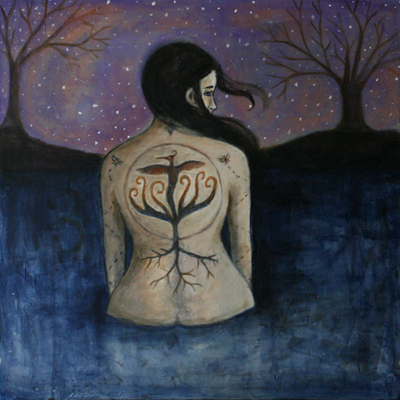
 world for them. It’s still essential to follow the



 The Fallen Monkey