Tag Archives: writing guidance

The Manuscript Manicure – Part II: Micro-Editing

All-righty, finally back with my next installment on editing a manuscript (refer to Part I if you missed it). Once again, this is all thanks to the ladies at Room to Write for sharing insights that might be new to you or least validating of what you already know. Nothing compares to that face-to-face conversation, but I love the interaction that occurs between writers online via blogs. As they said at the workshop, there is so much to be learned beyond our own work, after all—it’s as important to listen to and learn from the projects and experiences of others.

It also teaches us to peel back our skin and not be overly protective of our work. I had to laugh when author Wendy Robertson spoke on all the emotional loading that goes into the critique when we offer it to others for feedback; she said something to the effect that when we give our work to someone else:

“You’re giving your critiquer the power to upset you.”

Ain’t it the truth. Perhaps this is why when I sent the full edit of my first assigned manuscript to its author this afternoon, I cushioned my email with empathy and compliments of everything that was done well, hoping she’ll receive my suggestions for improvement in stride and be willing to work with me constructively.

Anyway, when it comes editing for ourselves, remember that we must become self-conscious of who we are as a writer and what it is we want to achieve. To do that best, we need to identify our style and describe it in a few words. If you read 50 pages of your own novel, what comes across on the page? Is your style spare, lyrical, conversational, whimsical, direct, abstract (to offer a few), or combination of more than one?

We are now shifting from macro-editingto micro-editing and need to explore our style in relation to our content:

– I mentioned the “shape” of the novel last time, which relates to your story arc. This might continually ascend like a surging wave or start thin (yet interesting) and thicken in density to an explosive climax—Wendy likened this to the body of a whale, with the tail being the interesting opening and the blow-hole the climax. Or maybe your chapters are individual stories unto themselves that link together in some way to provide continuity and relevance, like a chain with a large loop toward the end where this progression culminates into the climax (Blackbird House is an example of this shape).

Shapes can vary, but there should always be conflict (tension), climax (crisis), surprise and revelation. And from a micro-editing standpoint, this needs to apply to each of your individual chapters as well.

– Speaking of chapters, as mentioned last time, ensure there’s continuity between them, yes, but also within them on a paragraph-to-paragraph, sentence-to-sentence level.

– With continuity maintaining our story’s consistency and logical progression, we must also make sure the words and sentences flow. This concerns the musicality of the language itself, and the best way to determine this is to read it aloud so you hear it.

– Your musicality and style will be greatly impacted by your sentence construction, so evaluate your writing on a sentence-by-sentence level. Is the syntax effective? Does it flow? Does it make sense? It’s important to ensure you’re applying correct grammatical conventions through punctuation and arrangement of clauses. Use commas, semicolons, and colons for sentence variety and make sure they’re used correctly.

Of course, creative writing allows for creative departure from conventions as well, but make sure that if you do deviate from the rules, there’s a specific purpose for it that strengthens what you’re trying to say. If it’s not producing the intended effect, revisit it and, all else fails, run with the convention rather than muddle your ideas in unclear writing.

– The language you use is the building block for everything, so you need to evaluate your writing on a word-by-word level as well. Make every word count, the strongest choice it could be (English in particular is too word-rich to not take advantage of it!). And obviously don’t allow excessive repetition, incorrect/inappropriate use, or incorrect spelling distract and otherwise undermine your writing.

– The “look” of the page is important as well, so ensure ample inclusion of “white space” now and then to allow your reader’s eyes to “breathe.” This is usually achieved through dialogue that isn’t overly bogged down in paragraphs of description. Section breaks provide white space as well to help accentuate shifts in time/setting.

And if you’re cutting down for word count or tightening, rather than prune on a word/phrase level, they seemed to opt for removing whole chunks, if not lifting an entire chapter to see if the story even misses it. I would suffer some major separation anxiety in that case, but I know some of you have said in your blogs that you’ve done it and lived to tell the tale. And it might not be a matter of ridding of it entirely. I’m sure you’ve heard the saying:

“Don’t throw your babies out with the bathwater.”

Well, they warned us of this as well, and it’s actually why they cautioned not to overly prune on a word/phrase level—making our sentences sparser could deprive the story of some of its joy! And even lifting an entire chapter may just be a structural change by which you drop it into a different place in your manuscript. (Now that I have done, and it works so much better!) At any rate, they said:

“If you kill your darlings, don’t put them in the bin—save them for something else!”

Another novel, a short story, a poem, who knows?!

All right, folks, if I haven’t successfully made your eyeballs roll out with all this reading by now, keep them sucked into those sockets—I’ll be back with a little bit on what they had to say about manuscript formatting, publishers, and self-promotion.

PART I Macro-editing

PART III – Submitting a Manuscript

PART IV – On Publishers & Publicizing


The Manuscript Manicure – Part I: Macro-Editing

Hiya! I’m back to redeem that I.O.U. I gave you last week. See, my word’s good as gold ;)…

As I mentioned, I attended a writing workshop with Room to Write over the weekend that was geared toward prepping a novel manuscript for submission. The full-day conference was divided into two primary parts—Editing and Publication—the first of which I’ll address in part now and break the rest down into separate posts. But, first, I’ll start with some general notes I jotted along the way to get us in the proper mindset:

One thing they stressed is that, above all:

“Editing is a creative process.”

Yes, it involves the nitty-gritty technical stuff, but we’re not merely playing the role of English teacher grading for grammar with red pen in hand—revising our work requires every bit of imagination and innovative thought as writing our initial draft does. For as they said, when the first draft is finished:

“You’re only just beginning.”

Ah yes, it does feel that way doesn’t it…my question is, when the hell does it end???

Anyway, in order to become our own editor, we have to become a “self-conscious” one. No, not as in insecurity-ridden—I think I’ve already mastered that one just fine :). What they mean is to be conscious of the kind of writer we are and the audience we’re writing for. The better aware we are of this, the better  we’ll be able to edit our work with this focus in mind.

Macro-editing is concerned with the overall  novel as a cohesive work. It’s our opportunity to step back from our first draft and contemplate whether it has achieved what we wanted it to and is structured effectively. They encouraged us to print a hardcopy of the manuscript to initiate this stage, as reading your words on the page is truly a different experience from reading them on screen. (I wouldn’t have expected this, but wow. There’s so much more that I catch with that ms in hand.) You will also want to list your themes, summarize your entire book in three sentences, and keep these with you as you journey back through your text to ensure you aren’t straying from any critical elements.

Key aspects your self-conscious-editing self should look for (not only in the novel as a whole, but in every chapter and scene as well) are:

– A compelling beginning, a hook that makes the reader want to continue. The first chapter in particular should be compelling in an action sense, but also in a literary way—it needs to be beautifully written. Subsequent chapters likewise need their own hooks and should be varied in how they start (i.e., beginning with dialogue, beginning in the middle of action, etc.)

– Action, drama, or “trouble,” as they called it.

– Appropriate pacing.

Three-dimensional characters that are brought to life and desire something;

— Characters are “thinly veiled versions of the writer” (sound familiar?), but we must immediately establish distinction between them and from ourselves if they are to appear as separate people; if they’re all clones of us, then they’re clones of each other.
— If you can “see” the character in your mind (consider gathering clippings from magazines and such for reference), then they will come across on the page.
– Provide physical descriptions of your three main characters, enough to help visualize their traits, but not full-bodied detail. Leave something to your readers’ imagination.
— Characters should be consistent from start to finish (i.e., if you reveal or yourself learn something new about them later in the novel, are these traits present at the beginning as well? If not, try to introduce them at least subtly).
— We should see growth in the main character.

– Clear sense of when and where each scene partakes.

– Long sections of description/exposition that could be cut.

Changing up the writing between exposition, narrative, and dialogue.

– A sense of atmosphere and appeal to the senses that lends texture.

– Something in each chapter that surprises the reader.

Continuity between scenes and chapters; ensure nothing is missing.

– Evaluate the “shape” of your novel/chapter in terms of story arc. Shapes can vary, but there should in general be a rising sense of action/conflict until the climax, then a dip toward resolution (so check for any sagging in the middle).

– Evaluate the ending and ensure a sense of resolution. They advised us to look at six novels we personally enjoy and look at their endings as a guide for managing this successfully. They also admitted that, in the interest of keeping your ending brief (the resolution should just be a “flick” after the climax) as well as ensuring your reader understands what has happened, the resolution may indeed warrant more telling than showing.

Throughout your macro-editing assessment, then, you will want to sit back and assess whether this is the story you wanted to write in the first place. I suppose it doesn’t hurt if ends up morphing into something even cooler than you thought it could be, but if it seems to fall short in some way, pinpoint where it diverges and contemplate how to get it back on track. Another very important point to consider outside of yourself is if it is the story your reader will want to read—how will they experience it?

I’d better cut this off here until my next installment. Many thanks to author Avril Joy for guiding us through this session of the workshop! More to come…

PART II Micro-editing

PART III – Submitting a Manuscript

PART IV – On Publishers & Publicizing


I.O.U. – Going, Going, Gone Until Next Week

Writing a blog post here to tell you what I’m going to write in blog posts next week. Why do something so asinine? Because I’m shorter on time than I’d like to be today, and after my previous lapse in blogging, I really wanted to get a post in this week to represent, yo.

What I was going to write about this week (and will now have to next week) was the beginning of my editing process on someone else’s manuscript now that I’ve received my first assignment as freelance developmental editor. I respectfully will refrain from discussing this author’s specific plot and leave it purely to the general suggestions I’ve noted that are likewise duly filed away in me noggin for my own manuscript (and may be useful for yours).

Which brings me to another topic I was going to write about…my manuscript status. Not super interesting at this stage, other than I’ve had it printed and bound as-is to whisk away to the English countryside for another workshop with the Room to Write organization I met in March. This is the first time I’ve seen those words in print, and I’ll be damned if I didn’t catch a typo and sentences begging to be cut on first cracking it open. It’ll never end will it…Ah well, the focus of the workshop is manuscript revision and submission, so it’s just as well that mine is still a work-in-progress.

Which brings me to what I was going to write about next week anyway: the workshop. I promise to share what insights I take away from it (and I can cram an extra scone in my pocket for ya if you’d like).

Ah, and in catching up on some of your blogs, I see that I’m going to fulfill the reqs of receiving the “Honest Scrap” award from Milo James Fowler over at the always-enjoyable In Media Res blog. Thank you, Milo! So now next week in addition to the usual fur balls, I’ll be coughing up 10 random things about myself.

Until then, I owe ya…Happy Weekend, everyone!


From Sentiments to Sentences – Part II


Hiya!  I’m back from where I left off yesterday. Hopefully I didn’t leave anyone in a great deal of suspense, as this post will only reek of anticlimax :).

What I was about to continue yammering on about last night, at any rate, was that sentimentality is not the only way my past informs my writing.  To start, yes, I’ve had a lovely life—I’d be an ungrateful twit not to acknowledge that and count my blessings every day (I know, la-dee-frickin’-da, right?)—yet to be honest it concerned me this would hurt my writing, make it too naive, idealized, and anything otherwise be too two-dimensional and cliché.  And that’s a very valid concern…

I couldn’t help but peek ahead in my very-neglected Room to Write book, where on page 90 Bonni Goldberg says:

“Where we come from influences both what we write and how we write. […] This is why six people can describe the same tree differently. Each person sees it through a unique set of experiences.”

And then she warns that:

“Cliché seeps into writing when writers forget or neglect to bring who they are into the piece.”

This reinforces what eventually got me over the above concern.  Everyone’s life brings something to the writing desk, and maybe some of things I don’t understand first-hand consequently don’t have a place in my writing. Maybe this, then, helps me narrow down my focus, find my creative niche where what I do know can be optimized.  OR maybe what I don’t know presents that extra intellectual-emotional challenge that could be enriching to explore further through research and imagination, as when a method actor immerses into a new role.  In that way, I don’t have to be so pigeon-holed after all.

Then there is the simple fact that, despite general trend, my life of course hasn’t been entirely rosy! I know pain, heartache, depression, and have sharpened my teeth around anger and resentment pretty well in my day…I may idealize the past out of sentimentality, but I’ve also brought in the darker emotions from the tougher experiences I’ve had—case in point being the “writing-as-therapy” I mentioned yesterday. As a result, my protagonist shared in my own downturn, and in a way we worked through it together.  Then, when I succeeded in pulling out of mine, I could outstretch my hand to lift her out of hers.

I’m not going to do the writing prompt today, but the exercise on that above-mentioned page from Room to Write asks us to write about our origins, beginning with, “I come from.” In doing so, we’re to also consider the sensory details coinciding with our memories that, by virtue of experiencing them, have impacted who we are.

Now, to put my teacher-cap back on briefly, I can’t help but recall from this a poem I had to teach my sophomores during a unit on discovering our cultural identities and identifying how they shape our individual frames of reference:

Where I’m From, by George Ella Lyon

I am from clothespins,
from Clorox and carbon-tetrachloride.
I am from the dirt under the back porch.
(Black, glistening,
it tasted like beets.)
I am from the forsythia bush
the Dutch elm
whose long-gone limbs I remember
as if they were my own.

I’m from fudge and eyeglasses,
from Imogene and Alafair.
I’m from the know-it-alls
and the pass-it-ons,
from Perk up! and Pipe down!
I’m from He restoreth my soul
with a cottonball lamb
and ten verses I can say myself.

I’m from Artemus and Billie’s Branch,
fried corn and strong coffee.
From the finger my grandfather lost
to the auger,
the eye my father shut to keep his sight.

Under my bed was a dress box
spilling old pictures,
a sift of lost faces
to drift beneath my dreams.
I am from those moments–
snapped before I budded —
leaf-fall from the family tree.

In “An Interview with George Ella Lyon,” the poet says:

“If I weren’t from Appalachia (or from my family and my genetic expression and my experience — I don’t know how to separate these), my writing — and I —  might be bolder.  I might live in New York or L.A. and push it more. As it is, I’ve chosen to stay close to home and to be somewhat restricted in what I’ve written and/or published.  I anguish a lot about hurting or betraying family members…On the other hand, if I weren’t from Appalachia, my work might not have the same support of noncompetitive colleagues, of a community of memory, and of strong voices from my childhood that still speak in my head.  Certainly it wouldn’t have its roots in the rocky creeks and high horizons, the enfolding spirit of trees that I call home.”

Though kids inevitably groaned over reading and writing poetry, I always loved this activity because they’d surprise themselves—by recalling and isolating the simplest of images, smells, sounds, tastes, and textures, they’d craft their own “Where I’m From” poems that offered profound insight into who they were, and I think in the end they were proud, learning that if they seized the power to really know themselves, they could harness the power to write.

Such a simple exercise here, yet so dense as we draw out the good along with all the bad to build the organs and flesh around the skeletons of our characters and infuse them with blood and soul.

And YOU, my dears? How does your sense of self inform your writing?


From Sentiments to Sentences – Part I

Sentimentality is both a blessing and a curse.

I’ve demonstrated before to what extent I can cling onto the past in my guest post for Real Bloggers United, “CSI: Chronically Sentimental Individual.”  Now, in the spirit of the recently passed Halloween, let’s just say my memories continue to “haunt” me…

But in good ways (hence, a “blessing”), though sometimes they hurt so good (hence, a “curse”).  I first conceived this topic last week when my parents’ visit came to an end and they returned Stateside.  Though the effect has had a few days to wear off, I remember how I walked home from the tube and almost couldn’t bear how everything I saw reminded me of them because of our recent walks around the neighborhood together.  Forget that I’ve traversed that same route for over two years now and between their two visits they haven’t even been in London a total of two months…the memories with them seemed to replace my collective everyday experience.  Same went for when I returned to the flat and sobbed over little things like the coffee remaining in the French press that we’d shared earlier that morning.  I know, I know…it’s passed now, though tonight I’m jolted with another stroke of sweet sentimentality from home, as I just checked my Facebook messages and saw one from a former student I taught my last year in the States. She was a freshman at the time and is now a grown-up senior about to graduate…simply cannot believe it! My babies! Anyways, she had the sweetest things to say, which made me really pine for those happy teaching years.

In view of such “ghosts” from my past, I find that they appear in some incarnation or another in my writing, perhaps in special homage of these special people and moments.  “Write what you know,” they always say, and I do, knowing full well I am clearly not alone.  I’m constantly reading intros to novels that state how they’re the “most autobiographical” of the author’s works, and, really, isn’t every work of fiction arguably so?  Just ways of telling our truths “slant”?

At the time I started my current manuscript, I was in need of emotional healing to follow leaving home and career, so the tale I began to spin was much more so a “therapy” than an ambition. I didn’t care if it was unoriginal; I let my first chapters draw very much from my own background, which resurrected the spirit of my earlier happiness and allowed it drift and swirl around me in my new atmosphere. The words brought it alive, brought the people and the values back to me and reminded me who I was in an otherwise unfamiliar context that sapped me of purpose. The story certainly evolved from there into a terrain highly unlike anything on which I myself have embarked, but those early chapters gave my protagonist her core, and in doing so assured me of mine.

Among the sentimental inspirations from real life, there are very direct ones that creep up in sentences reflecting the comforting closeness of my family like:

“They weren’t the stuff best-sellers and blockbusters were made of, and prayed they never would emulate what society spent its money on or turned its channel to.”

“Her mom multi-tasked concern for her child with rescuing bacon strips from their spitting inferno.  She wore her short, hairsprayed curls like a helmet ready to combat any threats to her family head-on.”

I’ve also incorporated actual snippets from childhood diaries and adulthood travel journals. Plucked entirely out of their original contexts, though, it’s crazy the way they fit in and communicate something entirely new and different and had inspired new offshoots of sheerly imaginative thought, not that from experience.  It’s been like dismantling a clock and using some of its gears to operate, ooh, maybe something like the Happiness Machine in Ray Bradbury’s Dandelion Wine (which, in keeping with our theme here, is a valentine to Bradbury’s own childhood).

It’s all about our frames of reference.  No one could possibly perceive the world in exactly the same way that we do individually because we occupy separate space and move differently through it. This gives us our own private reality, then, and this is what writers constantly tap into to construct their fictional realities.  And there’s more I’d like to say on this, but am realizing this is getting long, so I’ll break it into two parts.  Fair enough?  Cool.  See you tomorrow.


Monkeys in My Tree

Just a quickie, folks, to notify that the wacky monkeys I descended from (a.k.a., Mom & Dad) have swung from a loooong vine across the Atlantic ocean to visit me.  We’ve just returned from a delightful weekend in the Cotswolds and Stratford-upon-Avon and are recovering from a not-so-delightful extended train ride back to London last night—our train hit someone on the tracks, the poor soul :(…Then tomorrow we’re off to rrrrOMA! for a few days.

Hopefully I’m not wearing the poor Ps out already; we’d had to flee town for this past weekend already because my genius husband and I managed to dumb-ass double-book ourselves, so a couple of our friends flew in from Italy last Wednesday before my parents arrived from Chicago the following morning.  Our wee abode officially bursting beyond capacity, I chose to head for the hills (or the “wolds,” I should say) to give everyone a bit of breathing room.  Since our first guests arrived in March of 2009, this is the 17th round of guests that we’ve hosted in London.  Not counting parental repeats, 30 different people have rested their heads at what we’ve long been calling the B&B.  I should’ve bought a guestbook from the getgo had I any freaking idea how many people would suddenly come out of the woodwork and want to stay with us once we moved somewhere cool.  I think our next home had better be in Nebraska.

Anyways, all whingeing aside, I’m having the best time with my parents, and I’m giddy because my Dear Reader has been emailing back her second round of feedback on my manuscript ending.  I’ve got some work cut out for me on that, but I’m so excited to revisit it and make it the strongest version of itself.  I have a November workshop on manuscript submission as my deadline for getting things as polished and perdy as can be :).

In the meantime, as long as my tree here continues to be occupied and me swinging hither and yon as Hostess with the Mostess, I’ll be out of commission in the blogosphere for several more days.  I shall miss you and your wonderful insights until then—*mwah*!!


Revisal of the Shittest

“I believe imagination is like a Darwinian system.”

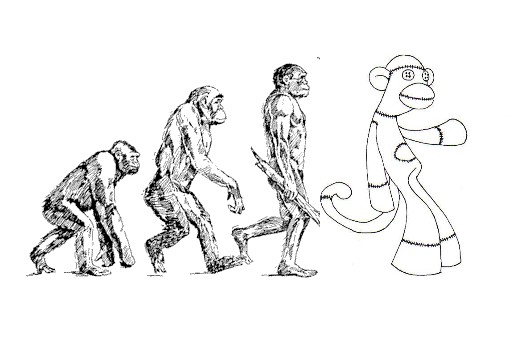
sock monkey image from cthulhufhtagn.deviantart.com

In the above quotation from the novel Sophie’s World (which I finally got through a week ago), Alberto Knox—the story’s philosopher—discusses with Sophie the nature of creativity and how it follows the natural selection of Darwinism:

“Thought-mutants occur in the consciousness one after the other, at least if we refrain from censoring ourselves too much.  But only some of these thoughts can be used.  Here, reason comes into its own.  It, too, has a vital function.  When the day’s catch is laid on the table we must not forget to be selective.”

Oh, that Alberto and his way with analogies…sorry, can’t help being sarcastic toward this book. Disregarding the tremendous education on philosophy it provides (which in itself is good reason to read the novel, and I’m glad that I did), it’s the fictional aspect of the plot that pricked into my skin like so many fleas in my fur. An interesting attempt to provide an entertaining means of digesting large concepts and history, the fictitious story line that distinguishes this as a “novel” versus “textbook” fell a little flat for me. The dialogue was unbelievably forced (most of Sophie’s comments/questions simply served as breaks or segues in the long lectures), and though it takes an interesting twist mid-way through, the characters and thin plot just didn’t endear themselves. Quite frankly, I found Sophie to be a precocious little twit. But I digress…

In any case, what he’s getting at here is that imagination generates the ideas, but reason weeds out the “mutants” and selects the best ones to carry on.  The plot twist in the book also ushered in some self-reflexive commentary on writing and the manipulative power the writer has over those ideas, settings, and characters in his/her charge. As far as the creative process in general, Alberto continues to say (with another analogy in practically the same breath as the first…):

“Maybe the imagination creates what is new, but the imagination does not make the actual selection.  The imagination does not ‘compose.’ A composition—and every work of art is one—is created in a wondrous interplay between imagination and reason, or between mind and reflection.  For there will always be an element of chance in the creative process.  You have to turn the sheep loose before you can start to herd them.”

This “wondrous interplay” is what laboriously polishes our inspired first drafts into final manuscripts. It’s what also keeps us in check so we don’t overly pillage our paragraphs of the words and thoughts that breathe soul into them; all too often, reason defeats imagination when there should instead be a balance of power.

Unlike the negligent Dr. Frankenstein, however, we do need to be mindful of what we bring into being. Our stories inspire us, they speak to us, they surprise us, yes, but they also rely on us to nurture and shape them, to help find a suitable place in the world for them. It’s still essential to follow the writing rules so we don’t feed our stories after midnight or get them wet, thereby leaving the sweet Mogwais of our imagination to metamorphose into Gremlins of loose redundancy and holes. That said, I don’t mean to be harsh on our uncensored minds, and perhaps my title isn’t fair in calling our first drafts “shit”…but far be it from me to pass up a good rhyme, and, anyways, sometimes they just really are ;).  (I think Sophie’s World, for example, might’ve benefited from another read-through…)

Serendipitously, at the same time as I’d read the chapter quoted here and mulled over this intellectual tightrope, Tahlia (author of Lethal Inheritance who blogs on the site of same name) posted “Do we write a story or uncover it?“—here, she asks how much we write using our rational intellect versus not thinking and just going with the flow.  It seems we universally tread this fine line, leaving us with this:  To think or not to think…that is the question when it comes to the evolution of our story.


Schoolhouse Crock

In the wake of my previous post on “taboo” words, I came to a horrifying realization: writers are going to put Lolly’s, Inc. from Schoolhouse Rock out of business!!!

A three-generation family business…I just don’t know if I can live with the guilt!

I therefore reemphasize what I said last time about still using the supposed no-no words like adverbs—just do so within reason—and I think dialogue or 1st-person narration deserves some leeway as well if it’s authentic to how a person would really speak.  So I guess I’ll still be unpacking my adjectives, too, but with discretion.

Working through this experience has introduced me to writer rules that *gasp!* I wasn’t necessarily teaching my high school students…when it came to dialogue tags, I confess I’d tell them that “said” is boring, so their characters should “exclaim” or “sneer” or even “smirk” something—I gave them a worksheet, in fact, that listed up to 50 different tags!  Gah!  And in looking at said worksheet, go figure the examples I used for dialogue punctuation:

I asked, “Did you see the monkey fall out of tree?”
Did you just say, “The monkey fell out of the tree”?
I screamed, “The monkey is going to fall out of the tree!”
He had the nerve to ask me, “Why didn’t you catch the monkey when it fell?”!

I will say this in my defense (not of subjecting my students to endless monkeys in their grammar examples ;), but of how I taught descriptive language):

– First of all, children and adults alike who are not naturally expressive in their writing do benefit a great deal from first learning what vast options their language provides them so they can later practice restraint when making more sophisticated stylistic decisions.

– Second, I certainly wasn’t teaching them that more words are better, merely that each of the words they are using should pack a punch.  It’s not about being redundant, it’s—for example—saying that someone “saunters” rather than “walks” or that the fish in the garbage smells “putrid” rather than “bad.”  These one-to-one swaps are sufficient in themselves to strengthen a sentence.

Thus, in their revision workshops, I’d ask them to comb through their writing and seek out any general nouns, verbs, adjectives, or adverbs and replace them with more specific ones.  They were also to identify which senses their descriptions appealed to and strive to address all five at some point.

“Writers with style never just eat breakfast.  They munch on granola, wolf down hotcakes, savor Frosted Flakes, or gorge on jelly doughnuts.” – Art Peterson, The Writer’s Workout Book: 113 Stretches Toward Better Prose

I must say it’s very fun, let alone ironic, playing the pupil and trying to follow my own and others’ lessons, and I’m grateful for the new perspective I’ll eventually bring back to the classroom.  I’m not only strengthening as a writer, but also as a teacher.


The Shotgun-Shack Story: Nowhere to Hide

The-Breakfast-Club-movies-21223076-1558-800

I’ve been sitting on a topic for a while that a recent blog post on Lethal Inheritance  has spurred me to finally write.  In Tahlia’s post, “Is writing the second novel easier than the first?“, she discusses how she has started writing her second book while her first manuscript awaits publishing.  She mentions ways in which this second story line differs from the first:

“[I]t takes place almost entirely in one set of adjoining suites in a castle, whereas Lethal Inheritance’s scenery is always changing. Thirdly, it’s character, relationship and emotion driven, rather than action driven. For me, that’s a harder brief, and that’s why I’m not sure at this stage if I can make it work.”

To which I responded:

“What I’ve been working on to date falls in that [same] category; there are not dramatic changes in setting or adrenaline-rushing action as it’s very concentrated on the psychological/emotional variations in my protagonist as she questions identity and her perceptions of reality.”

I proceeded to say that, though this is the type of story I’m personally drawn to, I realize it doesn’t necessarily have the mass-market appeal that would get it snatched up for publication.  And that’s okay—I am definitely writing the story I want to write; I started rereading it from the beginning yesterday and am all the more convinced of that.

So, today I’m dedicating this post to those incredible stories out there that capture our attention without catering to the modern-day ADD bred by MTV-esque rapid editing and car chases and explosions.  I’m not saying I’m not likewise entertained by the action-packed tales, just that they are not the only ones capable of, in fact, entertaining.

I attended a writing seminar last year in which a panel of agents, publishers, and authors spoke on the craft of writing in conjunction with getting published.  Someone in the audience had asked about commercial versus literary fiction, and an author responded that “commercial” fiction is story-driven whereas “literary” fiction prioritizes language and ideas—it is read for the beauty of the words and provocation of thought.  She attested that many authors try to combine both.

This got me thinking, then, about the more character-driven stories that I enjoy.  Where films go, I noticed a trend in my collection of one-setting movies; indeed, some partake in just one room.  Think about that!  One room.  If a film or novel can captivate you all the way through by virtue of situation and dialogue without having to change settings, that is a brilliantly written manuscript, in my opinion.

Don’t believe me?  Try watching Rear Window, 12 Angry Men, Rope, or, hey, even The Breakfast Club—all of which take place in a single room (with the exception of maybe a minute or two outside)—and tell me that you aren’t entertained.  These are carried by characterization and dialogue, just like other favorites of mine:  Before Sunrise and its sequel Before Sunset (which both admittedly change settings, but the respective cities of Vienna and Paris are just backdrops to the characters’ ongoing conversation), The Anniversary Party (an ensemble cast in a Hollywood couple’s home), and Gosford Park (in the vein of the Agatha Christie books I loved as a kid that transpire in a single setting—a mansion in And Then There Were None and a train in Murder on the Orient Express).  And it doesn’t take dramatic, in-your-face action and cutting from setting to setting to get the blood rushing, as not only evidenced by these mysteries and the two aforementioned Hitchcock films (Rear Window and Rope), but in haunting thrillers like Dead Calm and The Others as well…which coincidentally both star Nicole Kidman, the first taking place on a sailboat and the second in yet another old English mansion.

In speaking on setting, the visual examples of this most readily come to my mind through film, but the success in capturing even a viewer’s attention in this case comes down to the writing.  The writer scripts the dialogue and envisions the setting and behavior of the characters—in film, the director then works to capture this audiovisually.  Yet in a novel, it is all on the writer to convey these elements entirely in words.

Stripping away the attractive actors, elaborate sets, and soundtracks does not render mere words dull, nor is a single/minimal-setting book a bore.  If that were the case, where would that leave the classic works of authors like Austen or Bronte, whose stories don’t deviate far from the character’s homes.  Think of the chill sent down the spine by novellas like Henry James’s The Turn of the Screw or Poe’s The Fall of the House of Usher (houses), the adrenaline and fury aboard Hemingway’s The Old Man and the Sea (boat), or the intimate existential conversation in Salinger’s Franny & Zoe (the entire second part moves only from the bathroom to the living room) or Boethius’s 6th-century The Consolation of Philosophy (a prisoner speaks with Fortune in his cell).

What is it about the single-setting that so fascinates me?  I suppose it’s in part the appreciation I feel for the effectiveness of story-telling that doesn’t rely on bells and whistles.  And it’s the great experiment of what happens when you isolate people in a room—throw in a dash of tension, stir, and bring to a boil.  It becomes a study of humanity when characters aren’t able to escape each other or even themselves:

There is much heart, soul-seeking, and thrill to be had within four walls.  A writer can most certainly pull it off, though the impact can only be as strong as the writing itself in bringing it from the corners of a room to the corners of the mind.

How about you, readers and writers—do you gravitate toward the story-driven or character-driven?  What are some examples that successfully combine both?


The Fear Factor


The Prompt:

I love how Bonni Goldberg relates writing to medicine when it comes to protecting us against our fears:

“You take small doses of your fears in combination with written words and they create a kind of antibody: a cathartic human experience that authenticates your strength and fragility.”

Page 42 of Room to Write, then, asks us to write a list of our fears and describe one in more specific detail.

Response:

Some things I fear:

– geese

– clowns

– confined spaces

– death (mine, but mostly loved ones)

– being in any way “too late” for anything by the time I move back home

– losing my sight or hearing

– the debilitating effects of aging

– having children

– lack of purpose

– never finishing my book

– rejection

– regret

Okay, I think that’ll do.  Now, to pick just one…it’s tempting to go the route of writing-related fears, but I think I devote enough of this blog to that!  How about the “too late” factor, as I feel it’s one needing more explaining:

The fact that my aging parents continue to age in my absence while living abroad positively terrifies me.  I know many will find that irrational and say that I have to live my own life, but I will never, never forgive myself if something happens to either of them while I am an ocean away.  Just writing this right now is bringing me to tears.  It is something I really, truly cannot stand to fathom.  And I don’t want to miss out on my nieces’ and nephews’ milestones, nor do I want the littlest ones to not know their Auntie.  I am not the person who realizes what they have only when it is “too late”; I’m the person who has always known perhaps too clearly, which is why I would have never left in the first place if it were only up to me.  I don’t think of it as something holding me back; being with my family is actually part and parcel of my life’s ambitions, so anyone who thinks I should feel otherwise can suck it 🙂

My own aging has started to frighten me as well.  I don’t consider myself to be old, but my husband and I have agreed to wait until we return home to our support network before starting a family, at which time I will most definitely be at the infamous cut-off age that younger mommies love to throw out there as the danger zone of higher risks and mandatory tests.  Gee, thanks for making me feel geriatric.  Sorry my last decade has been pleasurable and focused on my needs and catering to my own identity before I give it over so fully to a little person of my making.  I genuinely hope I didn’t just offend any mothers reading this—I think parenting is the most noble occupation for one to assume, but it’s not my fault that I didn’t get married until after my friends were already popping out kids and that other life changes have thrown me for a loop such that there’s a lot I need to get sorted before I feel I could do a remotely good job of it myself.  So I’ll put off applying for that particular position a bit longer; yes, I know, at my own risk.  *eyes rolling*

Returning to find that my old job (for which I was only 1 year away from getting tenure) is not remotely available to me anymore is scary.  I moved the very week that the economy tanked, and what I’d considered a recession-proof job has still managed many layoffs since then, and some departments have frozen their hiring.  Barring that, even if I can vie for a position, perhaps I’ll be judged negatively for my time away from teaching; the powers that be may frown upon my rationale, not find value in how I’ve chosen to apply myself since then.  Even worse, what if I fear teaching itself?  After such a long hiatus, I’m no longer riding the momentum of consecutive years ramping up in the profession.  The flexibility (and sleeping in!) of my present days will be lost, and never doubt the intimidation of staring down 125+ teenagers a day and, even worse, their parents who will too quickly point the finger at you for the consequences of their own lack of parenting at home.  Then again, if I end up not having kids of my own, teaching is a great way to play surrogate.

I think what is overall frightening me is the realization that my life at home did not simply freeze once I took off on that plane, preserved in its tableau of near-perfection while I have my fun and then return to reinsert myself seamlessly back into it.  I will not be entirely the same person either, after all; current experiences are carving me from a square to an octagon-shaped peg.  So I fear the transition that will be repatriation, after expatriation was already so difficult.  I fear feeling out of place in my own home and possibly acknowledging a discontent that wouldn’t have otherwise been there.

But, you know, so be it.  Rejoining my family, starting a family, returning to teaching…I cannot think of three things more worth facing that fear.

Reflection:

First of all, allow me to apologize.  Addressing personal fear just automatically lends itself to a whiny rambling of self-pity, so thank you for bearing with me through it if you’ve made it this far 🙂  I don’t think this activity has brought out any special writing, per se…the fears are plain, so embellishment didn’t come naturally—the way I wrote it is not creative or revelatory.  It didn’t make me realize anything new about myself.

Maybe selecting a different fear or writing in another frame of mind would have made all the difference, but the one thing I can take away from this exercise is the fact that Goldberg was right!  When I started writing about this, as I said, it made me cry—it thrust me into my fear and made me tremble in the face of it.  And yet the more I wrote, the easier it was to pull out of this vulnerable state; putting it in writing made it very plain to see that, while my fears may be justified, they really aren’t as big of a deal as I sometimes let them be.  The more I wrote, the more my heart quieted and the more my mind said, “Poor you with the wonderful family and profession and wonderful period of creative flexibility and travel that you have in-between.  To have had it as long as you did is a gift, and you still might get your cake back to eat it too—or even be okay if you don’t.  So in the meantime, buck up.  Deal.”

In short, facing my fears was embracing my blessings.

And you, brave readers of mine?  What are you so afraid of? And how might your fears impact your writing?