Category Archives: Novel

Pacing Your Pages – Part I

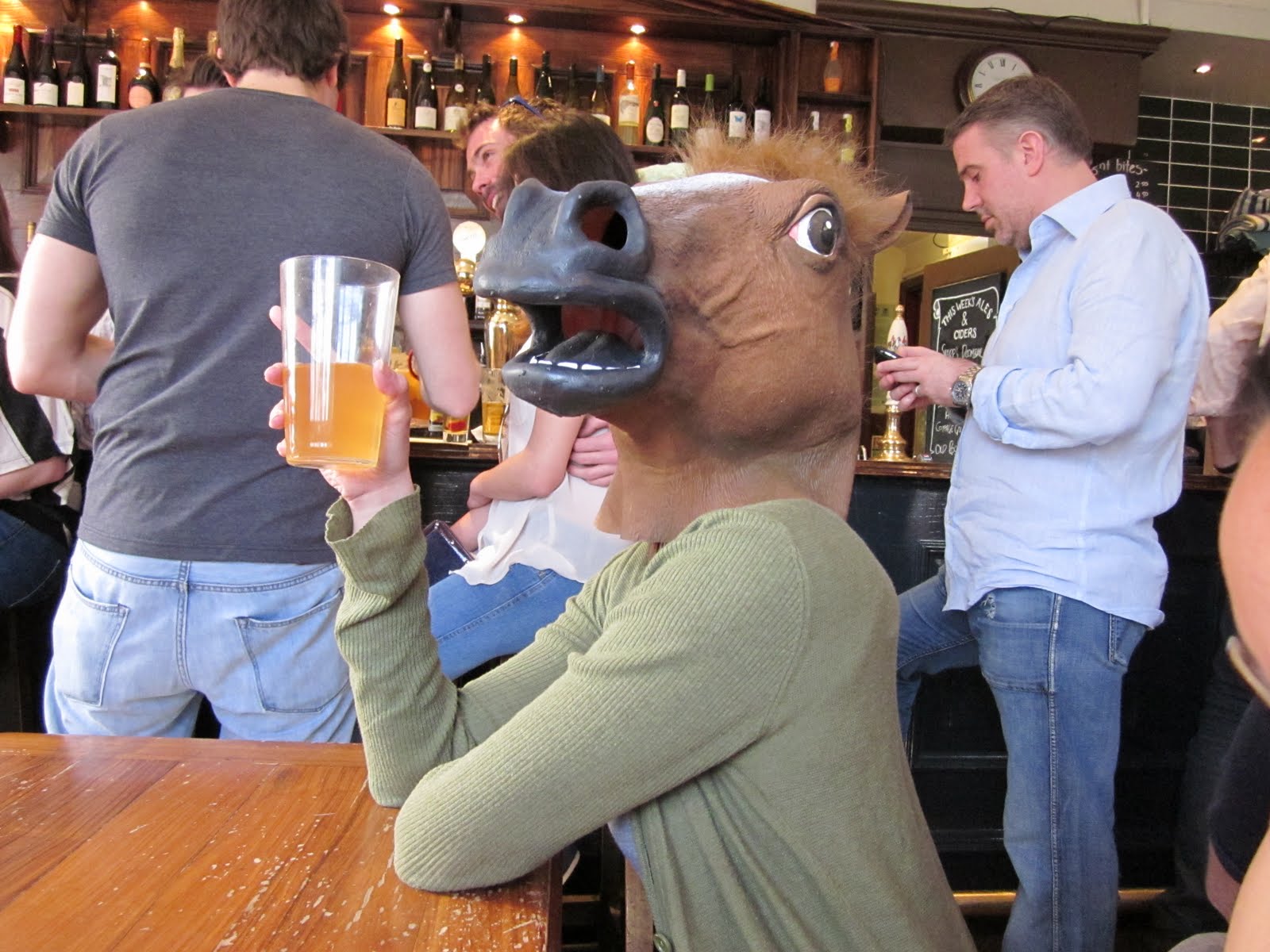
Whoa there, horsie! Slow-n-steady does NOT always win the race...

Ah yes, welcome back to the Animal Kingdom, where if I’m not a monkey, I’m evidently a horse…let’s just say my husband and I are big fans of the Grand National and cheer the horses on the best way we know how from the pub. Now the Grand National is a looong-lasting steeplechase, so, just as in the London marathon two days ago, the runners have to pace themselves strategically so they have enough energy to race through the climactic finish. But that doesn’t mean they start walking, and, of course, it’s crucial they stay on track. Likewise, the workshop I attended, “Pacing: Or, How To Keep ‘Em Turning Pages,” at the York Festival of Writing instructed on how to keep the pace of your novel moving without meandering off course.

To start, as you can see on the right side of the screen, I’ve just started reading the novel Getting Away With It. I’m doing so for entertainment, yes, but also as a lesson in pacing—it so happens that its author, Julie Cohen, led the above-mentioned workshop, so I thought I’d check ‘er out.

Cohen started out by noting “novel time” and recommended using a blank calendar to map out the story’s timeframe (bearing in mind “reader time,” the timeframe during which the readers actually read it…you want to keep a novel moving, but you also want to work in enough time for your readers to catch their breath). And while a longer novel versus a shorter one can allow more breathing room for character introspection (which are necessary moments), she recommends against over-using it.

As for conflict, Cohen calls us the “Time Lords” over reading time. 🙂 What she means is that reader time is subjective; it’s the writer who manipulates it. And she advocates doing so by including as much conflict as possible in each page, which I’m sure we’ve all heard before:

A lot of well-handled conflict will go quickly, no matter how many pages.”
Julie Cohen

She’s not talking car-chase, high-drama conflict at all turns but, rather, varying types of conflict—this could be any of the usual types: Man vs. Man, Man vs. Himself, Man vs. Society, Man vs. Nature. A blend of these conflicts are likely occurring in your novel, and Cohen suggests tracking them via a color-coding system to map out how they coincide chronologically. This can help you visualize the interplay of conflict as well as an approximation of your story’s shape.

Next up is function. A pacey book is efficient in its storytelling. Among the functions its chapters/scenes serve is moving the plot/subplot forward, developing character, creating emotion/atmosphere/conflict, and imparting information. But if you find you have several scenes serving the same function, either condense them or add in additional functions. A good way to determine this is to make a “scene function” list.

Also essential to pacing is starting and ending each scene with a hook, as well as giving your reader variety in mood, topic, theme, and style. To demonstrate the efficacy of this, Cohen had us do a simple exercise with Shakespeare’s Romeo and Juliet (it took a teacher to identify another teacher right off the bat, by the way—her presentation style was straight out of the trenches of keeping teenagers engaged, complete with energy, worksheets, and jigsaw activity. Everyone loved her! :)). Anyway, she’d provided a list of consecutive events from Act 1 Scene 1 to Act 2 Scene 2, and we were to label each with symbols denoting different tones, emotions, characters, and dramatic points of the story. The result is…*drum-roll*…That’s right, variety. You see an interplay of different elements without formulaic repetition.

Putting your readers on a rollercoaster is going to make them think and feel like they’re going faster.
Julie Cohen

So in an attempt to pace myself and allow time to digest the above, I’ll quit here and resume with the rest in Part II. But to practice my lessons, I’ll end on a hook. While I haven’t yet shared the punch-line to my “Why did the monkey fall out of the tree?” joke, I’ll leave you with this one, in keeping with today’s theme:

A horse walks into a bar, and the bartender says


My Book Fair Lady

“And without much ado
we can all muddle through
without you
.”
My Fair Lady

‘Tis the season of literary shenanigans, it seems. So soon in the wake of the Writing Festival in York came the London Book Fair this week. It was right in my neighborhood (practically “On the Street Where [I] Live,” so I figured it wouldn’t hurt to pop in, although I didn’t find the lengthy list of sessions to really offer much to writers themselves—more of an industry thing that didn’t leave me feeling “I Could Have Danced All Night” riding a book-high. What I definitely took away from it, though, is that traditional publishers are shakin’ in their boots a bit at the digital revolution occurring, that growing options for self-publishing are eliminating the gatekeepers of the industry, and that marketing your book requires the same amount of legwork on your end whether you’re traditionally or self-published. Contrary to popular belief, traditional publishers don’t guarantee you “discoverability” and may not allocate much money toward your marketing. So establishing your own fan-base via social media well in advance of your book’s submission/publication is key, as is making the effort to put yourself out in the community for book signings, speaking events, etc. afterwards.

The quotation yesterday that made me *gulp* at what I surely already knew:

“Writing is a passion. Publishing is a business.”

Meh. Nothing new, but it in a nutshell reminded me of the aspect I’ve disliked so much about this process so far. The best part was when I was just writing. But researching for submissions and revising in light of rejections and being overall totally lame where networking and self-promotion are concerned do kill the spirit a little… And yet it’s also rather exciting, isn’t it? I’ve always needed a challenge, and facing one that seems practically insurmountable is quite the motivator and defeater all at the same time.

The talk of self-publishing and e-books, though, I find heartening, and here’s my thoughts on it these days. It’s by no means a last resort—it’s getting your work out there for others to read, which is the point of wanting to get published, isn’t it? Yeah, it costs upfront for printing, cover design, and editorial services (money will always be a damn gatekeeper). But, barring that factor and looking at it just conceptually for a moment, if you have to market the crap out of yourself anyway, why not get a faster start at that to grow readers sooner? It’s not like you still can’t query an agent or publisher with that same manuscript afterwards. You still own the rights to it, no matter what, and you’ll have a nicer format and (hopefully) readers/reviewers by then to vouch for its content. I don’t know… What was sad and somehow so cute at once was that an older gentleman I’d met yesterday explained that he wants to self-publish because he doesn’t think he has enough time left to wait out the years traditional publishing could take. Aw 😦

It leaves me thinking that after I finish my current round of revision, I’ll do a massive query blast (my December/January queries were just dipping my toe into the waters), and if I don’t hear anything in the affirmative as the months roll by, self-publishing is the attractive option from there—even despite the stigma hovering over it. There are so many ill-edited indie books being put out there (simply because any schmo can), so it’s almost an obligation for diligent writers to get theirs in that market, too, and dilute the stereotype. I’ll stop spending money on freaking workshops and allocate it toward a professional editing service, then maybe start with an e-book until I can justify the funds for a print version. And then, I query-blast again! My publisher search would remain ongoing. So that’s a game-plan I’m at the beginnings of formulating in my head, anyway… Time (and funds) will tell.

Wouldn’t it be Loverly,” though, to go that route and say, “Just You Wait,” publishers, I can do this “Without You“!

So what are your thoughts on self-publishing (digital and/or print) versus traditional publishing? Is the former an option you’ve seriously thought about? Why or why not?


The Red Pen: The POVerdict

Hiya! Crap, it’s been a while, and I apologize for that. Especially when I have so much I want to share with you!

For today, though, I’m pleased to just announce that we’ve finally found compromise on the POV issue I’d related earlier. To quickly recap, an author I’m editing for had been writing through a sort of hybrid 3rd person limited/omniscient POV. The story alternates between POVs such that we have the sort of “head-hopping” found in an omniscient perspective, but it’s only between two characters (not all), which would signify the POV is limited.

So we originally thought entire scenes/chapters would need to be rewritten from one character’s POV or another to keep within 3rd person multiple limited perspective. This would entail extensive revision and kill some of the playful back-and-forth between the two main characters. On the other hand, revising it to be omniscient would be a lot of work, too, as additional characters’ thoughts would have to be written in. The solution proposed, then, is to simply insert section breaks between paragraphs where the POV makes the jump. The section breaks will serve as a visual cue to the reader that POV is going to shift, so the author can jump between her main characters’ thoughts within the same scene. In short, it hopefully means hardly rewriting anything; instead, it’s more of a structural revision. We’re lucky in this case that most of the scenes are in multi-paragraph chunks within a single POV to make this possible.

In the instances where we see a POV shift on a sentence-by-sentence level, on the other hand, the author will need to commit to one POV or the other and rewrite them as such. Again, though, this should be easy, as in a lot of cases, one character’s POV is definitely dominating, so it’s only a matter of revising stray sentences here and there.

I can’t share the author’s work here, so let me make up some BS text on the spot to demonstrate what I’m talking about:

Lucy was livid when she found out she had to revise her manuscript. She simply didn’t understand the problem with the way she approached point of view.

Bob, on the other hand, didn’t understand what the big deal was. Why couldn’t Lucy just suck it up and do it the right way?

Lucy looked at Bob and huffed; it figured he wasn’t going to take her side on this. [and this paragraph continues in Lucy’s POV…]

[Another paragraph in Lucy’s POV]

[Another paragraph in Lucy’s POV]

[A paragraph in Bob’s POV]

[Another paragraph in Bob’s POV]

[Another paragraph in Bob’s POV]

So, obviously the red font denotes Bob’s POV. We can see at a glance that Lucy’s POV dominates the first few paragraphs of this “story.” The first section, then, should be solely from her POV; therefore the two sentences from Bob’s POV that have strayed into there need to be rewritten into Lucy’s POV—what is there needs to be reasonably inferred by what Lucy can observe of Bob’s outward actions or dialogue. What we can also see at a glance here is that, once Lucy’s POV ends, we have a few paragraphs solely from Bob’s. This is okay. Nothing requires rewriting; all we need to do is insert a section break before Bob’s POV begins. Then the reader hopefully won’t be as confused when the scene suddenly continues in his head.

The revision (in bold) can look something like this:

Lucy was livid when she found out she had to revise her manuscript. She simply didn’t understand the problem with the way she approached point of view.

“I don’t understand what the big deal is,” Bob said. “Why can’t you just suck it up and do it the right way?”

Lucy looked at Bob and huffed; it figured he wasn’t going to take her side on this. [and this paragraph continues in Lucy’s POV…]

[Another paragraph in Lucy’s POV]

[Another paragraph in Lucy’s POV]

***SECTION BREAK***

[A paragraph in Bob’s POV]

[Another paragraph in Bob’s POV]

[Another paragraph in Bob’s POV]

Alternatively, the rewritten portion above could still have Bob not say anything. Something like:

Lucy looked at Bob and huffed. She could see from the way he screwed his face that he didn’t understand why it was a big deal. It figured he wasn’t going to take her side on this.

In a case like this where part of the original does get cut, if it’s something the author really likes and doesn’t want to lose entirely, she can try to find somewhere else to fit it without infringing on the wrong POV.

I don’t know how much sense I’m making with this, but let’s just say the author seems happy about it, which makes me happy. And let me also say there are entire scenes only in one POV, so the whole thing is not going to be chopped up in small sections all the way through. That would be a whole new issue if so.

I can’t say, though, that I’ve read many (if any) books like this. What do you think? Is this a reasonable approach that you’ve seen before (and that’s been done well), or do you think it’s still confusing for the reader?


The Second Coming: If at First You Don’t Succeed, Write and Write Again

Image from etsy.com

I’ve got lots and lots of material to share and will do so in the coming days (or weeks, more realistically, given the bat-shit craziness of my sheh-jule these days…). And what I’m noticing right now is that my writing life is experiencing a rebirth of sorts that has me coming back for SECONDS…

To start, while the jury is still out on the POV issue plaguing my first editing project (see “POV for Vendetta“), I’ve been assigned my SECOND PROJECT, which is already presenting issues of its own. In this case, the author is safely applying 3rd person limited across different characters by only shifting POV in new sections and/or chapters. However, its story arc is sagging in the middle due to a repeating element that flattens it out through lack of variety. In future posts, I’ll speak to both my editorial comments on this specific manuscript as well as pacing a story in general.

In the last couple weeks, I have also been mapping out a SECOND MANUSCRIPT of my own! Idea remnants that got left behind as I finished my first manuscript have inspired another story line altogether, so I’m working to apply all I’ve learned from my many, many mistakes on manuscript #1 to what will hopefully be a better planned and executed #2. Outlining the plot from the get-go is a first for me, as I’d nearly written myself into a hole the first time around and didn’t know how to bring it all together (see “Fraying at the End“). So while ms #1 accordingly still needs a lot tender lovin’ care, ms #2 is providing my mind a healthy diversion for a while. Having a second project in the pipeline also keeps me from placing too much pressure on that first one navigating its path to publication. As presenters at my workshop said last weekend, hardly any new author’s “debut” novel is actually the first book they’d written.

Speaking of workshop, I got a SECOND WIND for tackling both the manuscripts I’m writing and editing by attending the Festival of Writing in York this past Saturday and Sunday. In addition to two ten-minute one-to-one meetings with a literary agent and published author (the latter being Charles Darwin’s great-great-granddaughter, no less), I attended several workshops on topics like plotting, pacing, and marketability. It gave me gobs of food for thought, so I’ll share what smattering of notes and resources I can with you.

Finally, while I admittedly didn’t churn any creativity out during the month of February for Write 1 Sub 1, I feel I’ve gotten a SECOND CHANCE this month thanks to my sister-in-law, as fate would have it. This ridiculously talented lady is a graphic designer by day and painter, photographer, and potter by night. Her latest endeavor is to create a website for her lovely pottery, and instead of presenting each with an ordinary catalog-type description, she’s opted to pair them with short stories inspired by their design and function. So guess who’s the lucky gal who gets to write these?! I’ve written five short-short pieces so far with five to go (as far as I know), so hopefully these will be appearing online by mid-April. While I still aim to write stories for submission to literary publications in subsequent months, I’m hoping this gig at least covers me for March.

All right, time to shut my yapper. Just a preview of more posts to come after I take a SECOND to catch my breath… 😉

What’s on your writing agenda these days? Any writing firsts or seconds to celebrate this month?


POV for Vendetta

“[F]airness, justice, and freedom are more than words, they are perspectives…[I]f you see what I see, if you feel as I feel, and if you would seek as I seek, then I ask you to stand beside me…”

V for Vendetta

In the time since my last post, my eyes healed (thank you for your well wishes on that!), and I’d come to trade my sunglasses for a different mask of sorts…one that had tried to preserve an eternal grin to bear the POV debacle that was crashing down on me just as I set off on holiday last week.

Don’t fear. Though I now live in London, it is not my intention to load a tube train up with explosives and send it on its merry way to Westminster. (I did infiltrate Parliament once, though, back in ’98 when my friend—an intern—snuck me in. I stood on the MPs’ terrace and drank a Carlsberg in the pub they have in there. Oh, and I bumped into a blind MP, which made me feel really bad. In all fairness, however, he should have been able to smell me from a mile off, as I’d just gotten in from a train from Spain via Paris and hadn’t showered in all that time. But I digress…)

Anyway, the real issue at hand concerned the manuscript I’m editing for my freelance work with an independent publisher. I will certainly assume the title of “Dufus” on this one, but the whole situation really has had me reevaluating my perspective on, well, perspective…a.k.a. point of view.

So here’s the deal. The author intended the novel to be 3rd person limited POV, which is precisely how I read it as well, correcting here and there for stray thoughts of other characters to which the POV was not limited. This is a romance, and the two lead characters that comprise the central romantic couple share the limelight 50/50, as do their thoughts. The writing was strong, so it honestly didn’t confuse or distract me through my many reads of this ms that the POV was head-hopping between the two, sometimes on a paragraph level. I made sure the POV didn’t shift within a paragraph, but I didn’t see anything wrong with it doing so between these two characters within a scene.

Okay, technically, that’s more omniscient than limited where 3rd person goes, and that’s what the managing editor at the stage beyond my developmental edit called us out on. For 3rd person multiple limited, shifts in POV between the multiple characters should be denoted by a section or chapter break. If this author is asked to revise for this (which she was last week and, thank goodness, spoke up about it, as I agree with her), it’ll be like rewriting half the novel, and the playful sexual tension that the omniscience delivers so well will be squashed. If she’s required to adhere to this technicality of 3rd person limited, that is…

As it stands at present, our appeals induced the managing editor to forward the ms to the other MEs for their opinion on whether it can work as-is or be revised as 3rd person omniscient instead. The author and I are strongly preffing this option, as it’ll not only be a significantly less extensive revision, but will preserve said back-and-forth tension. It’s not that this tension couldn’t be brought about otherwise, just that it hasn’t been written that way all along, so in the direction the story has since gone, it would be difficult to change and really sap it of its spirit, at this point and in this particular case (you’d have to read it to know what I mean).

So this is my question to you: Why can’t a 3rd person limited POV (limited to multiple characters) head-hop between the characters it’s limited to if it’s been done in a skillful manner that is not confusing and actually enhances the tone and conflict of the text? Now, if this author is given the go-ahead to switch to omniscient, she’ll be adding thoughts of secondary characters as well, which is only promoting further head-hopping and extremely unnecessarily, all in the name of convention. Why would it be okay to hop around several different heads instead of just two if it’s all about ensuring clarity for the reader? Why can’t an “omniscient” POV be limited to two characters? Am I making myself sound like even more of a dufus?

My fear stems from the true limited POV being that of these editors who shun 3rd person omniscient (along with 1st person multiple perspectives—in that case, um, hello? Time Traveler’s Wife? Poisonwood Bible?)  from the get-go because they so often see it mistreated by inexperienced writers. I understand that perspective, I do; green writers can easily make a mess of either one, and do. Yet I don’t think it’s quite fair to essentially adopt as a policy when there are more skillful writers (even first-time ones) who do pull it off. So it’s my latest bone of contention that is rendering Point-of-View my Pain-in-Ass.

By the way, this is really, really humbling for me to share as both a newbie editor and former English teacher, for cripes sakes! I guess the wonderful world of creative writing will always be full of surprises, just when we think we’ve dissected it down to a science. If there’s anything to be learned in this, it’s that I have a lot to learn…which makes it difficult to know when to fight for what I think is fair, just, and promotes creative freedom or to just grin and bear it.

Have you encountered this issue with POV in your writing? Can you think of examples of literary works that somehow defy narrative convention and pull it off?


Hedging an Investment in Myself

“Fiction submissions should have no discernible genre. While the fiction editor enjoys writing that plays with form & conventions, and is eagerly awaiting writing that sparkles with surprise, it is widely known that each time a vampire story is written, somewhere an orphan dies.  Shame on you.”
– Ampersand Review Submission Guidelines, as quoted from Ampersand Books’ website

This, my aspiring author friends, this is the ray of sunlight I’ve been waiting to see in perusing the publishing world online to find who to query next. Hands-down the best submission requirement I’ve yet to find—bravo to them for lauding originality when everyone else seems to want the next Stephanie Meyer…

[Disclaimer: I’m in a mood, so this post may sound cynical or overly rationalizing in the way diva amateur writers do so well. Would I be saying any of it if I had an offer for publication and thousands of blog followers clamoring for their signed copies? Yeah, probably not. Fickle monkey.]

The fact is, reading used to be a joy. Writing used to be a joy. And then I entered the literary cyberworld. Suddenly, I was blogging, and stalking my WordPress dashboard to see how many hits I got, hooking the Monkey up with its own Twitter account and Facebook page, straying from my simple, original purpose of just writing for writing’s sake to instead wax philosophical and egotistical on my writer’s journey toward publication (as I’m totally doing now!), becoming paranoid that I’m not blogging as often as others or commenting enough on other blogs to link back to mine to grow an audience for my writing, then reading about authors obsessed with Amazon rankings, authors dissing reviewers, reviewers dissing authors, agents dissing queries, publishers dissing anything straying from formulaic conventions that feed their bottom line, and AAARRGGHH! I JUST WANT TO WRITE. I want to write what I want to read. And I want to read what I want again without comparing the author’s writing to mine or wondering how she worded her query letter and synopsis to land an agent and publisher, or what social media efforts she undertakes to get the story out there.

It’s exhausting. Am I alone in thinking this? And am I alienating myself from your support by letting my defenses down for a bit and starting to stitch up a white flag of surrender? I promise I won’t be waving that flag, but at present I’m feeling quite annoyed and really rather bored by this commercial racket.

I also recently wrote about letting go of the ego that can have so many writers sucking their tongues from the roofs of their mouths and heaving a sulky sigh at the criticism they receive of their work, and I vow to not become one of these…but that being said, I just turned down a generous option to rewrite my manuscript (which lies at the intersection of multiple genres) in a way that would conform better to what readers of one particular genre expect. Even though that could give me a better shot at getting it published with a certain indie publisher (as opposed to potentially no one), I’ve made the decision that I can’t make the story or my writing style something it’s not.

This is not going to be my commercially marketable manuscript; I know that and am at peace with it. And even if it were, do I even have the moxy for self-promotion? Who knows, maybe I’ll churn out a mainstream potboiler next time round to wedge my foot more firmly in the door, but seeing there are still proponents of non-formulaic literature out there gives me enough hope to keep pushing the story I’ve got now in a digestible form still faithful to its original vision (because I am revising, and substantially—don’t think that I don’t take constructive criticism to heart!). I will climb back up my tree and nurture its scraggly branches, dolling it up with an ornament or two and conducting necessary trimming, yes, yet pruning it in a shape still reflecting its natural growth rather than Edward-Scissorhanding it into a poodle.

In short, and in the profound words of Charlie Brown, “This commercial dog is not going to ruin my Christmas.” Metaphorically speaking. 😉


The Red Pen: Editing Another’s Manuscript – Part II

Hello again! Just accommodating the overspill from yesterday’s post, as I yet wanted to address developmental edits on my first manuscript assignment in this capacity. Again, I can’t share any comments that would give away plot/character specifics, and I’m obviously not including the little microediting minutiae here (like reworking sentence structures), but what I am doing is grabbing the meatier highlights of what I found to be the most prevalent issues in the hope it helps reinforce what to check for in your own manuscript as it did for mine.

So to speak on a macroediting level today, this author’s main focus now as she makes her edits (due back to me later this month) needs to be on her ending. We’ve talked story arc before, and a scene after a critical moment of rising action in a later chapter seemed to drag out too long as the reader nears the story’s climax, for which I noted:

[…] I’m not suggesting cutting these parts out, as they serve a purpose in the story and provide important information. Yet perhaps if they’re condensed a bit the pacing could keep flowing toward that climax. What’s key is to determine what you perceive as this story’s pinnacle and make sure everything is building up and up to that, keeping the reader compelled and not bogged down in too much talk or description that tends to flatten out the story’s trajectory when it should be climbing. Dialogue can be [tightened], limiting it to what keeps moving [the characters] and the reader forward.

And whereas that section seemed to drag on too long, the last chapter forced too much into too short a space in seeking a complete resolution. This is a romance novel, so that resolution naturally involves the two main characters attaining closure on where their relationship stands:

Hm, this sounds like a lot to load onto [him] all of a sudden […] when they’re only just working out whether they’ll stay together. I know in assessing that they may as well get all the big deal-breaker topics out of the way, but it still seems like a lot at once. Could she possibly just reference [her wants] in such a way that’s meant to show [him] she’s in for the long-haul with [him], too, in the spirit of taking it one step at a time?

And with romance novels, there’s always the risk of confusing “romance” with “sex,” so when the latter comes up (“up,” quite literally) right at the end and after a sweet moment of sentiment, I suggested:

Hm, seems to undermine the sincerity of the emotion. Maybe [this] can just be coinciding with his revelations of love for her, helping to unleash these realizations rather than being the way he chooses to show her his love after the fact (it’s a little caveman). Some description of her engagement with it might help as well to show this love as something they share in both the emotional and physical sense.

I expressed this merely as my reader’s POV, and not as a prude or a feminist. There’s a way sex can be written romantically, but this just wasn’t it, and I think the author agrees that the resolution can take a less easy, but higher road out.

Another item on the agenda is character development, and, in this work, I felt the two main characters were developed fully. I genuinely liked them and, from the romance aspect, really wanted them to get together—they made sense as a couple. Most importantly, I believed in them—they felt real, through their dialogue, actions, back-stories, chemistry, etc., and that’s all to the credit of this writer and her keen insights into people and engaging writing style. Where I did encounter some mixed feelings concerned the female protagonist and her ex-lover, a secondary character who is integral to the plot and the protagonist’s growth, yet himself appears very rarely in the story. Even so, his development felt too one-dimensional to me:

He is just so vile, and this makes perfect sense given his animosity toward [her revenge] and that he’s just a bad fit for her. What it leaves me wondering, though, is what it was about him that she used to care for. While I can see her insecurities leading her to choose the wrong men, [she] also has too much substance to go for someone with zero redeeming qualities beyond the materialistic.

Not that this would have to be developed in depth, but consider such opportunities where she’s [already] reflecting on him to somewhere incorporate (even just a sentence or two) the appeal he did once have for her, even if it only ended up being fake or that he changed.

In this case, the secondary character’s lack of believability could impact the protagonist’s, so this was a strongly suggested change to preserve consistency in her character—and, even better, it’s a quick, easy fix. Likewise with the following case where the protagonist still seemed to pine over her ex during the final scene with her new love:

From the way you’ve depicted him, I’m highly doubting [her ex-lover] would ever want [what she claims here], so I don’t see this as being the issue with him that would come to light at this point. I’m actually surprised that she’d be talking about him at all right now and getting choked up in residual emotion over it – [there was] sufficient enough closure [earlier]. Plus, she just [made several  grand gestures to win her new lover]—she’s all about [that guy] right now, and it doesn’t seem appropriate for her to bring up old flames in this intimate setting. […] Her not reflecting on him as anything that ever mattered would be a most convincing way of [showing her growth].

But that’s my take on it, which is why I label this as a “suggested” change, albeit a very strongly suggested one because I felt disappointed in [her] when she started saying all this.

And this last comment shows how I do try to approach my edits of another’s work delicately, keeping ultimate stylistic/plot control with the author while also trying to earn trust in my feedback. It’s very easy for all of us to get protective of our writing, but if we really want it to become its best, we need to consider reader response seriously. (Tahlia Newland addresses this fact and several other awesome tips on ms revision in her recent Lethal Inheritance post on how to know when your manuscript is ready.) And as I learned in teaching, the key with feedback is balancing the positive with the constructive so a writer isn’t feeling like there’s nothing of merit in his/her work; be honest, but preserve some pluck for carrying out those revisions effectively!

How about you? Have you ever had to edit someone else’s writing? How did it help you with your own?


The Red Pen: Editing Another’s Manuscript – Part I

As a new year is about making resolutions, I realized there are still a couple promises from my November I.O.U. that I haven’t yet fulfilled. So let’s tie up those loose ends!

To start, I owe Milo from In Media Res 10 random things about myself, which can be found at this link (’cause you know he’d send a guy to break my legs if I didn’t make good on that).

I’d also meant to share some of my editing notes on a manuscript that shall remain anonymous, so to the extent that I can do so without giving any specifics of the story away…

On a word level, I provided a list of frequently-recurring verbs/adjectives and noted:

Would be worthwhile to scan and determine how you might replace them with synonyms here and there for variety, or possibly eliminate altogether in the event the characters’ actions and/or dialogue already convey the same idea (thereby making description redundant). They’re great words that make description vivid, but because they stand out, their repetition is less invisible.

Try to reduce use of dialogue tags to when it’s necessary for identifying the speaker. Especially avoid overly descriptive ones – show tone instead through the dialogue itself or the character’s actions. In most cases, “said” is best, as it’s invisible to the reader.

I likewise advised on minimizing adverbs and “to be” verbs—the former “tell” more than “show,” and the latter slow down pace and sound a bit more passive. Where description was concerned, the issues that stood out most were telling-versus-showing, redundancy, and certain physical descriptions that ran too specific and frequent:

While you have an effective way of threading description through dialogue, sometimes that description can be condensed together rather interrupting the flow of the dialogue multiple times. Seeking opportunities for this will enhance the pacing and snappiness of your characters’ great dialogue rather than bog it down.

Just to interject another comment on adverbs and other description accompanying dialogue – think of how certain messages/attitudes/etc. might be conveyed through the characters’ dialogue or actions for the reader to figure out rather than be told outright. [Sometimes] it can make the reader feel like a detached third-party rather than in on the action. I definitely feel pulled into this story, but teeny moments like this can sometimes remind me that I’m reading something rather than “living” it—almost like little road bumps that interrupt an otherwise smooth experience.

And it’s not always about replacing description with description—it can be taking some description away altogether.  Your characters share such witty, snappy banter, that it may at times feel appropriate to just let them talk with minimal interruption. For example, if this first sentence of the paragraph was taken away, I would still catch on to [Secondary Character]’s displeasure and coolness by virtue of his brief first sentence and shift [in dialect].

Reduce level of description for secondary characters that do not recur. This draws attention to [Secondary Character] and makes me think I should know her well, yet she never reappears later.

Sometimes these color and make/model details seem superfluous. We see [Main Character]’s truck play an important role later, but [Secondary Character] and anyone else’s vehicles don’t really matter to the story.

Then there were structural considerations on sentence, page, and chapter levels:

Consider breaking down some paragraphs with embedded dialogue […]. It creates more white space to quicken the conversation’s pace and allows the reader’s eyes to “breathe.”

[T]he description of one character embedded with another’s dialogue sometimes makes it confusing who the speaker is. Sometimes, perhaps, a description like this could skip to the next line, provided the continuing speaker is tagged.

To enhance flow, perhaps join these two [simple] sentences using a semicolon or conjunction.

Section break to accentuate passage of time and shift of focus to [another character].

Basically, I proposed many paragraph breaks to not only help break up clunkier sections, but also separate dialogue from descriptions that didn’t correspond with it. My suggested section breaks not only helped to denote shifts, but also provide a breathable white space and prevent a chapter from becoming the structural equivalent of a run-on sentence. And in a couple cases, I recommended converting a section break to a chapter break—in the case of the very first chapter, doing such preserved the opening momentum as the second section was rather lengthy.

Such are just a few examples, but what all the edits peppering that manuscript boil down to is clarity and consistency.

This has gotten long, so I’ll save my two pence on the more developmental edits I made for tomorrow. Ta!


The Mind’s Eye

Now that I’ve confessed to initiating my submissions, I think it’s rather timely that I caught a film on TV last night that delivered a little perspective.

The Diving Bell and the Butterfly. Seen it or read it? I had read it about three or four years ago, and I’m not saying I think it’s a masterpiece or that the author is entirely likable, but the fact he wrote what he wanted to write and surmounted a massive obstacle to do so is commendable enough for me (not to mention makes me wonder what the hell I have to whinge about…).

The book is less than 150 pages, but if you’ve read it, you understand that there was nothing “short” about the process. If you aren’t familiar with the premise of the book, it chronicles the memories of a man (Jean-Dominique Bauby, former editor of French Elle magazine) diagnosed with “locked-in syndrome,” thus paralyzed from head to toe, other than the ability to blink one eye. The prison of his own body, then, became his enclosing “diving bell,” and after initially suffering an understandably defeatist attitude, he came to realize that his greatest mobility and freedom—his “butterfly”—was his mind and the imagination and memories it held. He learned that in this way he could escape to anywhere in the world, dine on the most sumptuous feasts, and do whatever else met his fancy. And thanks to the persistence of a hospital therapist, he learned he could write a book.

Unable to speak, unable to move, this man wrote a book. And I speak of him in the past tense because he passed away within days of this book’s publication in 1997. But it wasn’t about the publication; it was the process itself that helped preserve his will to live.

And, clearly, the way it came about is remarkable. In my second-to-last post, I talked about editing on a chapter-by-chapter, to paragraph-by-paragraph, to sentence-by-sentence, to word-by-word level; well, how about writing on a letter-by-letter one? As the woman transcribing his memoir would read through a special alphabet (arranged in order of the most frequently used letters), he would blink when she said the letter he wanted. Now imagine approaching writing this way; this is a time-consuming, surely exhausting effort, so you’re certainly not going to waste any words getting to your point. Yet it’s the presence of description that I remember astonishing me when I read the book. He “wrote” vividly, expressively, demonstrating that some detail is worth working for; it’s necessary to conveying the true idea.

So as I’ve written before, as we hack into our own pieces and try to reduce word count, it’s important not to strip those ideas of their joy. Every word needs to matter, however, so we must be discerning in our choices. And we must remember what we’re doing it for. Is it in the hope of being published so everyone knows our name and kidding ourselves that it’ll make us rich? Or is it the sheer achievement when the odds may have been against us? The joy of the act itself and of sharing it with others? Think of the celebration it is to pen the triumph of one’s mind, capturing in words the life we’re infused with through imagination and memory. It is tremendously difficult work, yes, and yet doesn’t inspiration sometimes flutter through us in a blink…peppering our pages with butterfly kisses from the lashes of our mind’s eye…


Serving My Fur-Balls up on a Platter

Or at least my brain and heart

You see, the Monkey is having difficulty throwing its own poop today.

Why?

Because it’s a difficult if not impossible action to undertake when one has scared oneself shitless.

Why?

Because I’m setting myself up for the first in a series of rejections on my manuscript this week, at long last. Isn’t that exciting?! It’s the moment I’ve been waiting for!

In all honesty, it does feel really good to finally be at this stage (or deluding myself that I’m ready for this stage). I’m certainly no diva who is staring down my novel and basking in its perfection…but I know I’m past my “Fraying at the End” point and have reached instead where I’ve read it over and revised so many times, walked away from it a while, walked back to it and read it over and revised so many times more that I personally am quite satisfied and happy with it. Yet I humbly also think it’s as far as I can take it myself until it falls in someone‘s nurturing hands, whether it’s actually picked up by an agent or publisher (dare I even think it?!) or me shelling out the cash for an editing service should I go the route of self-publication. My lovely beta-reader was tremendously helpful as I shaped up the early drafts, so if it meets with rampant rejection in its current form, she’ll surely be called back in for more consultation :). I once feared someone else’s suggestions would make the story less than my own. But through the beta-reading process and now developmentally editing another’s work for publication, I’ve come to see how nice-n-polished-n-perdy a tale can become from this outside input (my recently published sister likened it to a “spa treatment” for her novel). Not that I’m expecting to get any sort of feedback through the submission process. I know I won’t…

This is a rather vulnerable stage, isn’t it…in some way empowering, yet also feeling like sending one’s child off to school for the first time…*sniff* *sniff*…or to the gallows ;)…

I’m going to give my mind a little break on this for a bit, as I’ve written and revised to blindness, and rather than dwell on the negativity my Inner Critical Beeyotch may eventually spew, what I know right now is that my manuscript in its present incarnation passes the test I’ve had for it all along:

Is it the story I wanted to write? Check.

Is it a story I would want to read? Check.

Did I enjoy the process? Check.

Does it reflect who I am as a person and a writer? Check & Check.

Is it something I’m committed to strengthening further down the road for the sake of its own existence as its best self? Check.

Started during my first months living in London and spanning the two years I’ve lived here so far, there’s a lot in this work that encapsulates my own experiences and observations (hence, my “From Sentiments to Sentences” posts), so at the very least it will be a special little time machine for me take a spin in when nostalgic in the future.

Beyond this, I reckon it’ll be time to bring my blog back to its origins for a little while—i.e., belching out the randomness of my mind in response to short writing prompts. I’d originally started the blog to do just that as, at the time, I was caught in a writer’s block. Well, at this point, I think the creative rescuscitation will do me good in not only eventually revisiting this first manuscript and getting rolling with that second novel idea that’s been flitting about in the cobwebby corners of my cranium, but also, quite simply, writing for writing’s sake.

Those prompts could be just the laxative the Monkey needs to keep my throwin’ arm warmed up, after all…