Category Archives: Genres

Happy Endings

Friday night: Curled up on the sofa in a state of despondency. So quiet and lackluster that my husband continually asks me what’s wrong. To which I *sigh* and say I’m fine, just wiped out after a few days of steadily revising manuscript #1…yet again. What I don’t proceed to say is that I think my ending continues to suck, and I don’t know how to fix it, and I can’t wrap my brain around it anymore, and I’m so sick of my manuscript, and all I wanna do is lie curled there and sip from my glass of red wine and watch TV to lose myself in other people’s stories until I drift to sleep.

Saturday afternoon: Husband comes into our second bedroom/office to check on me at the computer because, masochist that I am, I couldn’t stay away from dear ms #1 for long. I look at him, smile, and proceed to bounce in my loudly creaking chair over and over and over again in a way that surely makes the neighbors think we’re up to something naughty. They’re not entirely wrong, because I am at  this point climaxing and reveling in a satisfying ending. My manuscript’s ending. The first version of it I’ve ever been happy with as providing decent resolution. My mind was massaged and able to get off in the end…it almost needed to smoke a cigarette afterward.

Sunday morning: I tweak a bit more at the ending and review how it follows after the climax (a bit tricky, this, as working with two narrative threads has kinda resulted in a climax-within-a-climax…I have zero clue if I’m handling it right, but it feels appropriate). And I realize that for all the work I just put into it, the revision of this ending wasn’t even a rewrite at all! Honestly, it was done through mainly structural changes in which I pulled earlier scenes (that worked better as falling versus rising action) and inserted them into the last couple chapters. It’s hard to explain how it works, but O-M-freaking-G it does!

One of my issues with story arc was an overly quick resolution. It wasn’t “satisfying” and failed to clarify what the heck had actually happened during the climax. This was a pure product of me thinking I’d be so clever and not hand-hold my readers through anything, make them work it out themselves and leave it fairly open-ended so the readers can do the work there, too, and form their own conclusions of what happens next…basically, make them do my job because I think I was honestly too tapped (or lazy) to figure it out myself. 🙂

Well, that’s fine and all, but when it comes down to it, I’ve learned we do need to throw readers an occasional bone. In my previous post on marketability, I’d mentioned the strategies I’d try to make my work more commercially viable but had come to realize: “Is that writing commercially exactly or just better?!” Writing in a way readers can understand and enjoy is not commercial. Writing a well-resolved, satisfying ending isn’t selling out. “Satisfying” doesn’t have mean “happily ever after” or that every single loose end is tied up and explained in full. No, we don’t have to dumb everything down so readers are not only hand-held but pushed along in an adult-sized stroller and spoon-fed a purée of the unthinking obvious—and that’s not me being a snob as a writer; that’s me being a snob as a reader who finds stories like that mind-numbingly dull if not insulting. Resolutions should be like “a flick of the wrist,” I’ve been told, so I think it’s left to the writer’s  judgment which matters can be wrapped up concisely, which developed a bit more, and which left to the reader’s imagination. I think a healthy mix of all of the above can be satisfying indeed for any novel.

I’m not saying I’ve written the perfect ending. It might not be satisfying yet to someone else or even to myself in a few days. It might go through dozens more face-lifts. But what I am saying is that the towel has been flicked at my arse, waking me up to the fact that the ending in my head wasn’t on the page, and mind-reading psychics aren’t necessarily my target demographic that would maybe make that okay. This is not only my story; it’s for future readers, so I need to be less selfish with what I share of it. And such is the moral at the end of this story. 🙂

How about YOU? What issues (if any) with your endings need some massaging out?


Picking My Fleas – aka, Constructive Criticism Part 2

* SPOILER ALERT if you haven’t seen The Sure Thing *

Ah, a little inspiration in one’s life can go a long way in one’s writing…love, love, love that movie.

But to pick up where I left off Monday, here are the last two items covered during my one-on-one sessions at the Festival of Writing with agent Juliet Pickering and author Emma Darwin—

Opening Chapter:  Does your opening chapter compel further reading?

JP – “I don’t have a strong sense of [main character’s] age or experience. She seems fairly calm in this alien place – has she travelled a lot before? Surprised that no wariness when accepting drinks etc.”

ED – “Yes, to some extent. Want to know about the mysteries in the past, and how the prologue fits. Can’t say I care much yet, about [main character] because we haven’t had much insight into what makes her tick, what drives her, why she’s come to [this setting], etc.”

Me: Let me just preface with some context –  as you can probably tell, my first chapter starts out with my protagonist traveling in a foreign country. During our session, Juliet had seemed mildly interested in the chapter, but her lack of feel for the character prevented her wanting to read more. Emma, however, told me she definitely did want to read more, if for any reason because she was intrigued by my prologue in the voice of the historical thread’s main character and how it would come to relate to my modern thread. To repeat (and elaborate on) my last post, I have both a modern and historical narrative. The modern thread is the dominant one accounting for the bulk of the story, but the historical one pops up now and then to gradually reveal its influence on the former. Emma was engaged by the historical voice and the mystery of its cryptic words, but it was unfortunately my modern protagonist that fell flat for her as with Juliet.

I place a lot of the blame on the fact that this first chapter used to be my third one. I’d hacked out a duller, wordier opening and likely didn’t thoroughly think through what necessary elements of character were thrown right out with it. I’ve therefore been working to reincorporate that into the opening chapter; it isn’t all as simple as adding an age reference in there, but showing more characterization (and consistency in that characterization) through thoughts, dialogue, and actions. Bearing in mind the critique of my writing style from last time, I’ve also worked to simplify sentences and present it in a *hopefully* snappier, more engaging way that will make the reader more interested in my gal by virtue of better understanding her personality, background, and motivations.

Next Steps:  Recommendations for the way forward.

JP – “Perhaps add a little more emotion into [main character’s] thoughts/feelings?”

Me: Juliet’s primary recommendation related to the issue above – characterization needs to be strengthened from the get-go. Emma hadn’t written anything down for this, but, in person, she reemphasized to me the importance of my two narrative threads having an impact on each other. She liked my writing (was hooked by the first sentence of Chapter 1—score!)—and just warned against the over-writing that confuses what I’m trying to say.

One sigh of relief was Emma’s validation with the way I shift POV between the two threads – the indie publisher I referenced Monday had an issue with that, but Emma said it was perfectly fine. There is an abundance of stigmas against first-time writers and what we are and are not able to do expertly enough; not that I’m saying I’m handling this case in point “expertly,” but I have a list of reasons why I’m doing it the way that I am that I’m choosing to stand by, no matter what. I can see it making a difference if a newbie tries something just for the sake of doing it, to be stylistic and experimental, but when there’s actual purpose underlying the choices we make, that’s gotta be worth something (see “POV for Vendetta” for an instance of this). We’ll see.

So once again, I ask you, readers, what feedback have you received on your manuscript’s opening that you’ve found helpful? How did you address it? 


Picking My Fleas – aka, Constructive Criticism Part 1


I’d mentioned ages ago that I would share the feedback I received at the Festival of Writing, so today I’m finally getting around to it. Along the lines of my post last week, the 10-minute one-on-one sessions were geared toward discussing the marketability of my story based on its first chapter (which the agent/author read in advance). I met with UK literary agent Juliet Pickering of AP Watt and author Emma Darwin (yes, she’s related to Charles), and this is what they wrote on the standard session form…

Market Appeal:  Is the concept of your MS well-designed for the market?

JP – “Literary fiction – female readership? Any authors you could reference in intro?”

ED – “Always room for well-written high-end commercial women’s fiction, but it still needs to be strong in narrative drive, and the history-plot needs to have an effect on the story of the modern strand.”

Me: Juliet had a harder time discerning who my market would be exactly, so she recommended being more specific in my query letter. I’m still not exactly sure what authors I would list…My inspirations for story came from Rumer Godden’s A Fugue in Time, Penelope Farmer’s Charlotte Sometimes, and Henry James’s The Turn of the Screw to an extent, but I kinda modeled my approach (*wishful thinking*) after more modern books by Audrey Niffenegger and Gregory Maguire (Lost, not his fairy tale retellings). I haven’t aimed to copy anyone’s style nor do I want to, but I guess I’d aspire to Kate Morton if I did.

In any case, during our session, Juliet did say she thought the ghost-story element of my manuscript is marketable at this time. I have two threads of narrative running through the manuscript of different time periods, so Juliet had also echoed what Emma later said about one narrative needing to have an impact on the other. Rest assured, they do relate, though the interaction only gradually becomes clearer by the second half, and I leave the reason for this relationship open to speculation until close to the end. Right or wrong, I’m relying on the mystery of that to keep the reader going and give the ending its ta-da!, so hopefully it’s okay that the connection isn’t readily obvious from the start.

Prose Style:  Is your prose style strong enough to sustain an agent’s interest?

JP – “Yes”

ED – “Potentially rich, and very evocative at its best, but it is over-written: too many elaborate words getting in each others’ way. Also I think it’s blinding you to where you’re using words loosely or wrongly, or a sentence doesn’t actually make sense.”

Me: Juliet’s commentary during the session was short-in-sweet on this point, too. Emma, however, was invaluable in calling me out on what I do get criticized on time and again. I had a professor in grad school who told me, “You’re a very good writer. You could be great if you relaxed it more.” The indie publisher who previously offered me a rewrite opportunity likewise said that my writing at the outset of my story was “very ‘erudite’ sounding with lots of metaphors and description, lots of almost ‘purple prose'” and needed to be “simplified a bit to make it more accessible so as to meet with the expectations of our typical readers.” So let’s just say I know this about myself and have for quite some time. I was also reading A.S. Byatt and stuff like Of Human Bondage and Victorian Gothic fiction at the time I started, which made a lot of old-school formality creep in. I’m working on it.

Interestingly enough, that publisher found my language to evolve over the course of the book, which no doubt has to do with practice making, well, closer to the elusive “perfect.” The act of writing itself is the way to become a better writer, and, not having tackled such a lengthy project before, I know that I fell into a more natural groove as the story progressed and had been applying other lessons learned along the way. So I’ve been concentrating lately on these opening chapters to make the writing more consistent. And when Emma says, “using words loosely or wrongly,” ha! Ouch! She’d noted specific instances in my first chapter, and they were definitely parts where I let myself drift into a bit of prose poetry without considering whether I’d let myself get too experimental/abstract. I’m hoping my writing prompts or Eda vignettes will be my outlets for that sort of thing and help get it out of my system for longer prose that should be more straightforward. 🙂

There are a couple other items on the list that I’ll leave for Part 2. In the meantime, happy writing-to-write-better, everyone! And please do tell what feedback YOU’VE received on the two questions above. How did you respond?


To Market, To Market

After a month hiatus, I’m finally back and swingin’! Travels and deadlines have quieted down, so I’m eager for a month of focusing on my own writing again. And some exciting news this week: my first editing assignment was published! Can’t wait to get my hands on a copy – it won’t be the same as looking at my own words in print, but still quite a creatively satisfying return on my two cents. 🙂 I’m thrilled for the author, her talent, and the trust she’d shown in my input.

Anyway, I couldn’t resist opening with the film clip above because, if you’ve ever seen The Player, you know how that pitched movie idea ends up…starring Julia Roberts and Bruce Willis, with a lot of commercial action and a happy ending. Why? Because “that’s reality” when test screenings of the original ending bombed. Which raises the question for me:

Is deliberately writing to “what sells” in the market selling out?

I’m not talking about those who genuinely enjoy reading commercial versus literary fiction and whose writing naturally takes to that course. I mean the literary fiction reader and writer who throws his or her hands up and decides, “Oh, to hell with it! I just want to get published!” Is there something to be said for catering to the broader market just to get one’s foot in the door, with the hope that down the road once one is established, one can write whatever one wants? Isn’t that what John Mayer did with his music?

I used to automatically look down on this tack, but lately I’m having a re-think. At the Festival of Writing, I’d attended a workshop called “The Market and the Muse,” which endeavored to discuss how writers can both write what inspires them while still being marketable. The UK author on the panel (C.M. Taylor, Premiership Psycho) reminded me oh-so much of screenwriter Tom at the end of The Player – the somewhat cocky way he sat back and spoke freely of tossing his failed literary attempts aside and just writing on a topic of mass interest (football AKA soccer), which, go figure, was the one that got picked up by a publisher. He spoke of the liberating feel of it, just writing, not poring over every word and working hard to build in symbolism and meaning…just writing and telling a story. It was definitely a moment of a once-literary fiction writer shrugging his shoulders and saying, “Hey, that’s what sells. And I had fun writing it.”

I was conflicted in my attitude toward him at the time, this peacock strutting so confidently now that publication had validated him as a writer, even though it didn’t reflect the writing he’d done before. And yet… As I continually revise ms #1, I find myself tweaking the phrasing to make it easier/faster to read, chopping out introspective moments to make the plot move forward faster, and I’m even contemplating how I might slap that happy ending on the damn thing after all! I’m not sure about that yet, but I do know this: the ms #2 that I’ve outlined is going to be approached in this new way, this less encumbered way of writing in which I just run with it and not struggle to make every sentence poetic or profound but keep the plot tight and always moving forward. It will still be the story I want to tell and in my own words, but let’s see if it doesn’t turn out to be something more marketable than the first baby I’ve nurtured so long now. Which then makes me wonder: is that writing commercially exactly or just better?!

Regardless, I won’t pitch ms #1 altogether, though I might not pitch it again (i.e., to agents/publishers) for a while either – not until I either find a way to make it more marketable or let it ride the coat-tails of ms #2’s undoubted success. 😉

What are your thoughts? Is there a perfect union between Market and Muse? 


Write or Get off the Pot(tery), Monkey!


Greetings, all! I managed to fall out of my tree again, having traveled 4 out of 6 recent weekends and hosting a close friend all last week right after the excitement of the royal wedding, and now I’m prepping for a 2-week trip to the States (split between Chicago and New York) as of this coming Monday. On top of this, I’ve had both my editing assignments fall back in my lap, so have been trying to sort those simultaneously.

I did manage to revise and submit my manuscript in time for a fiction contest in the midst of all this, but otherwise still feel the need to sit down with it properly and tend to its story arc before more serious querying. I’ll have to share with you the feedback I’d received at the writing festival, but what remains now is my own personal criticism of my protagonist’s development. Once my days extend to 36 hours apiece, I just might get to revisit that at some point…

Anyway, today’s post is sponsored by Eda Pottery. 🙂 I mentioned before that I was going to write vignettes for each pottery piece my sister-in-law Marlena creates for her new brand, as inspired by that particular item. Well, I’m pleased to announce that she’s already started displaying pieces for sale at her Eda Pottery website and on Etsy.com. I’ve also started posting my vignettes here on the blog, which you can find at:

thefallenmonkey.com/human-persona/eda

I’ve written a dozen so far, just little bite-sized bits with the corresponding pottery photos and links to Etsy if anyone’s interested in purchasing! My friend Joanna who was just visiting me is also a writer and good friends with Eda’s mastermind, so she may join me in writing for the brand as Marlena continues crafting her pretty pots. 

In any case, as you’ll see if you check out that link, I’ve added “Primate Portfolio” to my main menu as another way of throwing my fictional poop around. If you hover your cursor over its categories, Eda and fanfic titles will appear; otherwise, they’re also linked to their applicable category pages. When I’m feeling confident enough, I’ll perhaps post a chapter of my manuscript…it has a little ways to go yet…

All right then. Off to edit someone’s else’s manuscript. Hope you’re all well and am looking forward to swinging back into your blog trees, too!


Pacing Your Pages – Part II

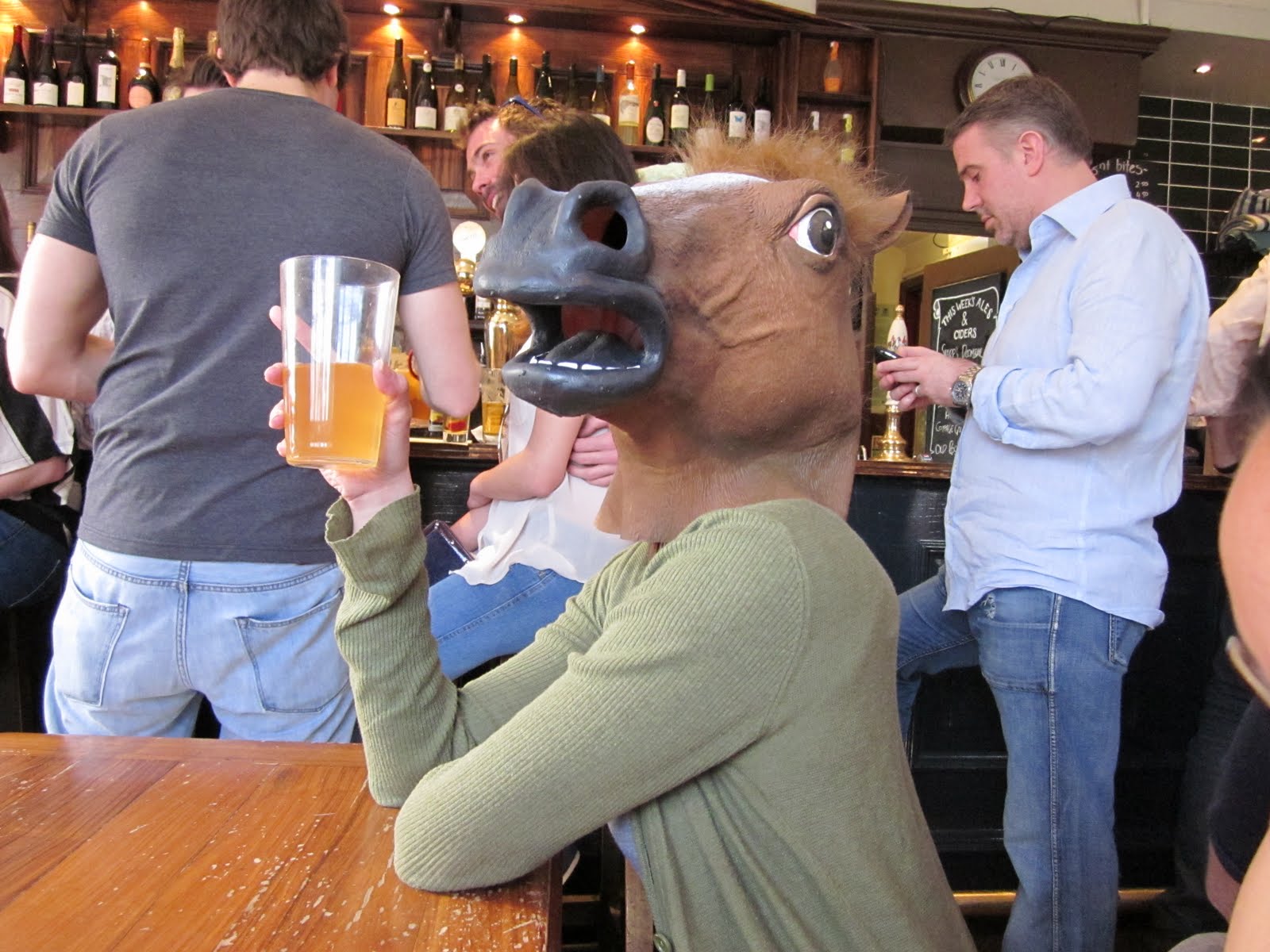
Playing the "Time Lord" is no matter to horse around with.

After surely leaving you in suspense all week with the dramatic hook at the end of my last post, “Pacing Your Pages – Part I,” I bring you the thrilling conclusion of the joke:

A horse walks into a bar, and the bartender says

“WHY THE LONG FACE?”

Boddum-bum. *ching!*

Right. To get back on topic, last time I introduced the first part of author Julie Cohen‘s workshop on Pacing. She’d explained how we’re the “Time Lords” over our readers’ experience with our novel—how engaged they are and how quickly they move through it. We’ve already been over analyzing our use of conflicts, functions, hooks, and variety, so moving onward today…

Keeping secrets is another tool for creating a page-turning novel. As Cohen said:

“Readers are nosy.”

As the writer, we can choose to either keep a secret from the reader or let them in on one that’s kept from a character. However you approach it, try to keep that secret for as long as you can, as wanting to find out what it is (or see the character do so) is what will prompt readers to keep reading. That being said, know when to let it go, even if it’s earlier than you’d want to if it means not distracting or overly teasing the reader. You want them intrigued, not annoyed.

And just when we’ve been talking about how to pick up the pace of your novel, just as important is slowing down. Moments warranting a slow-down are dramatic events, sudden happenings, and emotional high points that we might want to prolong for their significance and to allow the reader to process them. Strategies for expanding on reader time include adding section breaks, changing point-of-view, and leaving an incident for a chapter before returning to it later.

Then there’s the matter of speeding up. If you want to get things rolling a little faster, avoid coffee-drinking scenes and the like with characters just sitting around and gabbing if it’s not moving the story forward, along with description for its own sake. Establishing atmosphere and such can be better achieved through a few concise, well-selected descriptions than rambling on over every detail of everything appearing in a scene—and remember your R.U.E.: Resist the Urge to Explain! Other areas to cut include naturalistic but unneeded dialogue, bits that aren’t hooks at the beginning and end of scenes, and things necessary to real life but not fiction (think going to the bathroom or getting from one side of the room to the other).

Where making these cuts are concerned, Cohen says:

“If you have a sneaking suspicion something shouldn’t be in there, cut it.”

We new writers hear this advice at every turn. That’s because it’s essential, but it doesn’t have to be painful. Looking on the bright side of cutting things out, we can: 1) accept that we’ve learned something from writing it; and, 2) use it again somehow…perhaps in another story, as a “free read” on your website or blog as a means of drawing readership, or, quite possibly, it might even have to be stuck back in the story it originally came from! Cohen herself had this experience—she’d cut a scene out by her own choice, but when her editor later suggested that that part of the story was lacking a certain something, the bit that she’d cut was exactly the solution!

Finally, I’d mentioned her color-coding system before for determining the appearance and interplay of conflict throughout a manuscript. She likewise closed her session with a similar method for outlining other aspects of plot. Basically, however you’d like to slice and dice it, assign each plot element a color (e.g., interaction between hero and heroine, interaction between hero and his mother, etc.) and jot it on a Post-It note. Then go chapter by chapter and apply the Post-Its to a sheet of paper for each to see your story’s development. This isn’t so much for outlining in advance as it is a post-draft diagnostic tool.

* To see a photo of this strategy and read Cohen’s own description of it, see her blog post, “Post-It Plotting“:
http://www.julie-cohen.com/blog/2010/09/17/post-it-plotting/

What pacing strategies have worked for you? Would you give any of these from Part I or II a go?


Pacing Your Pages – Part I

Whoa there, horsie! Slow-n-steady does NOT always win the race...

Ah yes, welcome back to the Animal Kingdom, where if I’m not a monkey, I’m evidently a horse…let’s just say my husband and I are big fans of the Grand National and cheer the horses on the best way we know how from the pub. Now the Grand National is a looong-lasting steeplechase, so, just as in the London marathon two days ago, the runners have to pace themselves strategically so they have enough energy to race through the climactic finish. But that doesn’t mean they start walking, and, of course, it’s crucial they stay on track. Likewise, the workshop I attended, “Pacing: Or, How To Keep ‘Em Turning Pages,” at the York Festival of Writing instructed on how to keep the pace of your novel moving without meandering off course.

To start, as you can see on the right side of the screen, I’ve just started reading the novel Getting Away With It. I’m doing so for entertainment, yes, but also as a lesson in pacing—it so happens that its author, Julie Cohen, led the above-mentioned workshop, so I thought I’d check ‘er out.

Cohen started out by noting “novel time” and recommended using a blank calendar to map out the story’s timeframe (bearing in mind “reader time,” the timeframe during which the readers actually read it…you want to keep a novel moving, but you also want to work in enough time for your readers to catch their breath). And while a longer novel versus a shorter one can allow more breathing room for character introspection (which are necessary moments), she recommends against over-using it.

As for conflict, Cohen calls us the “Time Lords” over reading time. 🙂 What she means is that reader time is subjective; it’s the writer who manipulates it. And she advocates doing so by including as much conflict as possible in each page, which I’m sure we’ve all heard before:

A lot of well-handled conflict will go quickly, no matter how many pages.”
Julie Cohen

She’s not talking car-chase, high-drama conflict at all turns but, rather, varying types of conflict—this could be any of the usual types: Man vs. Man, Man vs. Himself, Man vs. Society, Man vs. Nature. A blend of these conflicts are likely occurring in your novel, and Cohen suggests tracking them via a color-coding system to map out how they coincide chronologically. This can help you visualize the interplay of conflict as well as an approximation of your story’s shape.

Next up is function. A pacey book is efficient in its storytelling. Among the functions its chapters/scenes serve is moving the plot/subplot forward, developing character, creating emotion/atmosphere/conflict, and imparting information. But if you find you have several scenes serving the same function, either condense them or add in additional functions. A good way to determine this is to make a “scene function” list.

Also essential to pacing is starting and ending each scene with a hook, as well as giving your reader variety in mood, topic, theme, and style. To demonstrate the efficacy of this, Cohen had us do a simple exercise with Shakespeare’s Romeo and Juliet (it took a teacher to identify another teacher right off the bat, by the way—her presentation style was straight out of the trenches of keeping teenagers engaged, complete with energy, worksheets, and jigsaw activity. Everyone loved her! :)). Anyway, she’d provided a list of consecutive events from Act 1 Scene 1 to Act 2 Scene 2, and we were to label each with symbols denoting different tones, emotions, characters, and dramatic points of the story. The result is…*drum-roll*…That’s right, variety. You see an interplay of different elements without formulaic repetition.

Putting your readers on a rollercoaster is going to make them think and feel like they’re going faster.
Julie Cohen

So in an attempt to pace myself and allow time to digest the above, I’ll quit here and resume with the rest in Part II. But to practice my lessons, I’ll end on a hook. While I haven’t yet shared the punch-line to my “Why did the monkey fall out of the tree?” joke, I’ll leave you with this one, in keeping with today’s theme:

A horse walks into a bar, and the bartender says


My Book Fair Lady

“And without much ado
we can all muddle through
without you
.”
My Fair Lady

‘Tis the season of literary shenanigans, it seems. So soon in the wake of the Writing Festival in York came the London Book Fair this week. It was right in my neighborhood (practically “On the Street Where [I] Live,” so I figured it wouldn’t hurt to pop in, although I didn’t find the lengthy list of sessions to really offer much to writers themselves—more of an industry thing that didn’t leave me feeling “I Could Have Danced All Night” riding a book-high. What I definitely took away from it, though, is that traditional publishers are shakin’ in their boots a bit at the digital revolution occurring, that growing options for self-publishing are eliminating the gatekeepers of the industry, and that marketing your book requires the same amount of legwork on your end whether you’re traditionally or self-published. Contrary to popular belief, traditional publishers don’t guarantee you “discoverability” and may not allocate much money toward your marketing. So establishing your own fan-base via social media well in advance of your book’s submission/publication is key, as is making the effort to put yourself out in the community for book signings, speaking events, etc. afterwards.

The quotation yesterday that made me *gulp* at what I surely already knew:

“Writing is a passion. Publishing is a business.”

Meh. Nothing new, but it in a nutshell reminded me of the aspect I’ve disliked so much about this process so far. The best part was when I was just writing. But researching for submissions and revising in light of rejections and being overall totally lame where networking and self-promotion are concerned do kill the spirit a little… And yet it’s also rather exciting, isn’t it? I’ve always needed a challenge, and facing one that seems practically insurmountable is quite the motivator and defeater all at the same time.

The talk of self-publishing and e-books, though, I find heartening, and here’s my thoughts on it these days. It’s by no means a last resort—it’s getting your work out there for others to read, which is the point of wanting to get published, isn’t it? Yeah, it costs upfront for printing, cover design, and editorial services (money will always be a damn gatekeeper). But, barring that factor and looking at it just conceptually for a moment, if you have to market the crap out of yourself anyway, why not get a faster start at that to grow readers sooner? It’s not like you still can’t query an agent or publisher with that same manuscript afterwards. You still own the rights to it, no matter what, and you’ll have a nicer format and (hopefully) readers/reviewers by then to vouch for its content. I don’t know… What was sad and somehow so cute at once was that an older gentleman I’d met yesterday explained that he wants to self-publish because he doesn’t think he has enough time left to wait out the years traditional publishing could take. Aw 😦

It leaves me thinking that after I finish my current round of revision, I’ll do a massive query blast (my December/January queries were just dipping my toe into the waters), and if I don’t hear anything in the affirmative as the months roll by, self-publishing is the attractive option from there—even despite the stigma hovering over it. There are so many ill-edited indie books being put out there (simply because any schmo can), so it’s almost an obligation for diligent writers to get theirs in that market, too, and dilute the stereotype. I’ll stop spending money on freaking workshops and allocate it toward a professional editing service, then maybe start with an e-book until I can justify the funds for a print version. And then, I query-blast again! My publisher search would remain ongoing. So that’s a game-plan I’m at the beginnings of formulating in my head, anyway… Time (and funds) will tell.

Wouldn’t it be Loverly,” though, to go that route and say, “Just You Wait,” publishers, I can do this “Without You“!

So what are your thoughts on self-publishing (digital and/or print) versus traditional publishing? Is the former an option you’ve seriously thought about? Why or why not?


The Red Pen: The POVerdict

Hiya! Crap, it’s been a while, and I apologize for that. Especially when I have so much I want to share with you!

For today, though, I’m pleased to just announce that we’ve finally found compromise on the POV issue I’d related earlier. To quickly recap, an author I’m editing for had been writing through a sort of hybrid 3rd person limited/omniscient POV. The story alternates between POVs such that we have the sort of “head-hopping” found in an omniscient perspective, but it’s only between two characters (not all), which would signify the POV is limited.

So we originally thought entire scenes/chapters would need to be rewritten from one character’s POV or another to keep within 3rd person multiple limited perspective. This would entail extensive revision and kill some of the playful back-and-forth between the two main characters. On the other hand, revising it to be omniscient would be a lot of work, too, as additional characters’ thoughts would have to be written in. The solution proposed, then, is to simply insert section breaks between paragraphs where the POV makes the jump. The section breaks will serve as a visual cue to the reader that POV is going to shift, so the author can jump between her main characters’ thoughts within the same scene. In short, it hopefully means hardly rewriting anything; instead, it’s more of a structural revision. We’re lucky in this case that most of the scenes are in multi-paragraph chunks within a single POV to make this possible.

In the instances where we see a POV shift on a sentence-by-sentence level, on the other hand, the author will need to commit to one POV or the other and rewrite them as such. Again, though, this should be easy, as in a lot of cases, one character’s POV is definitely dominating, so it’s only a matter of revising stray sentences here and there.

I can’t share the author’s work here, so let me make up some BS text on the spot to demonstrate what I’m talking about:

Lucy was livid when she found out she had to revise her manuscript. She simply didn’t understand the problem with the way she approached point of view.

Bob, on the other hand, didn’t understand what the big deal was. Why couldn’t Lucy just suck it up and do it the right way?

Lucy looked at Bob and huffed; it figured he wasn’t going to take her side on this. [and this paragraph continues in Lucy’s POV…]

[Another paragraph in Lucy’s POV]

[Another paragraph in Lucy’s POV]

[A paragraph in Bob’s POV]

[Another paragraph in Bob’s POV]

[Another paragraph in Bob’s POV]

So, obviously the red font denotes Bob’s POV. We can see at a glance that Lucy’s POV dominates the first few paragraphs of this “story.” The first section, then, should be solely from her POV; therefore the two sentences from Bob’s POV that have strayed into there need to be rewritten into Lucy’s POV—what is there needs to be reasonably inferred by what Lucy can observe of Bob’s outward actions or dialogue. What we can also see at a glance here is that, once Lucy’s POV ends, we have a few paragraphs solely from Bob’s. This is okay. Nothing requires rewriting; all we need to do is insert a section break before Bob’s POV begins. Then the reader hopefully won’t be as confused when the scene suddenly continues in his head.

The revision (in bold) can look something like this:

Lucy was livid when she found out she had to revise her manuscript. She simply didn’t understand the problem with the way she approached point of view.

“I don’t understand what the big deal is,” Bob said. “Why can’t you just suck it up and do it the right way?”

Lucy looked at Bob and huffed; it figured he wasn’t going to take her side on this. [and this paragraph continues in Lucy’s POV…]

[Another paragraph in Lucy’s POV]

[Another paragraph in Lucy’s POV]

***SECTION BREAK***

[A paragraph in Bob’s POV]

[Another paragraph in Bob’s POV]

[Another paragraph in Bob’s POV]

Alternatively, the rewritten portion above could still have Bob not say anything. Something like:

Lucy looked at Bob and huffed. She could see from the way he screwed his face that he didn’t understand why it was a big deal. It figured he wasn’t going to take her side on this.

In a case like this where part of the original does get cut, if it’s something the author really likes and doesn’t want to lose entirely, she can try to find somewhere else to fit it without infringing on the wrong POV.

I don’t know how much sense I’m making with this, but let’s just say the author seems happy about it, which makes me happy. And let me also say there are entire scenes only in one POV, so the whole thing is not going to be chopped up in small sections all the way through. That would be a whole new issue if so.

I can’t say, though, that I’ve read many (if any) books like this. What do you think? Is this a reasonable approach that you’ve seen before (and that’s been done well), or do you think it’s still confusing for the reader?


The Second Coming: If at First You Don’t Succeed, Write and Write Again

Image from etsy.com

I’ve got lots and lots of material to share and will do so in the coming days (or weeks, more realistically, given the bat-shit craziness of my sheh-jule these days…). And what I’m noticing right now is that my writing life is experiencing a rebirth of sorts that has me coming back for SECONDS…

To start, while the jury is still out on the POV issue plaguing my first editing project (see “POV for Vendetta“), I’ve been assigned my SECOND PROJECT, which is already presenting issues of its own. In this case, the author is safely applying 3rd person limited across different characters by only shifting POV in new sections and/or chapters. However, its story arc is sagging in the middle due to a repeating element that flattens it out through lack of variety. In future posts, I’ll speak to both my editorial comments on this specific manuscript as well as pacing a story in general.

In the last couple weeks, I have also been mapping out a SECOND MANUSCRIPT of my own! Idea remnants that got left behind as I finished my first manuscript have inspired another story line altogether, so I’m working to apply all I’ve learned from my many, many mistakes on manuscript #1 to what will hopefully be a better planned and executed #2. Outlining the plot from the get-go is a first for me, as I’d nearly written myself into a hole the first time around and didn’t know how to bring it all together (see “Fraying at the End“). So while ms #1 accordingly still needs a lot tender lovin’ care, ms #2 is providing my mind a healthy diversion for a while. Having a second project in the pipeline also keeps me from placing too much pressure on that first one navigating its path to publication. As presenters at my workshop said last weekend, hardly any new author’s “debut” novel is actually the first book they’d written.

Speaking of workshop, I got a SECOND WIND for tackling both the manuscripts I’m writing and editing by attending the Festival of Writing in York this past Saturday and Sunday. In addition to two ten-minute one-to-one meetings with a literary agent and published author (the latter being Charles Darwin’s great-great-granddaughter, no less), I attended several workshops on topics like plotting, pacing, and marketability. It gave me gobs of food for thought, so I’ll share what smattering of notes and resources I can with you.

Finally, while I admittedly didn’t churn any creativity out during the month of February for Write 1 Sub 1, I feel I’ve gotten a SECOND CHANCE this month thanks to my sister-in-law, as fate would have it. This ridiculously talented lady is a graphic designer by day and painter, photographer, and potter by night. Her latest endeavor is to create a website for her lovely pottery, and instead of presenting each with an ordinary catalog-type description, she’s opted to pair them with short stories inspired by their design and function. So guess who’s the lucky gal who gets to write these?! I’ve written five short-short pieces so far with five to go (as far as I know), so hopefully these will be appearing online by mid-April. While I still aim to write stories for submission to literary publications in subsequent months, I’m hoping this gig at least covers me for March.

All right, time to shut my yapper. Just a preview of more posts to come after I take a SECOND to catch my breath… 😉

What’s on your writing agenda these days? Any writing firsts or seconds to celebrate this month?