Author Archives: thefallenmonkey

About thefallenmonkey

Unknown's avatar
Primate that dapples in writing when not picking others' fleas or flinging its own poop.

NaNo Nuh-Uh

HAHAHAHAHAHAHAHAHAAAA!!!

Whoa, boy. What’s going on. Has the Monkey finally lost it? Did she ever have it to begin with?

Never fear, my resounding guffaw is simply me laughing in the face of my past self who actually thought she’d be doing NaNoWriMo this year. What? Really? HAHAHAHAHAHAAA! Who did you think you were kidding, girl?

Sad but true, I had to opt out. Again. And it’s killin’ me. But editing duty calls, and I am fully realizing the curse that is the otherwise-blessing of being both a writer and editor. Were I still in finance, shifting from numbers to writing after the workday would’ve been an easy enough if not hugely therapeutic way to decompress (I wish I did write back then). Were I still a teacher, I would admittedly still struggle to balance writing with the day-job like I do now since that’s an occupation where the work never ends, even after that last-period bell has rung. But I still dappled in freewriting and such back then as, again, a therapeutic way to shift gears and do what I love.

But as an editor…I spend all day every day troubleshooting story issues and thinking through different ways to rephrase sentences for other people’s manuscripts, so it’s not exactly a welcome relief to then jump into troubleshooting and thinking through mine. I need a break. I need to get away from the computer. I need to not brainstorm story ideas and sort out developmental stumbling blocks. Often, I don’t even want to read an already-published book because the activity is still too similar to what I do all day—and as it is, what I curl up with at night is usually just another raw manuscript that I’m reading on the Kindle and taking notes on so I can brainstorm its future plan of attack. Yes, that, after working on another story at the computer all day. So the most writing I do these days is in my head while I’m doing something else. It’s just kinda how it has to be, at least for now when I’m up against dueling deadlines.

Anyway. I didn’t mean to make this whole post a primate pity party. I’m so, so lucky to have the work that I do and to still have the ideas and drive to write my own stuff. And if I haven’t been writing anything new, I’ve actually been making good progress revising my original Manuscript #1 this month. And editing other people’s work is always a great way to hedge against mine sucking. I can still live vicariously through other writers’ talent. 🙂

If you’re participating in NaNoWriMo this year, huzzah! Bravo! Keep it up! Don’t lose steam! You’re over halfway there, and crossing the finish line is so sweet. Good job, and write on.


NaNoWriMonkey 2014

Hellooooo! And brrrrrrrrrr! The season has officially shifted—the temps are dropping, the days darkening, and lattes everywhere are getting infused with pumpkin spice whether they like it or not. I can smell Halloween in the air, and the day after that will be…National Novel Writing Month!

Now, I won’t pretend that I’m the most consistent, most winningest NaNoWriMo participant out there, but this year especially, I have a lot to be grateful to this event for. Those who’ve followed me awhile might recall my virgin yet Herculean (if I may say so myself) NaNoWriMo effort in 2011, when I first started in the middle of the month and still met my 50,000 words! The craziest thing about what I churned out over those couple of weeks is that I salvaged most of it as not pure and utter crap—I don’t credit my command of the craft for that so much as the OUTLINE I had going into it. I wasn’t writing purely off the top of my head but with specific plot points in mind for Manuscript #2, which gave me the destination to aim for even if the path I took was allowed to roam (which is really when the magic happens, I think…when you let go and just immerse and write, which leads to tapping into your storyworld so directly you almost feel like you’re just transcribing what already exists, not something you’re creating—see my NaNoWriMo follow-up post for more reflections on that experience).

In any case, what I salvaged from NaNo 2011’s 50,000 words can now be found in the novel that was published this year. So needless to say, I bow down to NaNoWriMo as a worthwhile endeavor no matter how ready or not you are. I’ve been itching to get back in the game ever since and attempted to last year, but I couldn’t knock my editing hat off to wear my writing one for long enough. And, granted, I wasn’t prepared with another WIP outline at that point; in lieu of that, I was going to try my hand at an anthology for all the miscellaneous paranormal ideas I have floating around. I did manage to write almost 8,000 words for one of those stories, which was in response to a call for submissions that had opened at the time. The publisher was looking for urban legend retellings, so I cranked out Bloody Hell, Mary!  It wasn’t accepted and certainly not the best I could do, but I appreciate the practice it gave me as I try to warm up my writing muscles for Manuscript #3…

…which is my NaNoWriMo goal for 2014. I still need to shape my next novel idea into an outline, but I’ve written a crapload of notes and wrote my first chapter yesterday. If I can start to find my groove over the course of October, I’m hoping November will be the month when Manuscript #3 gets officially underway.

And as for dear, sweet Manuscript #1…it’s hangin’ in there. I’ve revamped its opening chapters quite a bit and would like to tighten its second half around a more cohesive story arc. We’ll see. I know she isn’t going anywhere–which is both a relief and just what I’m afraid of. 🙂

All right, gang, so who’s with me? Who’s planning to get NaNoed this year? Write on!


Historical Fiction Meets Rom-Com: SEVEN FOR A SECRET by Rumer Haven

AVAILABLE AUGUST 12th, 2014

7forASecret_FRONT_REV

Author: Rumer Haven
Title: Seven For A Secret
Genre(s): Supernatural/Historical Romance
ISBN: 978-1-623421-09-0
Release Date: August 12th, 2014
Available in Paperback and eBook
Goodreads Link
Author Website
Twitter: @RumerHaven

Summary:

It’s the year 2000, and twenty-four-year-old Kate moves into a new apartment to find a new state of independence in a new millennium. Almost immediately, she starts crushing on a hot guy who lives in her building. Deciding to take a break from her boyfriend Dexter, Kate believes the only thing now separating her from the fresh object of her sexual fantasies is the thin wall between their neighboring apartments.

A former 1920s hotel, Camden Court has housed many lonely lives over the decades—and is where a number of them have come to die. They’re not all resting in peace, however, including ninety-year-old Olive, who dropped dead in Kate’s apartment and continues to make her presence known.

For Olive has a secret she’s dying to tell. One linking her to the sex, scandal, and sacrifice of a young dreamer named Lon. As the past haunts the present, Kate’s romantic notion that the thrill-of-the-chase beats the reality-after-the-catch unexpectedly entwines her modern-day love life with Lon’s Jazz Age tragedy.

With a little supernatural and a lotta’ razzle-dazzle, Seven for a Secret is where historical fiction meets contemporary rom-com—from the Roaring Twenties when the “New Woman” was born, to the modern Noughties when she really came of age.

Author Bio:

Rumer Haven is probably the most social recluse you could ever meet. When she’s not babbling her fool head off among friends and family, she’s pacified with a good story that she’s reading, writing, or revising—or binge-watching something on Netflix. A former teacher hailing from Chicago, she presently lives in London with her husband and probably a ghost or two. Rumer has always had a penchant for the past and paranormal, which inspires her writing to explore dimensions of time, love, and the soul. Seven for a Secret is her debut novel.


Seven for a Secret BLOG TOUR!

Okay, hopefully this will be one of the last times the Monkey is a little ho-bag to promotion on behalf of author Rumer Haven, that little tart who also happens to be me. 😉

Editing and ramping up to release day has been a thorough time suck lately, so while I’m not posting anything fresh and interesting today (uh, do I ever? Hm…I’ll throw myself a bone and say sometimes.), if I won’t be spreading the Monkey poop around, I may as well spread the “Rumer” that bloggers can now sign up for the…

SEVEN FOR A SECRET BLOG TOUR!

http://goo.gl/1tdaHS

Cover reveal is August 5th, and release day should be the 12th, if all goes to plan. The book summary is also already up on GOODREADS, so add it to your “to read” shelf if it meets your fancy! My publicist has picked the video below as the perfect companion song for Seven for a Secret, so let’s cha-cha-Charleston our way out to it…


crA-Z at A-Z

APRIL-CALENDAR [2014]

Hey there, Woodchuck Chuckers! It’s the Monk-monk Monkey, reporting back to duty after a loooong spell. I’ve actually been the opposite of inactive lately. First of all, due to the impending release of my debut novel, my social media energies have been focused on building my pen name’s brand.

But because I was such a slackass over at that blog, too, I decided to hop on board the April 2014 A to Z Challenge to build some momentum. So if you’d like to join me over there, Rumer’s been ruminating all month over the A to Zs of 1920s slang:

rumerhaven.blogspot.com

A2Z-BADGE [2014] - Support - small

Aside from that, things have finally gotten rolling on the editing front. Due to scheduling conflicts, my original editor had to reassign my manuscript to someone else, whom I’m just as pleased to have help me strengthen and polish my story. If all goes to plan, we should see the final result in August this year.

And where editing other authors’ work goes, it’s still been full-steam ahead. Piping hot steam, in fact, as I keep chug-a-chuggin’ through a stream of submissions. In the next month or two, I’ll be answering questions over at Nicki Elson’s Not-So-Deep Thoughts blog for her next “Ask an Editor” installment, so I’ll keep you posted. And if you have any additional questions not answered there, I’m more than glad to field them here.

Meanwhile, I’ve been saying it for a long time, but I’m still thinking about returning to my writing prompt roots at this blog since a lot of my writing experience will be logged over at Rumer Has It instead. I really need the kick in the primate pants to write some fresh fiction, much as I did when I created this blog in the first place. So we’ll see if I hold myself to that…

…After all, one of those writing prompts led to a short story that first featured here and at the Real Bloggers United blog (RIP to that one; it was fun while it lasted) but has since been published in Bibliotheca Alexandrina’s 2013 Beyond the Pillars fantasy anthology:

“She Who is Milk White”

CKWagner_She Who is Milk White

I also just found out this weekend that my contest-winning short story “Four Somethings & a Sixpence” has been accepted for publication. More on that as details develop…

So what have you kiddos been up to? I’ve missed you! Please do swing by and catch me up on your happenings, and call on dear Rumer, too, at her humble abode.

*Monkey Mmwah!*


Omniscient Deficient

Now that I griped about the challenges of third-person omniscient narration in my last Red Pen post, gol’ damn if I’m not going to try it in novel manuscript #3! After stewing on it and reviewing another manuscript submission that actually handled it quite well, challenging myself to write with an omniscient narrator has become a quest. But more important than that, I sincerely believe it’s the best choice for the story that is presently budding in my head. I can’t pretend I’ll be at all skilled in handling this POV, but why not try and broaden my range.

I have been so inundated with editing assignments that I can hardly fathom starting a new novel anytime soon (I can barely fathom when the hell I’m going to edit my own book—manuscript #2, which is now slated for publication this August), but the voices have started chattering in my head, and ever so slowly, I am sifting through them to hear my individual characters. So I’m just grabbing minutes when I can to brainstorm the people and plot in the random, sloppy, handwritten way that I do (see alter-ego Rumer’s “Madness to the Method.”). It’s crazy fun exploring this new idea, just when I thought I’d be tapped out on novel-length fiction for a spell. In the meantime, I’ve also kicked around some short story ideas for a paranormal anthology. (Alas, I thought I’d conquer NaNoWriMo 2013 to accomplish that project, but all I squeezed out was one story that I ended up posting as fan fiction, as a retelling of an urban legend.)

Anyway, back to third-person omniscient. Like I said, I wouldn’t use it just to try it; I think it’ll work great for my story, which will comprise an ensemble cast in a single setting over the course of a single night. Remember my ages-old post “The Shotgun-Shack Story: Nowhere to Hide“? I’m going for that. This will consequently place a lot of pressure on characterization and dialogue, and I’d honestly like to experience it as a fly on the wall. I’ve enjoyed writing in third-person limited narration so far—manuscript #1 is limited to a single POV, and #2 is limited to multiple–and that’s what I mostly read these days, be it published fiction or the yet-to-be-published stuff that I edit. But I don’t know…do you sometimes get sick of being inside the same head(s) as a writer or reader? Sometimes I’m bored trying to speak through a specific set of eyes all the time, and as an editor, I find a lot of authors over-indulge in introspection. I’m constantly hacking out superfluous inner narrative that either gets repetitive with itself or redundant with what’s already been said and done. The string of inner-questioning in particular seems a popular rookie favorite, the constant upswing in intonation at the end of every sentence that I “hear” with my inner ear driving me batty at every turn! We can’t let our characters just constantly stew in insecurity and indecision like that. I don’t care if the main characters eventually do get off their asses to proactively achieve their goals; even those small moments of having to swirl through the questions in their minds is just wheel-spinning and dizzying when we probe too deep too often.

So at any rate, I’m terribly eager to stick all my new characters into a room with each other and see what the hell they do. I don’t want to think for them. And I don’t want them to give anything away in their thoughts. So I’m going to aim for a truly objective POV, avoiding any head-dipping if possible. The risk, of course, is detaching the reader from these characters. It will sharply lose the intimacy that a subjective POV could provide. But that hasn’t stopped me from attaching to the characters I see on TV and in film, most of which don’t bring us into their thoughts like Dexter; they just let us watch and listen (with or without Ron Howard’s omniscient narrative assistance 🙂 ). So why not give it a go and practice my way from POV deficiency to proficiency?

How about you? Have you written third-person omniscient narrative before? Do you find it easy or difficult? Do you keep it purely objective, or do you like to head-dip now and then? And when do you think it’s most appropriate to use? Do you care for it as a reader?


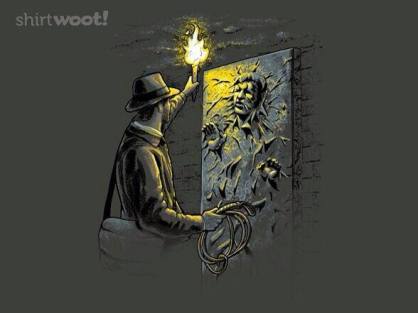
The Raiders Strike Back

Shirt Woot!

This leaves me screechless as one of the best things I have EVER. SEEN.


The Red Pen: POed at POVs

red penHappy Monday, my Monkey friends! I’m putting my editor hat back on today to comment on an issue that’s plagued me a lot as of late: POV. I ranted on this topic a while back in my post “POV for Vendetta,” when I feared a colleague and I were nearing impasse, ironically because we shared different points of view on point of view. As I eventually related in my follow-up post, “The POVerdict,” we did find compromise, and, in retrospect after gaining more experience, I do think the book is better for it. At the crux of it, though, was when sharing multiple POVs is head-hopping or not. The reading and editing community at large has become increasingly intolerant toward shifting between characters’ thoughts and prefers the nice-n-tidy confines of limited POV. But even when multiple POVs are limited versus omniscient, when can such perspectives alternate without having to denote the shifts between them with an obvious section or chapter break?

Now, I’ll be honest that I do personally prefer when a scene or chapter is kept to one character’s perspective. It’s simply easier to understand and allows me more intimacy with that character, provides me more insight. Even JK Rowling’s expert use of third-person omniscient in The Casual Vacancy drove me a bit nuts at times, purely because I don’t care for those shifts occurring on a sentence or paragraph level. For me, it always comes down to the story and the writing, whether the alchemy of the two produces an effect that works for my brain or not. It can be a very personal choice and difficult thing to articulate.

What perplexes me at the moment, though, is a novel I just finished: the NY Times and international bestseller The Expats, by Chris Pavone. No doubt the writing is good (better than mine fo’ sho’), and the story well crafted (though arguably a bit underwhelming and in need of a wee bit of tightening), yet I can’t reconcile the straying POVs within it. The story is 99.5% told through the protagonist’s point of view, but every now and then, we jump inside another character’s head. It’s an easy mistake but a just-as-easily fixed one, leaving me to wonder how these shifts got through—via oversight or justification? If the latter, I’d love to know what that was. Maybe I’m looking at this all wrong.

But allow me to share a challenging POV predicament that recently came my way—something I could and did do something about. Unlike The Expats, this manuscript tried for third-person omniscient narration, not limited, so shifting between perspectives was acceptable. But unlike the omnisciently narrated The Casual Vacancy, these shifts were intolerable. Rather than recreate the wheel, I’ve pasted an excerpt of my actual notes (with specific story information removed for sake of anonymity):

The aim here is evidently third-person omniscient, in which an all-seeing, all-knowing narrator is observing from the outside yet still able to know characters’ thoughts. Consistent with that, we do get to follow everyone around […]. The dilemma, however, is that it treads a fine line between omniscience and head-hopping that our acquisitions and editorial teams found dizzying.

Head-hopping and third-person omniscient narration are not the same thing, so I’m not going to claim that a story can’t reveal different characters’ thoughts in the same scene or even same paragraph. Omniscient narration is common in classic literature, after all; it’s just less common these days for assorted reasons. For some, it sounds old-fashioned; for others, they prefer the intimacy they can have with characters under a limited POV. Those are largely personal preferences—for readers, it’s a choice of which POV they like to read, and for writers, it can also be what they like to write, but first and foremost POV has to suit the story. Regardless, many writers shy from third-person omniscient because it’s very difficult to pull off without lapsing into head-hopping.

The strength of your narration is that it does maintain a consistent sense of voice. Even if it dwells with one character a while, it doesn’t assume that character’s voice instead. That’s vital for omniscience. There are also times when ducking in and out characters’ minds lends comic relief and a colorful storytelling quality to that narrative voice. But the main thing you have to ask yourself when approaching any story is whose story is it? Who is the hero? Whose perspective matters most?

As one of your first readers, if I were to answer these questions for [your manuscript], I’d say [A] is the story’s heroine with [B] as her leading man. Next in the hierarchy are [C] (the heroine of her own subplot, which triggers [A]’s main plot) and [D] (the villain of the story). These four are very tightly intertwined, though, and drive the story collectively, so I like your choice to use multiple points of view. Each of them is worthwhile to follow around, and their individual POVs can take us places where the others don’t go to provide us important information to be gleaned from different locales at once.

But note that I didn’t list anyone beyond those four characters. [P]resenting bits of the story through secondary characters’ POVs is more difficult to justify. There’s the comic relief, yes, but that’s embedded in the narrative voice itself and certainly shines through the four main characters. This quality of your storytelling wouldn’t be lost even if we don’t get to hear every minor character’s internal quipping (like I said before about killing your darlings, if it means editing out a good joke or clever wordplay, use it another story that shares similar dynamics. Maybe write a sequel with the same cast of characters but different leading roles, etc.). And even if their thoughts have important bearing on the plot, most likely we can acquire that information ourselves through their body language and dialogue.

[Example from the text.]

The other factor at play here is not just that [A]’s, [B]’s, [C]’s, and [D]’s POVs should be the main ones but that they already are. We spend more time in their heads than anyone else’s, so the story seems to already want to limit itself to their perspectives. And I think that’s where the overall POV has an identity crisis of sorts between omniscient and limited that lends to the head-hopping quality. When we’re in one perspective for most of a scene, it’s jarring to shift out and then back into it during that scene. On the other end of the spectrum is when we’re not oriented in any one POV at length but, rather, shifting around frequently among several people. Even between a couple of characters, shifting on such a sentence/paragraph level is really disorienting.

Very long story short, I’m generally not inclined toward using a third-person omniscient POV for this story because it:

–   detracts from the main characters, whose perspectives matter most
–   can easily slip into head-hopping or produce a similar whiplash effect when shifting POVs across too many characters too many times in a scene

So based on my own observations and those across our acquisitions and editorial teams, I highly recommend switching to third-person limited POV. You could (and should) still use multiple points of view […], but try to keep scenes within a single character’s POV and use a section/chapter break whenever there’s a shift.

The idea is to keep readers oriented and not jar them by shifting without warning. If POV does shift at all within a scene, it needs to be very, very carefully controlled on an absolutely as-needed basis. And weed out the strays if one character’s POV clearly dominates a section—e.g., say you have five paragraphs in a single POV except for a few sentences of an alternative POV interspersed within them. The best solution is to delete or rewrite those few sentences into the dominant POV.

When your main characters separate, it’s easy to choose which one’s POV to follow for that scene. But remember also that they’re often in the same room with each other, so even having to choose one POV among them doesn’t mean we can’t still see and hear the other characters and draw conclusions based on their spoken/body language (and whoever’s head we’re in at the time can form those conclusions for us in their thoughts, too). And if you’re dealing with one scene but really, really want to show it through more than one perspective, look for shifts that naturally lend themselves to a section break. If we see a situation in [A]’s POV for several paragraphs but then [B]’s POV kicks in with his viewpoint of the same time and place for the next couple pages, those are sizable chunks that can be divided with a section break marker but, together, still constitute a single scene. Section/chapter breaks aren’t the end-all, be-all way to handle shifts, but they’re the safest when in doubt.

So there’s my two pence on that topic. And in case you’re wondering, yes, the author was on board with shifting POV from omniscient to limited multiple. Very enthusiastically so, actually. And yes, my editorial plans can be long-winded. 🙂 Especially when they go to the author for a preliminary rewrite rather than straight to the editor, as I try to be as specific as possible in my guidance for newer writers.

As a reader and/or writer, what are your thoughts on omniscient vs. limited point of view? Limited vs. limited multiple POV? And how do you define the difference between true omniscience and head-hopping?


Publishing Ponderings

All right, so I’ve taken ages to follow up on the news I last shared. Forgive me. As I stare down the terrifying prospect of becoming a debut author, I also wear my editor hat for others getting published this year and next. I’ve worked on about ten manuscripts since my last post so have been pretty manic with that and actually appreciative that I haven’t had to start editing my own yet. With the New Year will hopefully come a clearer plate on which to focus on that once this current backlog is chipped away.

In any case, I’ve set up a new author website and blog for the occasion. The Monkey will remain a grand catch-all for all things writing and editing while the author site focuses more on book promotion and the silly lil’ persona I’ve set up for myself over there (as opposed to the very serious sock monkey here). Persona, did I say? Alas, yes, I’m using a nom de plume for my debut novel, which wasn’t an easy decision (I’ll address that in a future post), but I’m sticking to it. I know adding identities can only confuse things more, but honestly, I’m not huge on social media for my personal purposes—I might screech on Twitter as the Monkey, but I don’t tweet as a human, and Facebook updates only happen when I really feel like I have something to say. So developing profiles for the pen name hasn’t been all that bad—I can be compelled to actively engage online now that I’ve actually got something to promote beyond myself. I’m actually finding it quite fun and enjoying the relative anonymity of it.

That said, I’m not going to go to great pains to keep identities distinct and secret. Get real, as if anyone can pull that off in this cyber day and age. So allow me to out my human pen name here before I move on to talking about the craft of writing, not what I’m selling (you can visit Rumer’s blog for that ;)):

rumer_haven

Ta da! My debut novel Seven for a Secret, penned under Rumer Haven, is due for publication in spring 2014. Visit Rumer’s site for an unofficial summary and some miscellaneous bits relating to the story, and of course keep popping by there for updates as P-Day draws nearer.

But like I said…I’ll let Rumer be a little self-promoting tart while the Monkey just keeps keepin’ it real. I will need my cage here for refuge when the marketing zoo inevitably overwhelms me. Aside from being an editor (which I love), I’m not otherwise keen on delving deeper into the business of publishing, so I want this corner of cyberspace to focus on writing for writing’s sake. I’ve seen too many authors become discouraged by small sales and the endless labor that is peddling one’s work. It will no doubt happen to me, so I beseech you, dear readers, to help me remember what writing’s all about. And I promise to do the same for you. *BIG FAT WET SLOPPY MONKEY SMOOCH*

Well, it’s happening…

…my poop is getting published.

Novel manuscript #2, to be precise. Meanwhile, I’m on a tight deadline to pick the fleas out of someone else’s manuscript, so more Monkey messages to follow.