
Whoa there, horsie! Slow-n-steady does NOT always win the race...
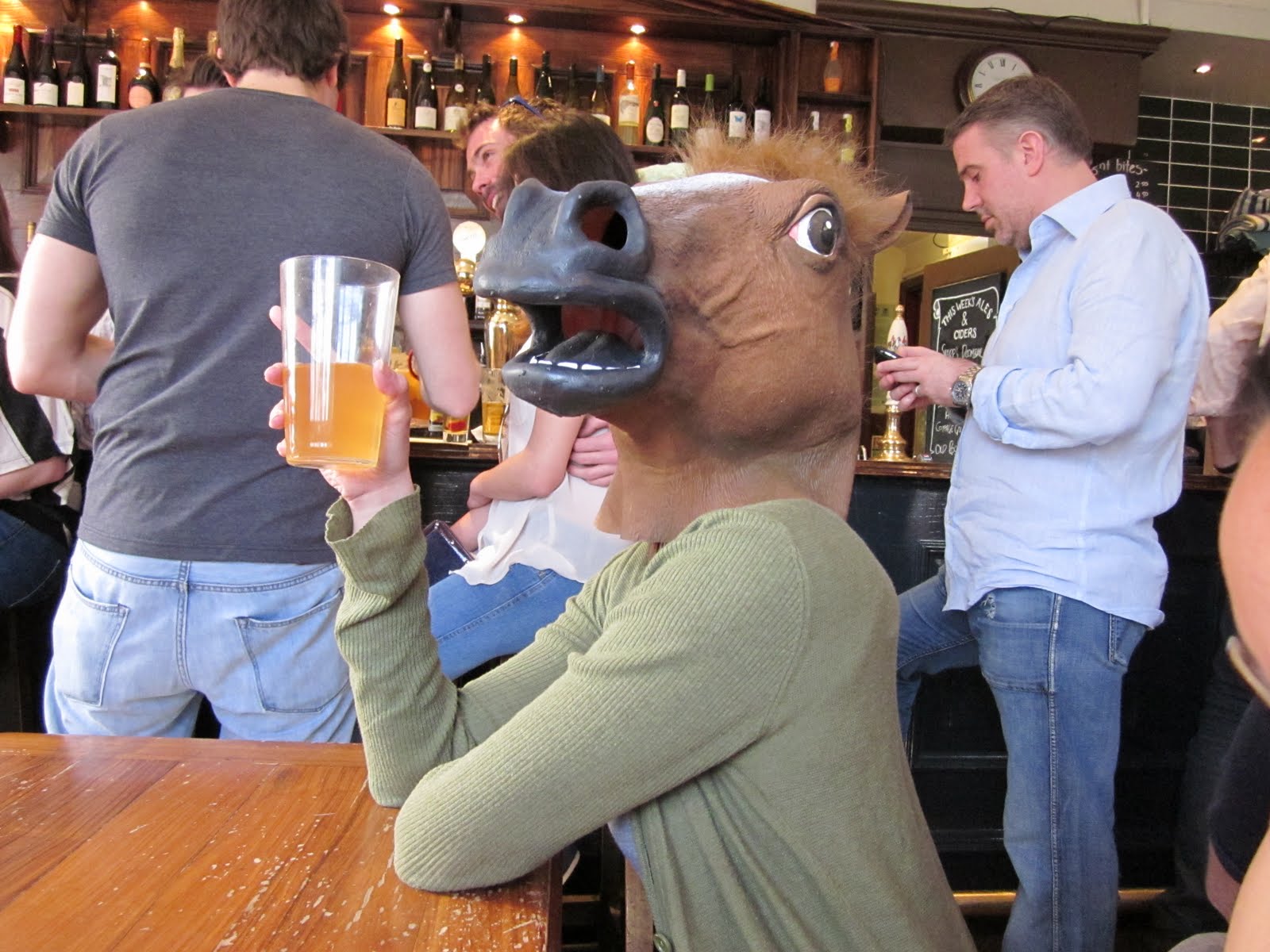
Ah yes, welcome back to the Animal Kingdom, where if I’m not a monkey, I’m evidently a horse…let’s just say my husband and I are big fans of the Grand National and cheer the horses on the best way we know how from the pub. Now the Grand National is a looong-lasting steeplechase, so, just as in the London marathon two days ago, the runners have to pace themselves strategically so they have enough energy to race through the climactic finish. But that doesn’t mean they start walking, and, of course, it’s crucial they stay on track. Likewise, the workshop I attended, “Pacing: Or, How To Keep ‘Em Turning Pages,” at the York Festival of Writing instructed on how to keep the pace of your novel moving without meandering off course.
To start, as you can see on the right side of the screen, I’ve just started reading the novel Getting Away With It. I’m doing so for entertainment, yes, but also as a lesson in pacing—it so happens that its author, Julie Cohen, led the above-mentioned workshop, so I thought I’d check ‘er out.
Cohen started out by noting “novel time” and recommended using a blank calendar to map out the story’s timeframe (bearing in mind “reader time,” the timeframe during which the readers actually read it…you want to keep a novel moving, but you also want to work in enough time for your readers to catch their breath). And while a longer novel versus a shorter one can allow more breathing room for character introspection (which are necessary moments), she recommends against over-using it.
As for conflict, Cohen calls us the “Time Lords” over reading time. 🙂 What she means is that reader time is subjective; it’s the writer who manipulates it. And she advocates doing so by including as much conflict as possible in each page, which I’m sure we’ve all heard before:
“A lot of well-handled conflict will go quickly, no matter how many pages.”
– Julie Cohen
She’s not talking car-chase, high-drama conflict at all turns but, rather, varying types of conflict—this could be any of the usual types: Man vs. Man, Man vs. Himself, Man vs. Society, Man vs. Nature. A blend of these conflicts are likely occurring in your novel, and Cohen suggests tracking them via a color-coding system to map out how they coincide chronologically. This can help you visualize the interplay of conflict as well as an approximation of your story’s shape.
Next up is function. A pacey book is efficient in its storytelling. Among the functions its chapters/scenes serve is moving the plot/subplot forward, developing character, creating emotion/atmosphere/conflict, and imparting information. But if you find you have several scenes serving the same function, either condense them or add in additional functions. A good way to determine this is to make a “scene function” list.
Also essential to pacing is starting and ending each scene with a hook, as well as giving your reader variety in mood, topic, theme, and style. To demonstrate the efficacy of this, Cohen had us do a simple exercise with Shakespeare’s Romeo and Juliet (it took a teacher to identify another teacher right off the bat, by the way—her presentation style was straight out of the trenches of keeping teenagers engaged, complete with energy, worksheets, and jigsaw activity. Everyone loved her! :)). Anyway, she’d provided a list of consecutive events from Act 1 Scene 1 to Act 2 Scene 2, and we were to label each with symbols denoting different tones, emotions, characters, and dramatic points of the story. The result is…*drum-roll*…That’s right, variety. You see an interplay of different elements without formulaic repetition.
“Putting your readers on a rollercoaster is going to make them think and feel like they’re going faster.”
– Julie Cohen
So in an attempt to pace myself and allow time to digest the above, I’ll quit here and resume with the rest in Part II. But to practice my lessons, I’ll end on a hook. While I haven’t yet shared the punch-line to my “Why did the monkey fall out of the tree?” joke, I’ll leave you with this one, in keeping with today’s theme:
A horse walks into a bar, and the bartender says…





 The Fallen Monkey