Tag Archives: writing fiction

On Priorities, Parks, Parents, and Publishing

Yowzah. Sorry I fell out of the tree again. These have been weeks of prioritizing, and unfortunately if I’m to make any blogging a priority, it’s gotta be the one I actually get paid for. ๐Ÿ™‚ In the meantime, while I haven’t been the most attentive commenter on your blogs lately, I’m glad to see you all are keeping busy and doing well, too!

I do finally want to pop in this week, though, before going on hiatus yet again. I’ll be heading Stateside in a few days for a brief visit to my sweet home Chicago before then undertaking the grand road-trip with my parents to Orlando for our big family Disney World vacation three years in the making. We made this pilgrimage many-a time as kids, but we started the tradition of returning with spouses and grandkids ten years ago. This is the first time since that allย of us siblings are able to make it again. So factor in me, me mum and dad, two brothers, one sister, two sisters-in-law, one brother-in-law, six nephews, two nieces, and my brother’s parents-in-law, and our grand total is nineteen. Could be an even twenty if my husband’s eleven weeks of grad school this year didn’t suck away all his work holiday and then some. ๐Ÿ˜ฆ In any case, leave it to my parents to be the only ones choosing to drive, so I’m making the journey with them to help out—they’ve had a rough year of health issues, and it’s the least I can do when I’m otherwise missing out on everything, the bad and the good, while living abroad. Time to shift my priorities to others, finally.

And who am I kidding. I love this stuff. Fire up the Family Truckster! Cracker Barrel, here we come! Marty Moose! Marty Moose! Marty Moose!

This is no longer a vacation—it’s a quest. It’s a quest for fun.”

In literary news, where my freelance editing work goes, I’ve wrapped up the developmental edit of a very fun YA paranormal novel so will await whatever the managing edit may throw back our way. And the second novel I’d edited has just been published! The author has been making a great effort at social media, so it looks like it’s doing well so far. Three-for-three wonderful authors to work with [knocks wood for next time]. And as for my own manuscript, I’ve been revisiting ms #1 after some time away from it and reckon my next step is consulting with a professional editor—I’ve been really envying the process I go through with my authors and would like to see my story get all buffed-n-polished, too. Regardless, I need to get more momentum behind that one; I admittedly haven’t been trying very hard to query. Dare I say it, I think I’ve settled into contentment with just the process of bringing it into being—I’ve entertained the hell out of myself!—so, where priorities go, getting it published has almost come to feel secondary. Or is that what all the unpublished say when they’re in massive denial? ๐Ÿ˜‰

In any case, I’ll try to pop back at least a couple more times this week before the *Disney magic* beckons me…

Room with a View

All good things must come to an end. *sigh*

I have more to write about my week, but for today as I make my return journey to London, I’ll just pay homage to the charming B&B that I called home the last five nights.

The table where I wrote.

The view of St. Austell Bay and the hills of Tywardreath, Par, and Fowey on down to Gribbin Head.

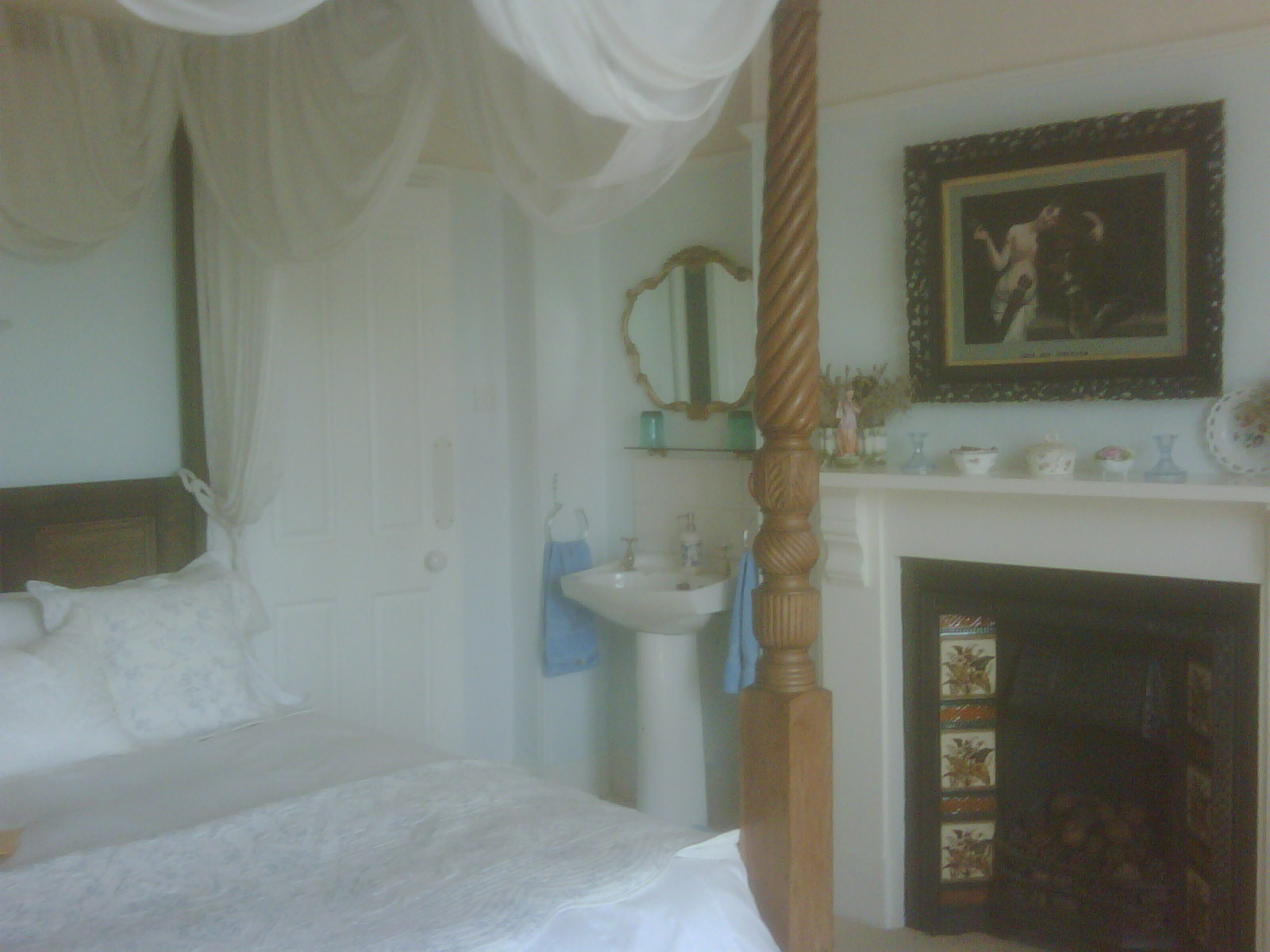
My sweet lil' room, where I secluded myself when not hiking out in them thar hills.

This is the heart of Daphne du Maurier country, which was no coincidence when I planned this trip. In the posts to follow, I’ll document my literary pilgrimage of sorts.

But for now, I heave another *sigh* in departing this peaceful region where the farmland meets the sea, the air doesn’t turn my snot grey, and strangers actually reciprocate friendly smiles and hellos. (Gasp! Can you imagine that, Londoners?! Looking up from the pavement and breaking through your barriers of fear and preoccupation to meet someone’s eye?! The horror…the horror…). Home-made and jarred marmalade, crisp vegetables straight from the local earth, and eggs straight from the local chickens’ va-jay-jays, purchased on the honor system at the end of a farmer’s driveway. Coastal paths with something new around every bend and questionable signage that lets you get good and lost a few times in the fields and woods, all in the spirit of things.

Cornwall agrees with me.

And my hosts have been most gracious, making me feel part of one big happy household, complete with Tilly the Terrier and the more elusive Barney the Cat and Charles the Chihuahua. Even a pair of other guests nearly brought me to tears (I’m serious) with their pure and utter loveliness. So blessed. So happy. So coming back.


From Graphic Leftovers to Graphic Tees

After all my woe-is-me-ing in my last post, I SWEAR I’m accomplishing all that I’d set out to here in the rolling hills and seaside cliffs of Cornwall. I am writing, and I am hiking. Lots of both.

But excuuuse me that my B&B happens to have WiFi, so I happen to be hopping on the internet occasionally to check email and look things up for writing research. Well, the random cyber-navigation of said “research” has just now led me via Urban Dictionary to a novelty T-shirt site, where I’ve enjoyed a little bit of earned procrastination.

I’m thus compelled to pop in here and share with you in quasi-realtime that I have just read and enjoyed this:

And that this next one has me almost reaching for my credit card:

That is all. Back to writing.


A Cage of One’s Own

Ya know, I usually play up the whole monkey thing because I think I’m so terribly clever and no one will ever get sick of it (shyeah right, you’re thinking), but, honestly, my flat really is starting to feel like a zoo right now.

Within one week of returning from two weeks in Singapore with my husband and in-laws, I already hosted two separate visitors and received news that another was scheduled to arrive, well, as of yesterday and staying for two weeks. Apparently so much poop flies around in here that my husband’s ears must’ve gotten clogged, because for the second time we have a scheduling conflict thanks to our stellar communication with each other. The first time was last fall when we double-booked my parents and a couple friends of ours—six adults in a wee flat of one bathroom + two beds + one punctured aerobed screamed nightmare to me, so I took my parents to the Cotswolds for most of the overlap while my husband hosted our friends. Problem solved.

Well, it turns out that I’m fleeing to the countryside yet again during my father-in-law’s present visit. Something about telling my husband, “If your father hasn’t decided on his dates yet, late August is out because I’m going on a writer’s retreat in the wake of our insane spring and summer,” got lost in translation, so he’d emailed his dad that late August still worked great. Great.

So here he is, and here I am packing up to leave on Sunday for five nights in Cornwall.

Could I have canceled? Sure.
Was there a chance in hell I was going to? No sir.
Do I feel a little bad about that? Of course!

But maybe this is a good time to mention that we’ve hosted over thirty (30) different people in less than three years since moving to London. And hosting is particularly problematic for those like me who work from home. And whose office is also the guest bedroom. In all fairness, though, this guest is super easy and independent, and we’ve given him the master bedroom so I can access my computer.

Nonetheless, after doing a little more basic math for this year alone, I estimate 30% of 2011 will have been spent hosting, traveling, and visiting home. Which leaves a lot of everyday life to be crammed into that remaining 70%. Which leaves not a lot of time for a reclusive writing life. (And I don’t even have kids!! How do you writers with children do it all??!!)

So I’m going, to a cage aaall to myself. No work, no hosting, undoubtedly a little hiking, but primarily writing. Selfishness has never tasted so delicious. See you in a week or so.

And how about you? How have you made a point to prioritize your writing, to give yourself some space to think, imagine, and create?


Is the Baby Still in the Bathtub?

I heard once at a writing seminar that every time we read, it’s an investment in our writing. So in light of that, we shouldn’t feel guilty when we spend our time reading someone else’s writing instead of working on our own.

When I do read someone else’s story, on one level of consciousness I’m processing how they’ve approached its construction and shaped its language, which helps me likewise reflect on my own projects.ย I still lose myself in the experience of the book, yet today was one of those when I did snap out of someone else’s story-world to reenter my own—because it had just smacked me upside the head, somewhere in the middle of the book I was reading, that I needed to work more on the beginning of the book I am writing. Seemingly out of nowhere, but I think my subconscious has known all along and somethingย I read must have finally dislodged that. Not merely the revelation of what I probably need to do, but my acceptanceย of it. I think I’ve known for a long while what I should do but have been nurturing my precious poopsies, running the warm water over them and adding more bubble bath.

I’ve only done some cursory restructuring so far, but looks like my manuscript needs to be run like a conveyor belt in reverse again, backing it up another couple chapters to start at even later one. If I do this, I must be mindful of what had happened last timeย and ensure the babies of characterization and exposition don’t get thrown out with the bath water in the interest of moving plot forward a bit faster. And it really isn’t so much that I’m trying to get a move-on with the story line; the more I look at those opening chapters, the more I realize that I was still finding my way into the story with them; it doesn’t all have to be scratched, but it needs to be tightened through rearranging. So as I try to look at the story elements in those chapters more strategically right now—isolating the “need to haves” from the “nice to haves”—it’s like they’re all lined up before me, beads of sweat glistening at their brows and sweaty palms wringing behind their backs as they try to stand tall, stand proud with chins up but lips quivering, and some surely wetting their pants.

I shall place the little dears in the foster care of my archives and keep faith they’ll find a good home in a short story or other novel some day. Until that time of weaning, I’m letting them push their little rubber duckies through the suds, scrubbing them extra clean behind the ears before tucking them into bed for the night all clean and sweet-smelling and raisin-fingered…who knows, perhaps after I sleep on it, too, I’ll change my mind.

I’m curious to hear about YOUR babies—it’s inevitable that some of them get chucked out the window, but have you actually had success reusing them elsewhere? How so?


What Characters Looove to Do…


Characters love to—

* sigh *
and take deep breaths
when they’re not
catching their breath at the back of their throats
or gasping!
They like taking sidelong glances as they
look out the corner of their eyes,
and they’re fond of
muttering,
mumbling,
murmuring,
andย growling
through clenched teeth.
They’ll pinch the bridge of their noses
or roll their eyes in frustration
or furrow/cock their brows in confusion.
And theirย mouths drop openย in shock.
In good moods,ย they’re wild about
smirking
and
winking
and
blushing
as they
chuckle or snicker or giggle
with smug grins.
In tender moments, they’ll
whisper
and do everything
softlyย and gently.
And they absolutely get off on
beginning to do some things
while starting to do others.

These are just some of the things I see characters loving to do all over the place when I edit manuscripts. (I catch ’em with the naked eye, but a tool like “Wordle” might also help authors divide and conquer those tendencies)

What penchants do YOUR characters have?

*


Editing Out the Editor

This shit editing is bananas, B-A-N-A-N-A-S.

Hey, Editors, are ya there? Editors? Editors? Bueller? Bueller?…

I recently saw this editorial, “The Price of Typos,” whichย comments on how “typos are everywhere” now—in large part because publishers are employing less editorial staff and rushing to publish books ever faster. And modern authors are playing their part in it, too:

โ€œUse of the word processor has resulted in a substantial decline in author discipline and attention. Manuscripts are much longer than they were 25 years ago, much more casually assembled, and beyond spell check (and not even then; and of course it will miss typos if the word is a word) it is amazing how little review seems to have occurred before the text is sent to the editor. Seriously, you have no idea how sloppy some of these things are.โ€

Though editors arguably have more work cut out for them in light of the above (man, don’t I know it firsthand!), when I read traditionally published books I’ve wondered the same: where are the editors? How did that typo get through? I’ve always said that I’ve never read a book without a typo, which is fine—annoying but fine, as I understand how that can happen maybe once or twice—but lately I see several mistakes, and it’s not just typos anymore.

Back when I read the Twilightย series (disclaimer: my Freshman Year students were squealing about it incessantly and kept begging to write book reports on it, so I felt it my duty to understand what they were talking about…and obsessively read all four books, and joined Team Edward, and watched all the movies so far, and…), and, I’m sorry, where was I? Oh, so when I read Stephanie Meyer’s decent storytelling but crappy writing, her overuse of words like “guffaw” and “mutter” bored a hole in my head as they plunk, plunk, plunkedย against my skull like water torture. Where was the editor to chuck a thesaurus at her and make her vary word choice? [See Also: “Sloppy YA Editing: Tic Words] ย And when each book got longer than the previous (and not in a good JK Rowling way), when plot didn’t thicken so much as stretch like taffy and read like a fanfiction of her own work, I asked myself, where was the editor to hack out those paragraphs and pages of redundancy and filler?

So maybe Twilightย is an unsurprising example, but I was in a bit of despair when I read the most recent book of one of my new favorite authors: The Distant Hoursย by Kate Morton. I loved her first two books in a way I hadn’t anything that I’d read in such a long time, and while I still enjoyed this third one, it needed a good, solid edit. The thread of an interesting story was there for me, which did keep me reading, but I found myself in a frustrated “get on with it” mode—and this from someone who can totally nurture the slow-going and character-based. I don’t need action and rapid pace, really I don’t, but I also don’t need constant dancing around with dazzling wordsmithing and every detail about yet another thunderstorm raging outside while, go figure, conflict between characters is on the rise, too. That’s my two cents, but here’s a sample of what I saw at Amazon as well:

“What on earth went wrong with this book? Was there no editor involved?”

“[T]oo long and too repetitive. A great deal of the fault lies with the editors.”

“What did this book lack? An editor!”

“This seems to be a problem with modern publishing…some way down the line in an author’s output either the editors stop thinking they need to edit or they believe it OK to drop an earlier piece of work on an unsuspecting readership who naively expect new books to be better books.”

Hear, hear! to that last one; I really do think publishers think we’re chumps when it comes to best-selling authors. I don’t read much Philippa Gregory, so maybe she’s been doing this all along in her historical novel series, but I recently read her The White Queenย and, while her writing style otherwise does keep a good pace (especially considering the mammoth amount of factual history she manages to distill), I felt little explosions in my head every time I chanced on passages like this:

“More importantly, I think, but I do not say, not even to Elizabeth, that once we are living in a private house quietly, my boy Richard might be able to join us. As we are stripped of our royalty my son might be with me again. When he is no longer a prince, I might get him back. He has been Peter, a boy living with a poor family in Tournai. He could be Peter, a visitor to my house at Grafton, my favorite page boy, my constant companion, my heart, my joy.”

Listen, I know there’s merit to lyrically using repetition for emphasis, but it loses its efficacy when this sort of thing is done over and over and over again for the length of a novel. I mean, seriously, this reads like she wrote the same thing a handful of different ways in brainstorming which she wanted to use and just forgot to scratch out the losing options.

And by this point, you’re probably all wishing Iย had an editor to keep this post concise. ๐Ÿ™‚ But before I go, I leave you with this: eliminating redundancies might be a subjective task, but spelling and grammar are not. An editing colleague recently emailed this sentence:

“A woman without her man is nothing”

Evidently, an English professor wrote this for students to then punctuate. Most of the boys wrote:

“A woman, without her man, is nothing.”

Most of the girls wrote:

“A woman: without her, man is nothing.”

The power of punctuation! Never underestimate the importance of attention toย detail—the importance of EDITING!


Blog Neglect

It’s happening again. Right now. As I type.

Well, not as badly right now as I’m technically tending to my blog by typing in it, but pretty badly nonetheless considering the worthless content I’m proceeding to dump here…

…just to say…

…that I’m traveling again so probably not going to give my blog nor any of yours proper attention until August. My sincerest apologies.

As penance, while I could do without a caning here in Singapore, how about next week I let the monkeys in Bali pelt me with their poop. Fair enough?


The Red Pen: Stylistic Variation, Story Arc, and Other Manuscript Concerns

Hey there! I haven’t shared any editing anecdotes in a while. To date, my first assignment has been published, the second has been passed on to the managing editor, and I’m getting started on my third. I’d never commented on the second one, so thought I’d retroactively share the issues addressed.

To start is advice I gave the author on stylistic variation:

Where sentence structure is concerned, you describe a lot of consecutive or simultaneous character actions, and, to convey that, โ€œas heโ€ and โ€œas sheโ€ are very frequent (as are โ€“ing verbs following a comma—these are called present participial phrases). While not technically incorrect, itโ€™s when repetitions of this structure become noticeable that they can be an issue, so just keep an eye out and consider ways to vary the syntax of your sentences to mix it up. Reading aloud is an awesome way to work through sentence/paragraph flow and catch where words/rhythms might repeat!

Examples:

โ€œAs she turned on her heel, she smiled and took his hand to lead him through the forest.โ€
โ€œShe smiled and turned on her heel as she took his hand to lead him through the forest.โ€
โ€œShe smiled and turned on her heel, taking his hand to lead him through the forest.โ€
โ€œShe smiled while she turned on her heel, took his hand, and led him through the forest.”

Etc., etc.

Story arc also needed work. This happens to be a rather sexy romance, so:

A key element to pacing is varying the functions each chapter serves. Too much of the same โ€œfunctionโ€ served by too many consecutive chapters risks flattening the story arc. In this case, the recurring function I see is sex, either with purpose or gratuitous. The sex is of course what readers will love about it, but from a story development standpoint (not a prude one :)), Iโ€™m concerned that the frequency of sex scenes is making the middle/third quarter of your story fall flat, with the underlying plot getting a bit lost. There can be too much of a good thing, and too much of anything can make reader attention wane no matter how exciting or saucy the action. And the function that sex serves in a romance novel is not only entertainment, but a vehicle for moving the central relationships forward, so it really ought to only appear when it does move the story forward, rather than be there for its own sake.

Don’t worry, if you ever read it, there’s still a-plenty left in it to warrant hosing yourself down afterward (hot damn!). Other issues addressed:

  • more than one dialogue tag used in a paragraph of the same character’s dialogue (not technically wrong, but judge when it’s superfluous)
  • dialogue tags used for almost every line of dialogue in a conversation – starts to sound overly “he said/she said” when it’s otherwise easy enough to tell who’s talking. Sometimes a corresponding character action suffices in place of tag; e.g.:
    • “Wait a minute,” she said as she held up her hand.
    • “Wait a minute.” She held up her hand.
  • redundancies in description / tendency to over-describe using lists of adjectives when one or two suffice
  • overly repeated (verbatim)ย words and phrases
  • use of “began to”/”started to” for actions that are followed through, not interrupted.
  • keeping each section within only one character’s POV (in keeping with 3rd person limited, multiple perspectives)
  • time continuity – matching the time-frame of an intermittent subplot to the main plot.
And regardless of how polished the new manuscript I’m editing is, I’m still encountering pretty common grammatical errors—I’ll pop back later this week to share these. Good luck with your own writing/editing!

Happy Endings

Friday night: Curled up on the sofa in a state of despondency. So quiet and lackluster that my husband continually asks me what’s wrong. To which I *sigh* and say I’m fine, just wiped out after a few days of steadily revising manuscript #1…yet again.ย What I don’t proceed to say is that I think my ending continues to suck, and I don’t know how to fix it, and I can’t wrap my brain around it anymore, and I’m so sick of my manuscript, and all I wanna do is lie curled there and sip from my glass of red wine and watch TV to lose myself in other people’s stories until I drift to sleep.

Saturday afternoon:ย Husband comes into our second bedroom/office to check on me at the computer because, masochist that I am, I couldn’t stay away from dear ms #1 for long. I look at him, smile, and proceed to bounce in my loudly creaking chair over and over and over again in a way that surely makes the neighbors think we’re up to something naughty. They’re not entirely wrong, because I am at ย this point climaxing and reveling in a satisfying ending. My manuscript’s ending. The first version of it I’ve ever been happy with as providing decent resolution. My mind was massaged and able to get off in the end…it almost needed to smoke a cigarette afterward.

Sunday morning:ย I tweak a bit more at the ending and review how it follows after the climax (a bit tricky, this, as working with two narrative threads has kinda resulted inย a climax-within-a-climax…I have zero clue if I’m handling it right, but it feels appropriate). And I realize that for all the work I just put into it, the revision of this ending wasn’t even a rewrite at all! Honestly, it was done through mainly structural changes in which I pulled earlier scenes (that worked better as fallingย versus risingย action)ย and inserted them into the last couple chapters. It’s hard to explain how it works, but O-M-freaking-G it does!

One of my issues with story arc was an overly quickย resolution. It wasn’t “satisfying” and failed to clarify what the heck had actually happened during the climax. This was a pure product of me thinking I’d be so clever and not hand-hold my readers through anything, make them work it out themselves and leave it fairly open-ended so the readers can do the work there, too, and form their own conclusions of what happens next…basically, make themย do my job because I think I was honestly too tapped (or lazy) to figure it out myself. ๐Ÿ™‚

Well, that’s fine and all, but when it comes down to it, I’ve learned we do need to throw readers an occasional bone.ย In my previous post on marketability, I’d mentioned the strategies I’d try to make my work more commercially viable but had come to realize: “Is that writing commercially exactly or justย better?!” Writing in a way readers can understand and enjoy is not commercial. Writing a well-resolved, satisfying ending isn’t selling out. “Satisfying” doesn’t have mean “happily ever after” or that every single loose end is tied up and explained in full. No, we don’t have to dumb everything down so readers are not only hand-held but pushed along in an adult-sized stroller and spoon-fed a purรฉe of the unthinkingย obvious—and that’s not me being a snob as a writer; that’s me being a snob as aย reader who findsย stories like that mind-numbingly dull if not insulting.ย Resolutions should be like “a flick of the wrist,” I’ve been told, so I think it’s left to the writer’s ย judgment which matters can be wrapped up concisely, which developed a bit more, and which left to the reader’s imagination. I think a healthy mix of all of the above can be satisfying indeed for any novel.

I’m not saying I’ve written the perfect ending. It might not be satisfying yet to someone else or even to myself in a few days. It might go through dozens more face-lifts. But what I am saying is that the towel has been flicked at my arse, waking me up to the fact that the ending in my head wasn’t on the page, and mind-reading psychics aren’t necessarily my target demographic that would maybe make that okay. This is notย only my story; it’s for future readers, so I need to be less selfish with what I share of it. And such is the moral at the end of this story. ๐Ÿ™‚

How about YOU? What issues (if any) with your endings need some massaging out?