Tag Archives: creative writing blog

Writing What You Know – My Date with Daphne, Part I

Young Daphne du Maurier (about 1930) Русский: ...

Daphne du Maurier (Photo credit: Wikipedia)

Well, it’s April, and the Monkey has climbed back up its tree. The branches up here are budding, and I’m likewise hoping to turn a new leaf and make this spring a productive one of blogging and creative writing. Until now, travels, hosting, and craploads of editing have derailed me; I recently finished my first freelance edit and am presently juggling two simultaneous manuscripts for the publisher. Having to donate my eyes and brain to others’ work makes it difficult to write my own stuff, but it’s always a learning process and always satisfying to at least be working on something that’s getting published.

In any case, last August when I’d found myself in a similar predicament, I’d whisked myself away to Cornwall for a solitary writer’s retreat (“A Cage of One’s Own“). I found myself doing more hiking there than writing, but even that activity was steeped with literary inspiration. I was walking in the footsteps of British author Daphne du Maurier and her characters, you see, and learning a great deal about how a writer’s environment can effectively influence the settings of his/her stories. I’d promised way-back-when to blog about this and totally flaked out, but now I really have no excuse considering I just returned from an Easter holiday weekend spent at the very same location in the very same room-with-a-view! I brought my husband this time so he could also hike the trails and find much-needed respite after completing one hell of an intense graduate program. Thus, ’twas a time of needed togetherness, not for me to go all reclusive-artsy-fartsy and climb into my turret to write.

Yet the breezes off that dynamic coastal landscape still carried the sweet inspiration of Daphne, so, starting this week, I’ll finally share with you my summer photo-journey of the real-life settings featuring in so much of her work. du Maurier lived in three homes between Par and Fowey (Menabilly, Kilmarth, and Readymoney) that were not only the places where she wrote, but also where she wrote about. Menabilly and Kilmarth housed her characters as well, which I find really validating considering my own two manuscripts are set in actual apartments I’ve lived in. I at first viewed that as a rookie comfort-zone, writing-what-you-know in the extreme, but the fact is, my stories are set in these places because these places—their distinctive features and histories—are what initially inspired my stories. So, why not? Daphne did it.

I’ve admittedly only read three of du Maurier’s novels, but her writing resonates with me. Weaving dark tales with beautifully crafted language, she managed to write commercially appealing plots with literary merit—which, in my opinion, is the ideal to aim for. Of the novels I’ve read, my hands-down favorite is Rebecca, which I first experienced through Alfred Hitchcock’s faithful screen adaptation of same name (du Maurier’s novella The Birds was likewise adapted into another not-as-faithful Hitchcock film of same name). A few years ago, a random stroll through Daunt Books in London resulted in leaving with Jamaica Inn in my hands (which takes place at the actual inn in England’s Bodmin Moor), and my return to Daunt soon after for The House on the Strand is what ultimately led me to choose the wee village of Tywardreath (the book’s setting) for my Cornish holiday.

And Tywardreath is where we’ll begin tomorrow as we travel a bit of southern Cornwall to view the inspiration behind du Maurier’s The House on the Strand. Dress warm, pack light, and wear some comfortable walking shoes. 🙂

PART II

PART III

PART IV


Keep Calm and Query On

KEEP CALM - CARRY ON

KEEP CALM - CARRY ON (Photo credit: atomicShed)

And at the snap of the fingers, the Primate goes from pensive to proactive…

Last week may have been my time to stop and take stock, but this week I’ve no choice, really, but to throw myself into working / writing / revising / job-searching. I’m leaving for the States next week, you see, for a couple weeks to visit Chicago and New York, and then I’m hosting my lovely sister and niece in London immediately thereafter. With March thus swallowed, my husband and I are also already making travel plans for April. So was I just worrying about finding full-time work? Who has time for full-time work??! 😉

But seriously, before I soon venture where technology goes to die (a.k.a. Mom and Dad’s), it’s full-on git ‘er done mode right now. I nonetheless thought I’d pause from that to share what have been my first non-form-letter rejections! Woo-hoo! Okay, the exclamation points may seem like either sarcasm or extremely unwarranted enthusiasm, but, honestly, after about a dozen standard manuscript rejections, it’s so very nice to receive personalized feedback. Both of these came in recently from small publishers. The first is in response to a re-submission, and, admittedly, shame on me for trying to wedge my octagon-shaped cross-genre manuscript into the square hole of genre fiction:

The changes that you made to the story were great! It flowed much more smoothly. […] Unfortunately, I think that it still won’t work for us. I think that it is a great “paranormal” story but there just isn’t the romantic element that [the publisher] is known for. I do think that you should really seek publication for this though. I think that it is a great story and a publisher that doesn’t specialize in romance would take it.

Fair enough. I knew that mere romantic elements does not a romance make, but it was worth a try. Moving on, I received this at the end of last week:

While your story was very interesting, and at times suspenseful, we have to be very selective due to a high volume of submissions received each week.

The beginning gripped me, and the end had my spine tingling. However, I felt that after the first chapter, the pace slowed quite dramatically. I kept wanting something more to happen, and though it did, it felt like it took a long time to happen (not until toward the later half). Again though, your story as a whole is wonderful, I just feel that another company would be able to offer better representation at this time.

We sincerely thank you once more for thinking of us, and wish you the very best in your journey to publication. We have no doubt that you will find representation with another publisher.

Those are both very gracious, no? It certainly softens the sting and encourages me to keep on truckin’ and strengthen that story. As of now, in the meantime, I have a query outstanding with another small publisher and the full manuscript with an agent. My upcoming travel schedule is probably an aptly-timed excuse to step back from all this for a bit, eagerly await those responses, refresh, and come back swinging in spring—hopefully with a second manuscript to query on behalf. 🙂


The Roads Newly Taken

[Warning: The rocky trail ahead is just me placing the needle back on my same broken record. Am in pausing-to-take-stock mode, and writing is my way of therapeutically reflecting through it, so please don’t feel you need to keep reading if you’ve already heard all this crap. :)]

It’s been a lot of work and reinvention of my professional self this last decade and a half, what with making the Finance-to-Education career move and then the USA-to-UK geographical move that abruptly demanded I figure things out all over again…just when I’d had it all sorted. I was happy as an English teacher, truly, and gave a go at teaching in London. But let’s just say I know the joy to be found in teaching, so when I found myself treading water through an unpleasant situation that didn’t let me fully be who I am, well, signs to move on simply don’t come clearer than that.

I was devastated having my professional playing field leveled on moving overseas, but I find myself looking back on these last three and a half years—which had always felt rather random and drifting—and seeing what I’ve been doing in that time is finally starting to gel. I think. Even when I was teaching and loving it, my primary love for the English language and literature that I instructed naturally fed my dreams of also becoming a writer and editor. So, I’ve been biding my time writing web content and editing fiction on a freelance basis, and I’m on the cusp of finishing a second novel. And while my editing to date has been for the same small publisher, I’ve just been approached for my first outside gig and am thinking of shaping that independent role into something more official.

Baby steps.

The querying and job-searching continues as I seek to ultimately become a published writer and full-time editor. It’s humbling to compete with so many talented writers likewise seeking publication, and it’s humbling to compete with young graduates for the same in-demand entry-level jobs. I’m 35 with a Masters degree and CFA and have applied for an unpaid internship, for cripes sakes. It’s fair to say I officially checked my ego at the door in 2008. And now I’m wriggling and fussing a bit, as we newborns will do while we wait for our sight to sharpen and learn new uses for our arms, legs, and minds.

But in the meantime, best thing I can do is keep cultivating mah skillz, yo—hoping they pave a relevant path toward what I suppose is shaping into a third freaking career. And London itself just continues being its wonderful, literary self for me to absorb and enjoy, introducing me to Charles Dickens’s great-great-great-granddaughter, Lucinda, last week and various publishing professionals last night in the very space Sir Laurence Olivier dressed and rehearsed for his stage debut. Ahh, London. I love ya.

So can you tell I’m just feeling out my sense of validation here? Glad I warned ya? Not to worry—I’m very content. I just need to stop now and then to assess the situation…because I work just as hard now as I ever did, but without the compensation or recognition. Fine, I guess I’m not money-motivated. But I’d also always been one of those people who functioned best within the straight-and-narrow, doing everything I was supposed to with clear goals in mind. MY goals, fending for myself. And then I became someone’s wifey. And then supporting his goals resulted in resetting mine (no small feat when you’re as stubbornly independent and feisty as me and will rage against anything threatening your autonomy and inner life). And now that my never-expected-to-have-to-set-new-goals-so-soon new goals are finally clarifying, the road to reach them, I see, is a little less marked and a lot more meandering than what I’m used to. In fact, it looks to me like there are multiple pathways still lying ahead, some flat, some steep, some wide, and some narrowly hugging a cliffside. All of them, though, appear to converge on the horizon…so I guess it’s time for me to just stuff my yapper with a protein bar and take a hike. 🙂


The Red Pen: Stating the Obvious that Obviously Needs Stating

I’ve been wearing my editor hat again the last couple weeks, working with someone’s raw manuscript that is pending rewrite for resubmission. For confidentiality reasons, I apologize that I can’t be more specific than I am. What follows below are merely some overarching concerns that a rookie can easily overlook (hey, I’m one, too!) and sometimes get the Monkey’s head beating against the trunk of its tree:

1. Research – They say, “Write what you know,” but one doesn’t have to live in a place or serve in a certain profession, for example, to be able to research authentic details relating to such. Writing fiction doesn’t give the liberty to entirely fabricate a place or occupation if it’s one that actually exists. The internet is a beautiful place for research, as are books, site visits, and interviews with people in the applicable locations/fields. Be knowledgeable of your story’s setting and subjects and use common sense to discern what claims need to be fact-checked, then verify them accordingly. (see also “Settingcategory)

2. Narrative – Do NOT “tell” versus “show”! That is Writing 101. Your story shouldn’t read like an extended synopsis that lists events rather than describes them in such a way that immerses the reader. Don’t say that your character is making a facial expression that looks angry, show that his brows are furrowed and lips screwed into a menacing sneer. Don’t say that the room is filled with expensive-looking furniture, show that it’s cluttered with ornately carved oak chairs upholstered in embroidered silk astride side-tables trimmed in gold leaf (I don’t know if that’s “expensive” or just tacky…). And don’t say something in dialogue that you then paraphrase in narrative—communicate the info/insight one way or the other; to do both is redundant.

Also, avoid an abundance of character introspection. Readers really don’t need to know every single thought and motivation of your character. Make them privy, yes, if it’s from a certain character’s POV, but it’s also more interesting and vivid to visualize if you concisely show their body language and actions and let the reader reasonably infer some of what they’re thinking or feeling. Telling all on characters and the labyrinth of questioning they’re wondering their way through is tedious and doesn’t let readers form questions of their own that’ll make them keep reading in search of answers. Leaving something to the imagination not only indulges one of the joys of reading but can heighten a story’s sense of conflict and climax when the reader isn’t already in the know of everything. (see alsoDescriptive LanguageandSensory Detailscategories)

3. Dialogue. In keeping with the above, character conversation can come across as unnatural when too much information is shared by this means. Be subtle when doling out back-story or insight via dialogue, otherwise it’s blunt and awkward: your manipulations of story become too transparent, and the characters don’t sound like real people. (see alsoDialoguecategory)

4. Characterization. The above narration/dialogue factors are just as important to building a strong sense of character. Do your characters sound believable? Are you showing enough description of features, mannerisms, and personality such that your reader can visualize your characters (yet not so much that you’re telling readers everything about them and leaving nothing to the imagination)? And are you giving your reader reason to remotely care about them and whether or not they reach their goals? Without any of this, characters aren’t even two dimensional; they’re stick-straight lines. Boring. Flesh ’em out and make them more interesting with flaws if they seem too goodie-goodie or benign—or with redeeming qualities if they’re otherwise the Devil incarnate. No one likes a purely good hero or a purely evil villain. (see alsoCharactercategory)

5. Story Arc. Tensions need to rise as the story progresses. Not overly telling and giving everything away (as discussed above) will help contribute to this as readers speculate character motivations and future actions and reactions; scan and replace lengthy sections of introspection with concise, external descriptions of character body language/expression and leave readers to their own interpretations. Add complexity by interweaving relevant back-story and subplot(s). Foreshadowing is also a useful device for enhancing curiosity along the way as readers form predictions, but it will blow up in your face if the seeds you plant are too obvious! Don’t lead up to your big reveal only for your reader to go, “Uh, derr!” That reeks of anticlimax.

It’s not to say everything should be a surprise for the reader—it can be just as suspenseful when the reader already knows something the character doesn’t (like in horror movies when you know the killer is lurking right around the corner from the innocent victim), but only when it’s deliberately played to this effect. There’s a craft in pulling that off, so don’t think simply telling your reader everything and leaving your character in the dark is an easy shortcut—be discerning in what you share and withhold.

Your big revelations can likewise be a let-down if your characters’ own responses fall flat. Think about what you’re wanting your readers to anticipate, to get excited about, and make sure you deliver it in a commensurately enthusiastic fashion. If there’s a big secret out there that your reader knows and is dying for your character to find out, is the character finding out in an exciting and unexpected way? Or is, for instance, another character just explaining it in a straight-forward conversation, garnering a reaction as enthralling as, “Oh.” (see alsoStory Arccategory and, more specifically, Pacing Your Pages” Parts I & II)

6. Other: Plot Elements (in general). Map out all the major and minor elements of your plot and subplot(s) alike and make sure every piece of them flows/connects logically. Ensure not a single important question they could raise is left unanswered if it’s vital to understanding and believing in the story. Loose ends that leave something to the imagination or tease for a sequel are one thing, but overlooking major gaps in how a character got from Point A to Point B (just because you want them to get there for the sake of driving the story forward in other ways) undermines a story’s entire credibility. Don’t just say something happened if it’s not entirely logical for it to have happened and assume your readers won’t notice, that they’ll just take your word for it. If something is complicated whether you like it or not, do the work to figure it out; stop writing and start reasoning through it (via outline or time-line, perhaps). Do more research if it’s necessary. And if it’s not working, accept it and change it to something that will.

Readers’ disbelief can only be suspended so far; you have to earn their trust if they’re going to follow the journey you want to take them on. Even the most fantastical of story-worlds need plausibility (working within the rules/parameters the author so designs for those worlds if it’s not the one we actually live in), so the reader must understand how plot events feasibly come to happen and tie together for the story to be realistic and identifiable.

Speaking of “Uh, durr!” and “Oh,” that’s probably your reader-response to all of the above. But you’d be surprised what we writers can’t see in our own writing that we so clearly do in others. As the author, the mental full-picture we see tends to automatically fill the gaps of the written story that our readers otherwise trip into. With that in mind, never underestimate a pair of fresh eyes; it really does pay to have others read your work. So toughen that skin and git ‘er done! Constructive criticism has groomed the Monkey’s own fur into a nice thick and glossy coat. 🙂


The Bookish Baboon

Cover of "The Book Thief"

While I feature the books I’m currently reading in the right margin of this blog, I don’t often comment on them. But as I have book club tonight, I’m in the spirit to do so.

First off, I was never one to join a book club before. My to-read list has always been infinite, and to have someone else choose what I read and dictate the time I read it within always seemed too constrictive. Why I joined this one, however, was a no-brainer: it’s a group of my friends who I’d want to hang out with anyway and who share my love of wine and low-key attitude. There’s no sense of penalty if you haven’t read more than 5 pages of the book, there’s no set list of questions we must answer, and the time-frame has been pretty wide open—so far, a couple months, which leaves me enough time to read something else of my own choosing in between.

Tonight is only our second meeting, and the book is The Book Thief, by Markus Zusak. I am lazy, so allow me to just copy the notes I already jotted in my book journal:

Liked it. Took a while to get into it (one-third of the way through), largely because of language and structure/style—its very unique descriptive and figurative language is striking, but perhaps would prefer such in a short story vs. novel-length. Unexpected similes for sake of originality sometimes barred actual envisioning (e.g., “Her wrinkles were like slander.”), which opposes the aim of that literary device. A lot of characters introduced right away, too, so took time to feel acquainted with main ones, but ultimately did connect and sympathize. Interesting perspective of non-Jewish German suffering, and I did appreciate the dehumanizing effect achieved by repeatedly describing people as inanimate objects and inanimate objects as living beings (anthropomorphism)—e.g., “There were shocked pyjamas and torn faces.”

Overall, I give it 4 out of 5 stars. In the end, I was moved.

Our first book choice, on the other hand, was sheer disaster. It came highly recommended as a bestseller, and I have zero idea why. Here’s what I had to say in my little journal about Victoria Hislop’s The Island:

Boo! Premise was interesting (history of the leper colony on Greek island of Spinalonga), but story was poorly written and developed. Over-described, redundant, simplistic, 2D characterization, ridiculous head-hopping (three times in one paragraph at one point!), and spent too much time away from present-day story-line to give a crap about its main character. Secondary plot surrounding sister in the past story thread was absurd (her affair was drawn out too long to believe in its continued passion, and the way it comes to an end is very unoriginal melodrama). Climax was too abrupt with little resolution of interest. Nothing of literary merit to discuss.

Overall, I gave it 2 out of 5 stars per Goodread’s rubric (“It was okay”). I’m tempted to change that to a 1 because I hate it more with every recollection, if not for the fact that I did find the history interesting. A shame it couldn’t have been conveyed more powerfully.

And to round this out as a literary trifecta, the book I just completed out of non-book-club-related pleasure was The Night Circus, by Erin Morgenstern. I just dropped 5 out of 5 stars on that baby despite understandable limitations as cited by other readers. One Goodreads reviewer says, “The Night Circus will be a 5-star book for a certain reader. This reader likes a lot of descriptions, doesn’t mind a very slow story and has a soft spot for circuses. I am not that reader.” Fair enough. It all the more reinforces how there’s a reader out there for every book (plenty of folks just loooved The Island, after all), so those of us who write and aspire to have readers of our books one day need to keep the faith.

Because—with the exception of the “soft spot for circuses,” as they generally creep me out—I am that reader described above. I hated the amount of description in The Island because it was redundant; I loved the amount of description in The Night Circus because, for me, it was immersive. Yes, plot was rather thin, I expected there to be more action-oriented warring of the magician’s magic, and even at the end I didn’t grasp the point of the whole magic competition and why its stakes had to be so high. But this book in itself had a magical quality that made it an exception for me; the whimsical, decadent, candlelit, and velvety descriptions are abundant but so lovely. More so than a story, the book was an experience, a stroll through the black and white tents of a circus echoing the surreal artistry of Cirque du Soleil. For that reason alone, it’s a 5 for me, and I’m seriously contemplating reading it again from the start as I already miss the warmth, illumination, and caramel scent to be had inside those tent flaps.


NaNoWriMonkey – Follow-up Reflections (Finally!)

Just over a month of recovery has transpired since my NaNoWriMo burnout. Like a Roman candle, the concentrated spew of writing was glorious, dazzling my eyes with a populated computer screen after a long stretch of spark-less procrastination. And then November ended and fffffzzztt. So did the writing. For the most part. Just like legs need a rest after a marathon, I needed to retrieve my eyeballs and fingers from where they’d fallen off onto the keyboard and step away from that project for a bit.

In the meantime, I’ve been tweaking my first manuscript and rewriting query letters over and over again to get ready for a much-delayed round of submission. I also headed Stateside for another two weeks for Christmas, which was crazy-busy but magical, just like the Disney trip before that. 🙂 Anyway, I’d promised to follow up on my NaNoWriMo experience, so let’s get on with it.

Writing 50,000 words in one month is a concept that makes folks wary, and understandably—for years I assumed it could only generate pure and utter crap; good writing is not to be rushed. But now having gone through it, there’s no question it was a useful exercise that I highly recommend, and here are some reasons why:

1. NaNoWriMo was like a writing enema. I’d been stopped up for a while in that respect, sitting on a story outline I’d completed in spring only to sputter out one chapter in summer and jack until November. It was shit-or-get-off-the-pot time, and NaNoWriMo was precisely the initiative I needed. So, to run with my disgusting metaphor, even if a lot of my massive brain-dump was crap, it was purifying to get it out of me. I did have an outline to keep me focused, but I think if you’re still in novel-brainstorming mode, it’s a perfect way to write your way into a storyline to run with beyond NaNoWriMo.

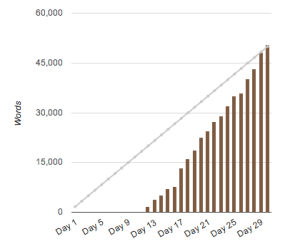
2. NaNoWriMo gave me discipline. For as much as I’ve preached on this blog that writing is a discipline, I still tend to fall in with the “I write when I feel like it” crowd. It’s incredibly difficult for me to establish routine in my writing, so having that NaNoWriMo goal was such a motivating force. Not only did my profile stats continually calculate how many words I had to average per day based on my actual pace, but punching in my new word counts and watching those bars climb on the chart was immensely satisfying. It pushed me each day to stick to a daily word goal and punch out a few more sentences just when I thought I had no words left in me. Contrary to such doubt, there’s always more waiting in the folds of our grey matter.

3. NaNoWriMo pushed me out of my comfort zone. There’s obviously no hard-and-fast “right” way to write. Some writers vomit out their stories first and revise later, and others revise as they write. I trend toward the latter category. It has merit, but I found it worthwhile to try a new approach, and the result broke some bad habits I’d naturally fallen into. One of the major flaws of my first manuscript was that its early drafts were overwritten. I pored way too much over every word and sentence and stopped writing new material in favor of revising finished chapters to death first. The writing needed to relax, and, what’s more, I hadn’t mapped out that entire story yet. To so painstakingly revise early chapters when I still had no idea where the later chapters were going was just stupid. It was only when I’d finished drafting the entire story that I realized what needed to change at the beginning to improve consistency. So, not only did I outline my second manuscript beforehand this time around, but NaNoWriMo forced me to keep driving this story forward and not complicate phrasing through over-thinking it—there simply wasn’t the time to. It’s not as though I had no opportunity for some thoughtful wordsmithing, logically thinking through plotting, or researching to enrich descriptive detail and authenticity. I simply mean that, overall, I had to write more off-the-cuff and to-the-point than I’m used to, a risk my writing in particular really needed to take.

4. NaNoWriMo powerfully immersed me in my storyworld. Curling up with a single story for so many hours of the day every day was the deepest sea-diving into my imagination I’d ever done. I was truly married to my characters, setting, and situations at that point; the level of commitment was tremendous when I promised to come back to them every day, and the short gaps between bouts of writing ensured I never really loved ’em and left ’em. It’s essential to at some point step away from a story and come back to it with fresher eyes (as I’m doing right now), but the benefits of sticking with it for better or worse in November included seeing my storyworld more vividly and improving its continuity—I remembered details more clearly and strung them together more efficiently since they were written only a matter of hours/days apart from each other.

5. NaNoWriMo was P90X for my brain. In view of all the aforementioned, my mind clearly got warmed up and broke a sweat trying to keep pace with my required daily average word count (~2,700/day thanks to my late start). The mind is a muscle, after all, and it needs to be flexed in order to grow. Pushing yourself to go as far as you can one day will strengthen you to do the same if not more the next. And haven’t you found that the more you exercise, the more you want to? In the same way, NaNoWriMo energized me to the point where I wasn’t writing because I had to. I wanted to. I honestly woke up every morning excited to get back to my computer to research and write.

Granted, there’s no way I could’ve sustained the intensity of NaNoWriMo beyond that month, but I do think the lessons it taught can be applied in realistic doses going forward on my project. I went into it with 10,000 words, came out with 60,000, and estimate I have about 15,000-20,000 more words to go until my first draft is finished. There’s no question I’ll have to revise the hell out of it, but I definitely don’t discount the earnest progress I initially made on it in a very, very concentrated amount of time—I think (*hope*) going into NaNoWriMo with an advance, focused vision of my story optimized how many of those 50,000 words actually have a shot at remaining in the final draft…the major ideas at the very least.  I tried my best to work smarter, not harder, so we’ll see one day what I have to show for it. 🙂


NaNoWriMonkey

Twelve days into November, I made the idiotic decision to first join NaNoWriMo, and ever since, my desk has been a feces-flingin’ factory of writing. Victory seemed improbable but is oh-so sweet for this now official NaNoWriMo-Fo. Reflections on the experience are forthcoming, but for now I really need to take a shower…


And now a word from our sponsors…

* * BEEEEEEEEEEEEEEEEEEEEEEEEEEEEEP * *

This blog is temporarily on hiatus.

The Primate was at first preoccupied with October travels,
and now with November NaNoWriMo.

(see sidebar widget to track my progress…
…and have mercy. I joined 12 days in.) 

Please stay tuned for The Fallen Monkey’s winter season line-up, though, when it returns to its regular schedule.

Same Monkey Time. Same Monkey Channel.

*


On Priorities, Parks, Parents, and Publishing

Yowzah. Sorry I fell out of the tree again. These have been weeks of prioritizing, and unfortunately if I’m to make any blogging a priority, it’s gotta be the one I actually get paid for. 🙂 In the meantime, while I haven’t been the most attentive commenter on your blogs lately, I’m glad to see you all are keeping busy and doing well, too!

I do finally want to pop in this week, though, before going on hiatus yet again. I’ll be heading Stateside in a few days for a brief visit to my sweet home Chicago before then undertaking the grand road-trip with my parents to Orlando for our big family Disney World vacation three years in the making. We made this pilgrimage many-a time as kids, but we started the tradition of returning with spouses and grandkids ten years ago. This is the first time since that all of us siblings are able to make it again. So factor in me, me mum and dad, two brothers, one sister, two sisters-in-law, one brother-in-law, six nephews, two nieces, and my brother’s parents-in-law, and our grand total is nineteen. Could be an even twenty if my husband’s eleven weeks of grad school this year didn’t suck away all his work holiday and then some. 😦 In any case, leave it to my parents to be the only ones choosing to drive, so I’m making the journey with them to help out—they’ve had a rough year of health issues, and it’s the least I can do when I’m otherwise missing out on everything, the bad and the good, while living abroad. Time to shift my priorities to others, finally.

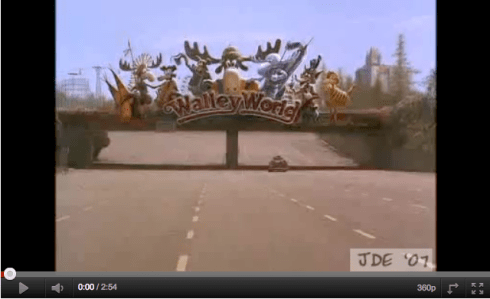
And who am I kidding. I love this stuff. Fire up the Family Truckster! Cracker Barrel, here we come! Marty Moose! Marty Moose! Marty Moose!

This is no longer a vacation—it’s a quest. It’s a quest for fun.”

In literary news, where my freelance editing work goes, I’ve wrapped up the developmental edit of a very fun YA paranormal novel so will await whatever the managing edit may throw back our way. And the second novel I’d edited has just been published! The author has been making a great effort at social media, so it looks like it’s doing well so far. Three-for-three wonderful authors to work with [knocks wood for next time]. And as for my own manuscript, I’ve been revisiting ms #1 after some time away from it and reckon my next step is consulting with a professional editor—I’ve been really envying the process I go through with my authors and would like to see my story get all buffed-n-polished, too. Regardless, I need to get more momentum behind that one; I admittedly haven’t been trying very hard to query. Dare I say it, I think I’ve settled into contentment with just the process of bringing it into being—I’ve entertained the hell out of myself!—so, where priorities go, getting it published has almost come to feel secondary. Or is that what all the unpublished say when they’re in massive denial? 😉

In any case, I’ll try to pop back at least a couple more times this week before the *Disney magic* beckons me…


Room with a View

All good things must come to an end. *sigh*

I have more to write about my week, but for today as I make my return journey to London, I’ll just pay homage to the charming B&B that I called home the last five nights.

The table where I wrote.

The view of St. Austell Bay and the hills of Tywardreath, Par, and Fowey on down to Gribbin Head.

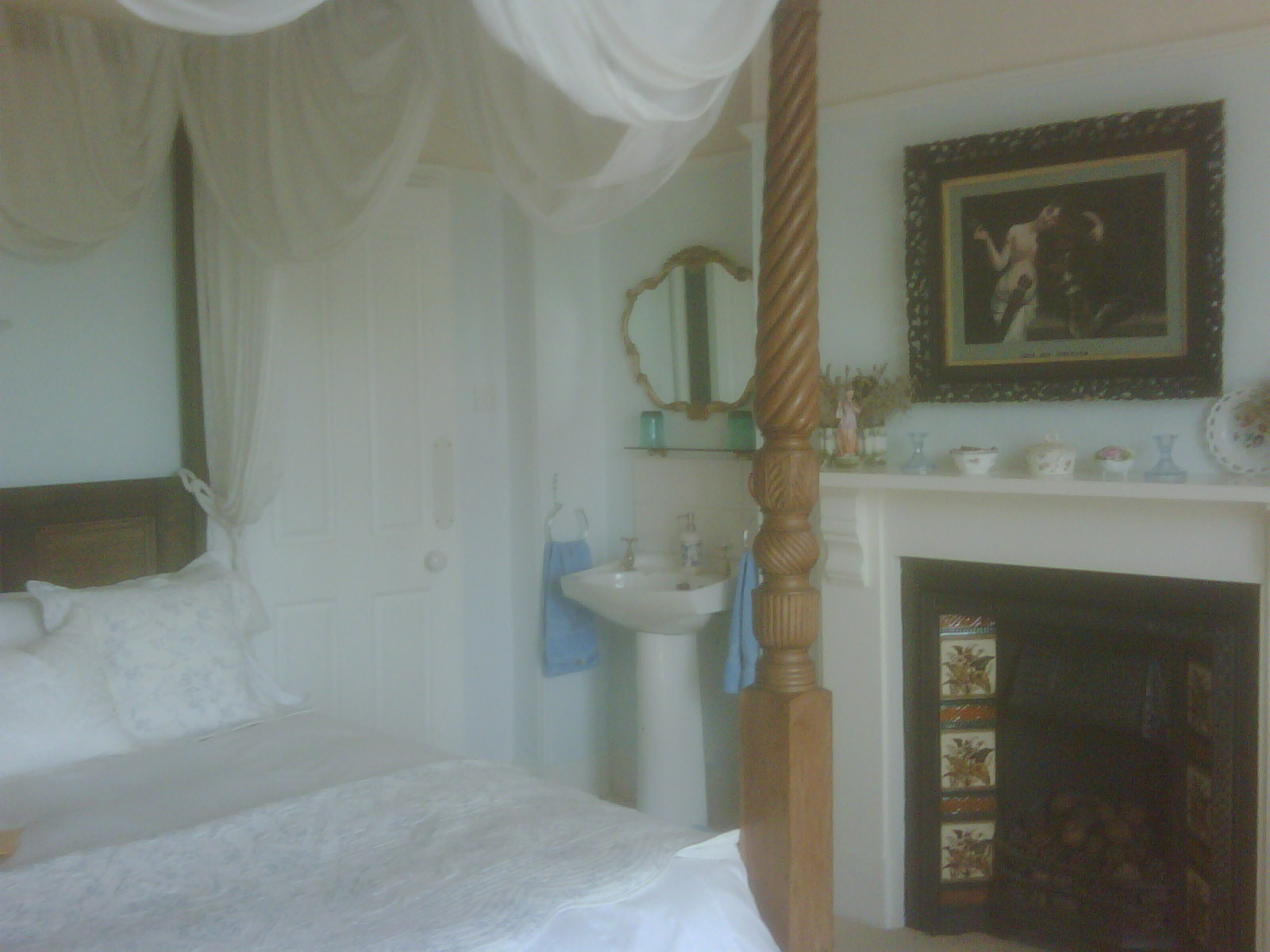
My sweet lil' room, where I secluded myself when not hiking out in them thar hills.

This is the heart of Daphne du Maurier country, which was no coincidence when I planned this trip. In the posts to follow, I’ll document my literary pilgrimage of sorts.

But for now, I heave another *sigh* in departing this peaceful region where the farmland meets the sea, the air doesn’t turn my snot grey, and strangers actually reciprocate friendly smiles and hellos. (Gasp! Can you imagine that, Londoners?! Looking up from the pavement and breaking through your barriers of fear and preoccupation to meet someone’s eye?! The horror…the horror…). Home-made and jarred marmalade, crisp vegetables straight from the local earth, and eggs straight from the local chickens’ va-jay-jays, purchased on the honor system at the end of a farmer’s driveway. Coastal paths with something new around every bend and questionable signage that lets you get good and lost a few times in the fields and woods, all in the spirit of things.

Cornwall agrees with me.

And my hosts have been most gracious, making me feel part of one big happy household, complete with Tilly the Terrier and the more elusive Barney the Cat and Charles the Chihuahua. Even a pair of other guests nearly brought me to tears (I’m serious) with their pure and utter loveliness. So blessed. So happy. So coming back.