Category Archives: Genres

Writing What You Know – My Date with Daphne, Part II

If you were so kind as to join me yesterday for Part I of this “My Date with Daphne” series, lace up those hiking boots for a literal and literary journey through Daphne du Maurier’s old stomping grounds in Cornwall. Today we’re hitting the trail for her novel The House on the Strand.

Our tour begins in Tywardreath. Tywardreath—pronounced tower-dreth—derives from a Celtic word that originally meant “house on the sand”:

The Benedictine Priory of St. Andrew was founded in Tywardreath in the 12th century, and the parish church (pictured below) was dedicated in the 14th century. The church/priory accounts for much of The House on the Strand’s early description and is the stopping point for one of protagonist Dick Young’s drug-induced travels in time. While his consciousness is exploring the old priory back in the 14th century, his body is physically wandering the 20th-century churchyard, where the Vicar taps Dick on the shoulder and wakes him to the present.

This church also figures into du Maurier’s novel The King’s General—in the book, its graveyard serves as a cache for weapons during the Cornish revolt against Parliament, and it’s the actual burial site of a skeleton discovered in du Maurier’s Menabilly home, which in turn inspired The King’s General’s ending.

For those of you who haven’t read The House on the Strand, its main character Dick and his friend Professor Lane frequently take an experimental drug that causes the mind to time-travel, if not the body. It consistently takes the men about 600 years back in time, and their 14th-century wanderings lead them into awkward if not dangerous circumstances in 20th-century places. In addition to the churchyard, below are a couple more such locations:

The house on Polpey Lane where Dick (soaking wet from wandering through the marshes in his drug-induced state) awakes to a very confused modern-day postman.

Treesmill Farm, where Dick frequently returns trying to find the lovely 14th-century Isolda where she lives in the House on the Strand. Once an old ford when the original southern Cornish coastline extended much further inland, Dick crosses the water only to wake up in the middle of a modern-day road, where he’s almost hit by a car.
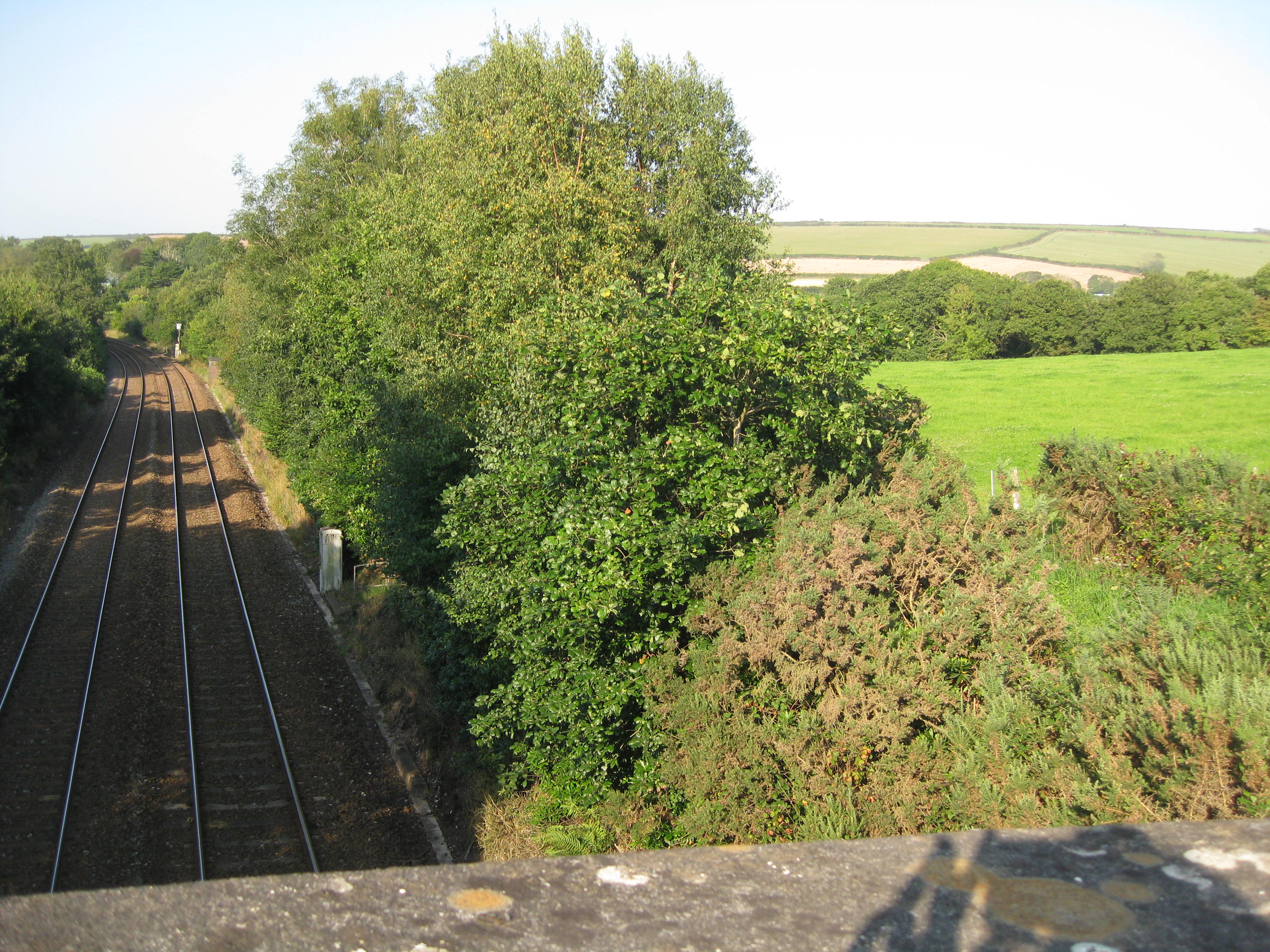
The train tracks just down the road from Treesmill where Professor Lane’s “time traveling” inadvertently leads him into the path of an approaching train.

The changing coastline and landscape over the centuries was a fascination for du Maurier, so The House on the Strand gave her ideal opportunity to research this and play up the contrast as her main character travels between two time periods. The locations below are examples of areas that were once underwater:

The old marshland has left behind a residual creek, which you cross when following the Saint’s Way path north out of Tywardreath.

Following the creek-side trail west toward Par leads you to the vicinity of the 14th-century shoreline where Dick Young witnesses Oliver Carminowe’s ambush and murder of Otto, Isolda’s love interest.

Par Beach, located just below Tywardreath and which was once part of a broad estuary. It since clogged up with silt from mining waste to create this barrier against the sea that helped reclaim much land from the seabed.

From Par Beach, we continue south along the coastal path to pass below Kilmarth, where Daphne du Maurier and her character Dick Young lived at the top of the hill. Dating back to the 14th century, the house’s original owner (Roger Kylmerth) and the occupant just prior to du Maurier (a scientist, who left behind a basement full of odd jars containing things like embryos) provided key inspiration for The House on the Strand. Roger is fictionalized as Dick’s “guide” through the past, and Professor Lane is the fictional present-day owner of house who allows his friend Dick to holiday there and whose experiments in the basement include the time-travel drug in question.

Kilmarth, as viewed from the road high above the coastal path.

Time to depart The House on the Strand and continue along the coastal path to the real-life influences of Daphne du Maurier’s other works…if you’ve stuck with me this far and are keen for more, see ya tomorrow!

PART I

PART III

PART IV


Writing What You Know – My Date with Daphne, Part I

Young Daphne du Maurier (about 1930) Русский: ...

Daphne du Maurier (Photo credit: Wikipedia)

Well, it’s April, and the Monkey has climbed back up its tree. The branches up here are budding, and I’m likewise hoping to turn a new leaf and make this spring a productive one of blogging and creative writing. Until now, travels, hosting, and craploads of editing have derailed me; I recently finished my first freelance edit and am presently juggling two simultaneous manuscripts for the publisher. Having to donate my eyes and brain to others’ work makes it difficult to write my own stuff, but it’s always a learning process and always satisfying to at least be working on something that’s getting published.

In any case, last August when I’d found myself in a similar predicament, I’d whisked myself away to Cornwall for a solitary writer’s retreat (“A Cage of One’s Own“). I found myself doing more hiking there than writing, but even that activity was steeped with literary inspiration. I was walking in the footsteps of British author Daphne du Maurier and her characters, you see, and learning a great deal about how a writer’s environment can effectively influence the settings of his/her stories. I’d promised way-back-when to blog about this and totally flaked out, but now I really have no excuse considering I just returned from an Easter holiday weekend spent at the very same location in the very same room-with-a-view! I brought my husband this time so he could also hike the trails and find much-needed respite after completing one hell of an intense graduate program. Thus, ’twas a time of needed togetherness, not for me to go all reclusive-artsy-fartsy and climb into my turret to write.

Yet the breezes off that dynamic coastal landscape still carried the sweet inspiration of Daphne, so, starting this week, I’ll finally share with you my summer photo-journey of the real-life settings featuring in so much of her work. du Maurier lived in three homes between Par and Fowey (Menabilly, Kilmarth, and Readymoney) that were not only the places where she wrote, but also where she wrote about. Menabilly and Kilmarth housed her characters as well, which I find really validating considering my own two manuscripts are set in actual apartments I’ve lived in. I at first viewed that as a rookie comfort-zone, writing-what-you-know in the extreme, but the fact is, my stories are set in these places because these places—their distinctive features and histories—are what initially inspired my stories. So, why not? Daphne did it.

I’ve admittedly only read three of du Maurier’s novels, but her writing resonates with me. Weaving dark tales with beautifully crafted language, she managed to write commercially appealing plots with literary merit—which, in my opinion, is the ideal to aim for. Of the novels I’ve read, my hands-down favorite is Rebecca, which I first experienced through Alfred Hitchcock’s faithful screen adaptation of same name (du Maurier’s novella The Birds was likewise adapted into another not-as-faithful Hitchcock film of same name). A few years ago, a random stroll through Daunt Books in London resulted in leaving with Jamaica Inn in my hands (which takes place at the actual inn in England’s Bodmin Moor), and my return to Daunt soon after for The House on the Strand is what ultimately led me to choose the wee village of Tywardreath (the book’s setting) for my Cornish holiday.

And Tywardreath is where we’ll begin tomorrow as we travel a bit of southern Cornwall to view the inspiration behind du Maurier’s The House on the Strand. Dress warm, pack light, and wear some comfortable walking shoes. 🙂

PART II

PART III

PART IV


Keep Calm and Query On

KEEP CALM - CARRY ON

KEEP CALM - CARRY ON (Photo credit: atomicShed)

And at the snap of the fingers, the Primate goes from pensive to proactive…

Last week may have been my time to stop and take stock, but this week I’ve no choice, really, but to throw myself into working / writing / revising / job-searching. I’m leaving for the States next week, you see, for a couple weeks to visit Chicago and New York, and then I’m hosting my lovely sister and niece in London immediately thereafter. With March thus swallowed, my husband and I are also already making travel plans for April. So was I just worrying about finding full-time work? Who has time for full-time work??! 😉

But seriously, before I soon venture where technology goes to die (a.k.a. Mom and Dad’s), it’s full-on git ‘er done mode right now. I nonetheless thought I’d pause from that to share what have been my first non-form-letter rejections! Woo-hoo! Okay, the exclamation points may seem like either sarcasm or extremely unwarranted enthusiasm, but, honestly, after about a dozen standard manuscript rejections, it’s so very nice to receive personalized feedback. Both of these came in recently from small publishers. The first is in response to a re-submission, and, admittedly, shame on me for trying to wedge my octagon-shaped cross-genre manuscript into the square hole of genre fiction:

The changes that you made to the story were great! It flowed much more smoothly. […] Unfortunately, I think that it still won’t work for us. I think that it is a great “paranormal” story but there just isn’t the romantic element that [the publisher] is known for. I do think that you should really seek publication for this though. I think that it is a great story and a publisher that doesn’t specialize in romance would take it.

Fair enough. I knew that mere romantic elements does not a romance make, but it was worth a try. Moving on, I received this at the end of last week:

While your story was very interesting, and at times suspenseful, we have to be very selective due to a high volume of submissions received each week.

The beginning gripped me, and the end had my spine tingling. However, I felt that after the first chapter, the pace slowed quite dramatically. I kept wanting something more to happen, and though it did, it felt like it took a long time to happen (not until toward the later half). Again though, your story as a whole is wonderful, I just feel that another company would be able to offer better representation at this time.

We sincerely thank you once more for thinking of us, and wish you the very best in your journey to publication. We have no doubt that you will find representation with another publisher.

Those are both very gracious, no? It certainly softens the sting and encourages me to keep on truckin’ and strengthen that story. As of now, in the meantime, I have a query outstanding with another small publisher and the full manuscript with an agent. My upcoming travel schedule is probably an aptly-timed excuse to step back from all this for a bit, eagerly await those responses, refresh, and come back swinging in spring—hopefully with a second manuscript to query on behalf. 🙂


The Red Pen: Stating the Obvious that Obviously Needs Stating

I’ve been wearing my editor hat again the last couple weeks, working with someone’s raw manuscript that is pending rewrite for resubmission. For confidentiality reasons, I apologize that I can’t be more specific than I am. What follows below are merely some overarching concerns that a rookie can easily overlook (hey, I’m one, too!) and sometimes get the Monkey’s head beating against the trunk of its tree:

1. Research – They say, “Write what you know,” but one doesn’t have to live in a place or serve in a certain profession, for example, to be able to research authentic details relating to such. Writing fiction doesn’t give the liberty to entirely fabricate a place or occupation if it’s one that actually exists. The internet is a beautiful place for research, as are books, site visits, and interviews with people in the applicable locations/fields. Be knowledgeable of your story’s setting and subjects and use common sense to discern what claims need to be fact-checked, then verify them accordingly. (see also “Settingcategory)

2. Narrative – Do NOT “tell” versus “show”! That is Writing 101. Your story shouldn’t read like an extended synopsis that lists events rather than describes them in such a way that immerses the reader. Don’t say that your character is making a facial expression that looks angry, show that his brows are furrowed and lips screwed into a menacing sneer. Don’t say that the room is filled with expensive-looking furniture, show that it’s cluttered with ornately carved oak chairs upholstered in embroidered silk astride side-tables trimmed in gold leaf (I don’t know if that’s “expensive” or just tacky…). And don’t say something in dialogue that you then paraphrase in narrative—communicate the info/insight one way or the other; to do both is redundant.

Also, avoid an abundance of character introspection. Readers really don’t need to know every single thought and motivation of your character. Make them privy, yes, if it’s from a certain character’s POV, but it’s also more interesting and vivid to visualize if you concisely show their body language and actions and let the reader reasonably infer some of what they’re thinking or feeling. Telling all on characters and the labyrinth of questioning they’re wondering their way through is tedious and doesn’t let readers form questions of their own that’ll make them keep reading in search of answers. Leaving something to the imagination not only indulges one of the joys of reading but can heighten a story’s sense of conflict and climax when the reader isn’t already in the know of everything. (see alsoDescriptive LanguageandSensory Detailscategories)

3. Dialogue. In keeping with the above, character conversation can come across as unnatural when too much information is shared by this means. Be subtle when doling out back-story or insight via dialogue, otherwise it’s blunt and awkward: your manipulations of story become too transparent, and the characters don’t sound like real people. (see alsoDialoguecategory)

4. Characterization. The above narration/dialogue factors are just as important to building a strong sense of character. Do your characters sound believable? Are you showing enough description of features, mannerisms, and personality such that your reader can visualize your characters (yet not so much that you’re telling readers everything about them and leaving nothing to the imagination)? And are you giving your reader reason to remotely care about them and whether or not they reach their goals? Without any of this, characters aren’t even two dimensional; they’re stick-straight lines. Boring. Flesh ’em out and make them more interesting with flaws if they seem too goodie-goodie or benign—or with redeeming qualities if they’re otherwise the Devil incarnate. No one likes a purely good hero or a purely evil villain. (see alsoCharactercategory)

5. Story Arc. Tensions need to rise as the story progresses. Not overly telling and giving everything away (as discussed above) will help contribute to this as readers speculate character motivations and future actions and reactions; scan and replace lengthy sections of introspection with concise, external descriptions of character body language/expression and leave readers to their own interpretations. Add complexity by interweaving relevant back-story and subplot(s). Foreshadowing is also a useful device for enhancing curiosity along the way as readers form predictions, but it will blow up in your face if the seeds you plant are too obvious! Don’t lead up to your big reveal only for your reader to go, “Uh, derr!” That reeks of anticlimax.

It’s not to say everything should be a surprise for the reader—it can be just as suspenseful when the reader already knows something the character doesn’t (like in horror movies when you know the killer is lurking right around the corner from the innocent victim), but only when it’s deliberately played to this effect. There’s a craft in pulling that off, so don’t think simply telling your reader everything and leaving your character in the dark is an easy shortcut—be discerning in what you share and withhold.

Your big revelations can likewise be a let-down if your characters’ own responses fall flat. Think about what you’re wanting your readers to anticipate, to get excited about, and make sure you deliver it in a commensurately enthusiastic fashion. If there’s a big secret out there that your reader knows and is dying for your character to find out, is the character finding out in an exciting and unexpected way? Or is, for instance, another character just explaining it in a straight-forward conversation, garnering a reaction as enthralling as, “Oh.” (see alsoStory Arccategory and, more specifically, Pacing Your Pages” Parts I & II)

6. Other: Plot Elements (in general). Map out all the major and minor elements of your plot and subplot(s) alike and make sure every piece of them flows/connects logically. Ensure not a single important question they could raise is left unanswered if it’s vital to understanding and believing in the story. Loose ends that leave something to the imagination or tease for a sequel are one thing, but overlooking major gaps in how a character got from Point A to Point B (just because you want them to get there for the sake of driving the story forward in other ways) undermines a story’s entire credibility. Don’t just say something happened if it’s not entirely logical for it to have happened and assume your readers won’t notice, that they’ll just take your word for it. If something is complicated whether you like it or not, do the work to figure it out; stop writing and start reasoning through it (via outline or time-line, perhaps). Do more research if it’s necessary. And if it’s not working, accept it and change it to something that will.

Readers’ disbelief can only be suspended so far; you have to earn their trust if they’re going to follow the journey you want to take them on. Even the most fantastical of story-worlds need plausibility (working within the rules/parameters the author so designs for those worlds if it’s not the one we actually live in), so the reader must understand how plot events feasibly come to happen and tie together for the story to be realistic and identifiable.

Speaking of “Uh, durr!” and “Oh,” that’s probably your reader-response to all of the above. But you’d be surprised what we writers can’t see in our own writing that we so clearly do in others. As the author, the mental full-picture we see tends to automatically fill the gaps of the written story that our readers otherwise trip into. With that in mind, never underestimate a pair of fresh eyes; it really does pay to have others read your work. So toughen that skin and git ‘er done! Constructive criticism has groomed the Monkey’s own fur into a nice thick and glossy coat. 🙂


The Bookish Baboon

Cover of "The Book Thief"

While I feature the books I’m currently reading in the right margin of this blog, I don’t often comment on them. But as I have book club tonight, I’m in the spirit to do so.

First off, I was never one to join a book club before. My to-read list has always been infinite, and to have someone else choose what I read and dictate the time I read it within always seemed too constrictive. Why I joined this one, however, was a no-brainer: it’s a group of my friends who I’d want to hang out with anyway and who share my love of wine and low-key attitude. There’s no sense of penalty if you haven’t read more than 5 pages of the book, there’s no set list of questions we must answer, and the time-frame has been pretty wide open—so far, a couple months, which leaves me enough time to read something else of my own choosing in between.

Tonight is only our second meeting, and the book is The Book Thief, by Markus Zusak. I am lazy, so allow me to just copy the notes I already jotted in my book journal:

Liked it. Took a while to get into it (one-third of the way through), largely because of language and structure/style—its very unique descriptive and figurative language is striking, but perhaps would prefer such in a short story vs. novel-length. Unexpected similes for sake of originality sometimes barred actual envisioning (e.g., “Her wrinkles were like slander.”), which opposes the aim of that literary device. A lot of characters introduced right away, too, so took time to feel acquainted with main ones, but ultimately did connect and sympathize. Interesting perspective of non-Jewish German suffering, and I did appreciate the dehumanizing effect achieved by repeatedly describing people as inanimate objects and inanimate objects as living beings (anthropomorphism)—e.g., “There were shocked pyjamas and torn faces.”

Overall, I give it 4 out of 5 stars. In the end, I was moved.

Our first book choice, on the other hand, was sheer disaster. It came highly recommended as a bestseller, and I have zero idea why. Here’s what I had to say in my little journal about Victoria Hislop’s The Island:

Boo! Premise was interesting (history of the leper colony on Greek island of Spinalonga), but story was poorly written and developed. Over-described, redundant, simplistic, 2D characterization, ridiculous head-hopping (three times in one paragraph at one point!), and spent too much time away from present-day story-line to give a crap about its main character. Secondary plot surrounding sister in the past story thread was absurd (her affair was drawn out too long to believe in its continued passion, and the way it comes to an end is very unoriginal melodrama). Climax was too abrupt with little resolution of interest. Nothing of literary merit to discuss.

Overall, I gave it 2 out of 5 stars per Goodread’s rubric (“It was okay”). I’m tempted to change that to a 1 because I hate it more with every recollection, if not for the fact that I did find the history interesting. A shame it couldn’t have been conveyed more powerfully.

And to round this out as a literary trifecta, the book I just completed out of non-book-club-related pleasure was The Night Circus, by Erin Morgenstern. I just dropped 5 out of 5 stars on that baby despite understandable limitations as cited by other readers. One Goodreads reviewer says, “The Night Circus will be a 5-star book for a certain reader. This reader likes a lot of descriptions, doesn’t mind a very slow story and has a soft spot for circuses. I am not that reader.” Fair enough. It all the more reinforces how there’s a reader out there for every book (plenty of folks just loooved The Island, after all), so those of us who write and aspire to have readers of our books one day need to keep the faith.

Because—with the exception of the “soft spot for circuses,” as they generally creep me out—I am that reader described above. I hated the amount of description in The Island because it was redundant; I loved the amount of description in The Night Circus because, for me, it was immersive. Yes, plot was rather thin, I expected there to be more action-oriented warring of the magician’s magic, and even at the end I didn’t grasp the point of the whole magic competition and why its stakes had to be so high. But this book in itself had a magical quality that made it an exception for me; the whimsical, decadent, candlelit, and velvety descriptions are abundant but so lovely. More so than a story, the book was an experience, a stroll through the black and white tents of a circus echoing the surreal artistry of Cirque du Soleil. For that reason alone, it’s a 5 for me, and I’m seriously contemplating reading it again from the start as I already miss the warmth, illumination, and caramel scent to be had inside those tent flaps.


NaNoWriMonkey – Follow-up Reflections (Finally!)

Just over a month of recovery has transpired since my NaNoWriMo burnout. Like a Roman candle, the concentrated spew of writing was glorious, dazzling my eyes with a populated computer screen after a long stretch of spark-less procrastination. And then November ended and fffffzzztt. So did the writing. For the most part. Just like legs need a rest after a marathon, I needed to retrieve my eyeballs and fingers from where they’d fallen off onto the keyboard and step away from that project for a bit.

In the meantime, I’ve been tweaking my first manuscript and rewriting query letters over and over again to get ready for a much-delayed round of submission. I also headed Stateside for another two weeks for Christmas, which was crazy-busy but magical, just like the Disney trip before that. 🙂 Anyway, I’d promised to follow up on my NaNoWriMo experience, so let’s get on with it.

Writing 50,000 words in one month is a concept that makes folks wary, and understandably—for years I assumed it could only generate pure and utter crap; good writing is not to be rushed. But now having gone through it, there’s no question it was a useful exercise that I highly recommend, and here are some reasons why:

1. NaNoWriMo was like a writing enema. I’d been stopped up for a while in that respect, sitting on a story outline I’d completed in spring only to sputter out one chapter in summer and jack until November. It was shit-or-get-off-the-pot time, and NaNoWriMo was precisely the initiative I needed. So, to run with my disgusting metaphor, even if a lot of my massive brain-dump was crap, it was purifying to get it out of me. I did have an outline to keep me focused, but I think if you’re still in novel-brainstorming mode, it’s a perfect way to write your way into a storyline to run with beyond NaNoWriMo.

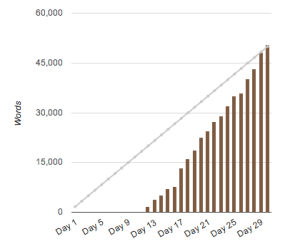
2. NaNoWriMo gave me discipline. For as much as I’ve preached on this blog that writing is a discipline, I still tend to fall in with the “I write when I feel like it” crowd. It’s incredibly difficult for me to establish routine in my writing, so having that NaNoWriMo goal was such a motivating force. Not only did my profile stats continually calculate how many words I had to average per day based on my actual pace, but punching in my new word counts and watching those bars climb on the chart was immensely satisfying. It pushed me each day to stick to a daily word goal and punch out a few more sentences just when I thought I had no words left in me. Contrary to such doubt, there’s always more waiting in the folds of our grey matter.

3. NaNoWriMo pushed me out of my comfort zone. There’s obviously no hard-and-fast “right” way to write. Some writers vomit out their stories first and revise later, and others revise as they write. I trend toward the latter category. It has merit, but I found it worthwhile to try a new approach, and the result broke some bad habits I’d naturally fallen into. One of the major flaws of my first manuscript was that its early drafts were overwritten. I pored way too much over every word and sentence and stopped writing new material in favor of revising finished chapters to death first. The writing needed to relax, and, what’s more, I hadn’t mapped out that entire story yet. To so painstakingly revise early chapters when I still had no idea where the later chapters were going was just stupid. It was only when I’d finished drafting the entire story that I realized what needed to change at the beginning to improve consistency. So, not only did I outline my second manuscript beforehand this time around, but NaNoWriMo forced me to keep driving this story forward and not complicate phrasing through over-thinking it—there simply wasn’t the time to. It’s not as though I had no opportunity for some thoughtful wordsmithing, logically thinking through plotting, or researching to enrich descriptive detail and authenticity. I simply mean that, overall, I had to write more off-the-cuff and to-the-point than I’m used to, a risk my writing in particular really needed to take.

4. NaNoWriMo powerfully immersed me in my storyworld. Curling up with a single story for so many hours of the day every day was the deepest sea-diving into my imagination I’d ever done. I was truly married to my characters, setting, and situations at that point; the level of commitment was tremendous when I promised to come back to them every day, and the short gaps between bouts of writing ensured I never really loved ’em and left ’em. It’s essential to at some point step away from a story and come back to it with fresher eyes (as I’m doing right now), but the benefits of sticking with it for better or worse in November included seeing my storyworld more vividly and improving its continuity—I remembered details more clearly and strung them together more efficiently since they were written only a matter of hours/days apart from each other.

5. NaNoWriMo was P90X for my brain. In view of all the aforementioned, my mind clearly got warmed up and broke a sweat trying to keep pace with my required daily average word count (~2,700/day thanks to my late start). The mind is a muscle, after all, and it needs to be flexed in order to grow. Pushing yourself to go as far as you can one day will strengthen you to do the same if not more the next. And haven’t you found that the more you exercise, the more you want to? In the same way, NaNoWriMo energized me to the point where I wasn’t writing because I had to. I wanted to. I honestly woke up every morning excited to get back to my computer to research and write.

Granted, there’s no way I could’ve sustained the intensity of NaNoWriMo beyond that month, but I do think the lessons it taught can be applied in realistic doses going forward on my project. I went into it with 10,000 words, came out with 60,000, and estimate I have about 15,000-20,000 more words to go until my first draft is finished. There’s no question I’ll have to revise the hell out of it, but I definitely don’t discount the earnest progress I initially made on it in a very, very concentrated amount of time—I think (*hope*) going into NaNoWriMo with an advance, focused vision of my story optimized how many of those 50,000 words actually have a shot at remaining in the final draft…the major ideas at the very least.  I tried my best to work smarter, not harder, so we’ll see one day what I have to show for it. 🙂


NaNoWriMonkey

Twelve days into November, I made the idiotic decision to first join NaNoWriMo, and ever since, my desk has been a feces-flingin’ factory of writing. Victory seemed improbable but is oh-so sweet for this now official NaNoWriMo-Fo. Reflections on the experience are forthcoming, but for now I really need to take a shower…


Oh, Okay Fine. May as Well.

It seems inevitable that part of the aspiring author’s procrastination from writing consists of farting around with mocking up potential cover art. I suppose I might have sort of maybe done this myself before…in which case, oh, okay fine. May as well share with ya.

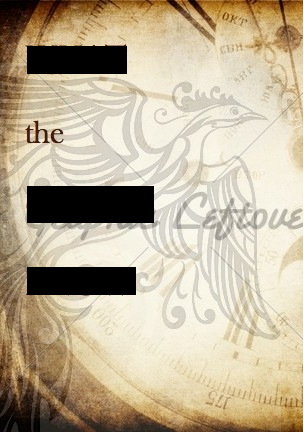
I came up with two possibilities for my first ms. No, I’m not sharing my title yet (too irrationally afraid to), and, yes, I’ve used stock images with watermarks still on them (too cheap to pay for them). Whatever. Do you like them or not? Sorry, that came out more antagonistic than I’d intended. And I’m also sorry that I for whatever reason didn’t keep a file that would’ve allowed me to just delete (versus hideously black out) the title in the 2nd image. So just to be clear, my title is not “Graphic Leftovers.” 😉

  – OR –  

Have you ever done this, too? I’d love to see ’em!


Is the Baby Still in the Bathtub?

I heard once at a writing seminar that every time we read, it’s an investment in our writing. So in light of that, we shouldn’t feel guilty when we spend our time reading someone else’s writing instead of working on our own.

When I do read someone else’s story, on one level of consciousness I’m processing how they’ve approached its construction and shaped its language, which helps me likewise reflect on my own projects. I still lose myself in the experience of the book, yet today was one of those when I did snap out of someone else’s story-world to reenter my own—because it had just smacked me upside the head, somewhere in the middle of the book I was reading, that I needed to work more on the beginning of the book I am writing. Seemingly out of nowhere, but I think my subconscious has known all along and something I read must have finally dislodged that. Not merely the revelation of what I probably need to do, but my acceptance of it. I think I’ve known for a long while what I should do but have been nurturing my precious poopsies, running the warm water over them and adding more bubble bath.

I’ve only done some cursory restructuring so far, but looks like my manuscript needs to be run like a conveyor belt in reverse again, backing it up another couple chapters to start at even later one. If I do this, I must be mindful of what had happened last time and ensure the babies of characterization and exposition don’t get thrown out with the bath water in the interest of moving plot forward a bit faster. And it really isn’t so much that I’m trying to get a move-on with the story line; the more I look at those opening chapters, the more I realize that I was still finding my way into the story with them; it doesn’t all have to be scratched, but it needs to be tightened through rearranging. So as I try to look at the story elements in those chapters more strategically right now—isolating the “need to haves” from the “nice to haves”—it’s like they’re all lined up before me, beads of sweat glistening at their brows and sweaty palms wringing behind their backs as they try to stand tall, stand proud with chins up but lips quivering, and some surely wetting their pants.

I shall place the little dears in the foster care of my archives and keep faith they’ll find a good home in a short story or other novel some day. Until that time of weaning, I’m letting them push their little rubber duckies through the suds, scrubbing them extra clean behind the ears before tucking them into bed for the night all clean and sweet-smelling and raisin-fingered…who knows, perhaps after I sleep on it, too, I’ll change my mind.

I’m curious to hear about YOUR babies—it’s inevitable that some of them get chucked out the window, but have you actually had success reusing them elsewhere? How so?


Editing Out the Editor

This shit editing is bananas, B-A-N-A-N-A-S.

Hey, Editors, are ya there? Editors? Editors? Bueller? Bueller?…

I recently saw this editorial, “The Price of Typos,” which comments on how “typos are everywhere” now—in large part because publishers are employing less editorial staff and rushing to publish books ever faster. And modern authors are playing their part in it, too:

“Use of the word processor has resulted in a substantial decline in author discipline and attention. Manuscripts are much longer than they were 25 years ago, much more casually assembled, and beyond spell check (and not even then; and of course it will miss typos if the word is a word) it is amazing how little review seems to have occurred before the text is sent to the editor. Seriously, you have no idea how sloppy some of these things are.”

Though editors arguably have more work cut out for them in light of the above (man, don’t I know it firsthand!), when I read traditionally published books I’ve wondered the same: where are the editors? How did that typo get through? I’ve always said that I’ve never read a book without a typo, which is fine—annoying but fine, as I understand how that can happen maybe once or twice—but lately I see several mistakes, and it’s not just typos anymore.

Back when I read the Twilight series (disclaimer: my Freshman Year students were squealing about it incessantly and kept begging to write book reports on it, so I felt it my duty to understand what they were talking about…and obsessively read all four books, and joined Team Edward, and watched all the movies so far, and…), and, I’m sorry, where was I? Oh, so when I read Stephanie Meyer’s decent storytelling but crappy writing, her overuse of words like “guffaw” and “mutter” bored a hole in my head as they plunk, plunk, plunked against my skull like water torture. Where was the editor to chuck a thesaurus at her and make her vary word choice? [See Also: “Sloppy YA Editing: Tic Words]  And when each book got longer than the previous (and not in a good JK Rowling way), when plot didn’t thicken so much as stretch like taffy and read like a fanfiction of her own work, I asked myself, where was the editor to hack out those paragraphs and pages of redundancy and filler?

So maybe Twilight is an unsurprising example, but I was in a bit of despair when I read the most recent book of one of my new favorite authors: The Distant Hours by Kate Morton. I loved her first two books in a way I hadn’t anything that I’d read in such a long time, and while I still enjoyed this third one, it needed a good, solid edit. The thread of an interesting story was there for me, which did keep me reading, but I found myself in a frustrated “get on with it” mode—and this from someone who can totally nurture the slow-going and character-based. I don’t need action and rapid pace, really I don’t, but I also don’t need constant dancing around with dazzling wordsmithing and every detail about yet another thunderstorm raging outside while, go figure, conflict between characters is on the rise, too. That’s my two cents, but here’s a sample of what I saw at Amazon as well:

“What on earth went wrong with this book? Was there no editor involved?”

“[T]oo long and too repetitive. A great deal of the fault lies with the editors.”

“What did this book lack? An editor!”

“This seems to be a problem with modern publishing…some way down the line in an author’s output either the editors stop thinking they need to edit or they believe it OK to drop an earlier piece of work on an unsuspecting readership who naively expect new books to be better books.”

Hear, hear! to that last one; I really do think publishers think we’re chumps when it comes to best-selling authors. I don’t read much Philippa Gregory, so maybe she’s been doing this all along in her historical novel series, but I recently read her The White Queen and, while her writing style otherwise does keep a good pace (especially considering the mammoth amount of factual history she manages to distill), I felt little explosions in my head every time I chanced on passages like this:

“More importantly, I think, but I do not say, not even to Elizabeth, that once we are living in a private house quietly, my boy Richard might be able to join us. As we are stripped of our royalty my son might be with me again. When he is no longer a prince, I might get him back. He has been Peter, a boy living with a poor family in Tournai. He could be Peter, a visitor to my house at Grafton, my favorite page boy, my constant companion, my heart, my joy.”

Listen, I know there’s merit to lyrically using repetition for emphasis, but it loses its efficacy when this sort of thing is done over and over and over again for the length of a novel. I mean, seriously, this reads like she wrote the same thing a handful of different ways in brainstorming which she wanted to use and just forgot to scratch out the losing options.

And by this point, you’re probably all wishing I had an editor to keep this post concise. 🙂 But before I go, I leave you with this: eliminating redundancies might be a subjective task, but spelling and grammar are not. An editing colleague recently emailed this sentence:

“A woman without her man is nothing”

Evidently, an English professor wrote this for students to then punctuate. Most of the boys wrote:

“A woman, without her man, is nothing.”

Most of the girls wrote:

“A woman: without her, man is nothing.”

The power of punctuation! Never underestimate the importance of attention to detail—the importance of EDITING!